STARLINK SATELLITE FLARES: SpaceX's Starlink satellites are flaring as sunlight glints from their flat surfaces, creating flashes in the night sky that can rival the brightest stars. Last night, Tristan Cools of Bruges, Belgium, saw the train of satellites pass overhead and sends this report: "Almost all the objects from the Starlink launch between the leading and trailing satellites were flaring, some very brightly around magnitude 0." Between flares, the satellites were mostly invisible to the naked eye. See for yourself: Heaven's Above has local flyby predictions.
SOLAR WIND SPARKS "RAINBOW AURORAS": Earth is inside a stream of solar wind flowing from a hole in the sun's atmosphere. First contact with the gaseous material on May 29th produced an outburst of colorful auroras over Canada. Harlan Thomas photographed the display northwest of Calgary:


"The outburst was filled with amazing hues from blue to pink," says Thomas. "The aurora danced the dance of colors that only it can produce."
NOAA forecasters expect solar wind effects to continue for another 24 to 48 hours. Full-fledged geomagnetic storms are unlikely, but intermittent auroras may be seen in northern places where the waxing midnight sun has not yet wiped out the night sky. Aurora alerts: SMS Text.
BRIGHT NOCTILUCENT CLOUDS OVER EUROPE: Noctilucent cloud season is beginning with a bang. Last night in Kiel, Germany, Laura Kranich witnessed bright electric-blue tendrils reaching up from the northern horizon. "Wow, I'm really stunned!" says Kranich. "The clouds covered a huge area of the sky."
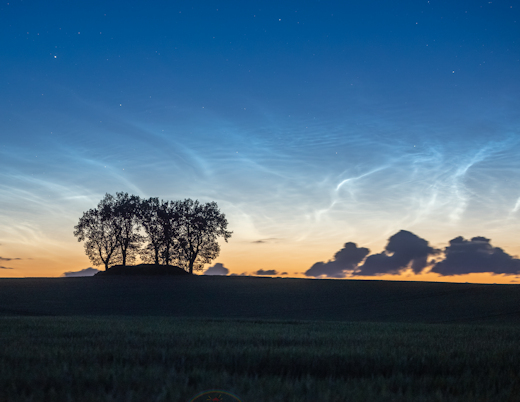
Her sunset photo, above, shows the difference between normal clouds, grey and scudding low over the ground, vs. noctilucent clouds rippling in the twilight more than 80 km above Earth's surface.
Noctilucent clouds are a summertime phenomenon. They form when wisps of water vapor rise to the top of Earth's atmosphere and crystallize around specks of meteor smoke. The season typically starts in late May, peaks in July, and peters out in August.
"This is my earliest observation of noctilucent clouds and, considering the fact that it's only May, they were exceptionally bright and well structured," says Kranich. "Seems like this is going to become a great season!"
Previous studies have shown that noctilucent clouds sometimes intensify during solar minimum. Solar minimum conditions are in effect now as the sun has been without spots for 10 consecutive days--a situation that may favor the frosting of meteor smoke high above Earth. Monitor the NLC photo gallery for more sightings.
Realtime Noctilucent Cloud Photo Gallery
Free: Spaceweather.com Newsletter
THE SPACE HAMMER FOR FATHER'S DAY: Just in time for Father's Day: The Space Hammer. On May 2nd, the students of Earth to Sky Calculus flew a payload of hammers to the edge of space, 35.0 km (115,000 feet) above Earth's surface on board a high altitude helium balloon. You can have one for $97.95:

These compact 8 oz. hammers are light enough to fly on a balloon yet dense enough to deliver a powerful blow. The magnetic head holds a nail for one-handed starting, and the stubby 6 in. length is perfect for tight work areas.
Each space hammer comes with a unique gift card showing the tool floating at the top of Earth's atmosphere. The interior of the card tells the story of the flight and confirms that this gift has been to the edge of space and back again.
Far Out Gifts: Earth to Sky Store
All sales support hands-on STEM education
STARLINK SATELLITE FLARES: SpaceX's Starlink satellites are flaring, creating flashes of light in the night sky that can rival the brightest stars. Veteran observer Tristan Cools of Bruges, Belgium, reports: "Yesterday evening almost all the objects from the Starlink launch between the leading and trailing satellites were flaring, some very brightly around magnitude 0."

Flat surfaces on the bottom of the Starlink satellites are reflecting sunlight down to Earth.
Marco Langbroek of the Netherlands, famous for recording the first video of the Starlink train, saw last night's flares, too.
"The flaring behaviour was interesting," he says. "There was a series of brief naked eye flares, one after the other. I did not count but I think I saw at least 15 or so do this within a time span of 1 to 2 minutes. The flares were magnitude +1.5 to +2"--that is, only a little dimmer than 1st magnitude stars.

SpaceX launched 60 satellites on May 23rd--the first installment of a Starlink "mega-constellation" that could number 12,000 by the time the project is complete. Starlink aims to surround Earth with satellites and provide broadband internet to every corner of the globe. Astronomers won't be happy, however, until SpaceX finds a way to dim these flares. A globe-circling swarm of flashing satellites could wreak havoc with the type of deep-sky observations crucial to modern research.
Ready to see the Starlink satellites with your own eyes? Visit Heavens-Above.com and click on "Starlink (leader)" for local flyby predictions. A dynamic display of the satellites' current location is also available.

Realtime Space Weather Photo Gallery
Free: Spaceweather.com Newsletter