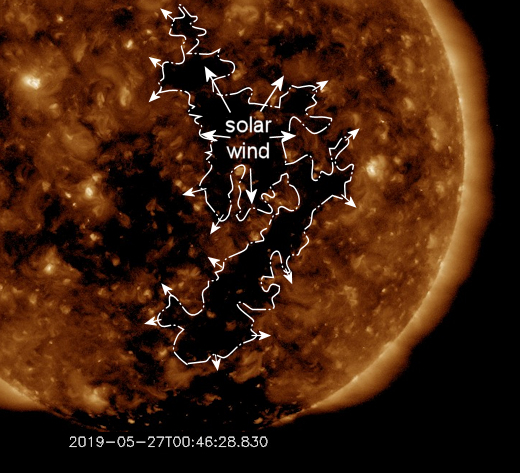
SOLAR WIND SPARKS RAINBOW AURORAS: Earth is inside a stream of high-speed solar wind flowing from a hole in the sun's atmosphere. First contact with the gaseous material on May 29th produced an outburst of rainbow auroras over Canada and a green "ET" over the South Pole. Solar wind effects could continue for another ~24 hours as Earth moves through the stream. Aurora alerts: SMS Text.
A SUNSPOT FROM THE NEXT SOLAR CYCLE: Getting tired of Solar Minimum? Good news: It won't last forever. In fact, the next solar cycle made a brief appearance this week. On May 28th, a small sunspot materialized in the sun's northern hemisphere, then, hours later, vanished again. The polarity of its magnetic field marked it as a possible member of Solar Cycle 25:
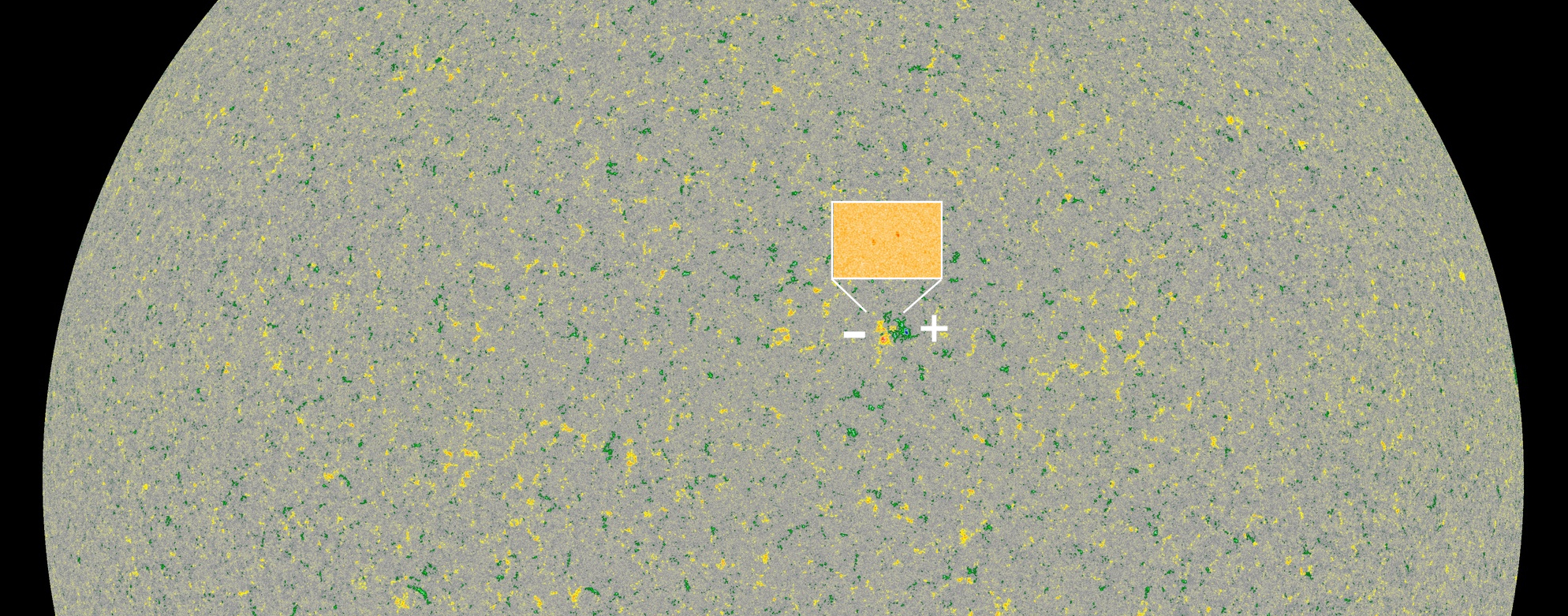
Above: A magnetic map of the solar surface on May 28, 2019. Credit: NASA/SDO
Northern sunspots from old Solar Cycle 24 have a +/- polarity. This ephemeral sunspot was the opposite: -/+. According to Hale's Law, sunspots switch polarities from one solar cycle to the next. The unnumbered sunspot appears to be a herald of Solar Cycle 25.
Solar cycles always mix together at their boundaries. Indeed, ephemeral sunspots possibly belonging to Solar Cycle 25 have already been reported on Dec. 20, 2016, and April 8, 2018, and Nov. 17, 2018. Now we can add May 28, 2019, to list. The slow transition between Solar Cycle 24 and Solar Cycle 25 appears to be underway.
Realtime Space Weather Photo Gallery
Free: Spaceweather.com Newsletter
FISHING IN THE STRATOSPHERE: Father's Day is less than 3 weeks away. Just in time for giftgiving, we present the first fishing lure in space. This unique hook, inscribed with the message "I love you more than you love fishing," hitched a ride onboard an Earth to Sky Calculus cosmic ray balloon on May 17, 2019, reaching an altitude of 117,454 feet:
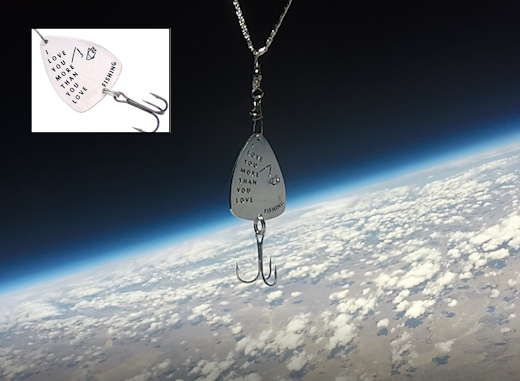
You can have it for $99.95. The students are selling these lures to support their cosmic ray ballooning program--an increasing necessity because of the worldwide helium shortage. Each hook comes with a greeting card showing the item in flight and telling the story of its journey to the edge of space and back.
Far Out Gifts: Earth to Sky Store
All sales support hands-on STEM education
NOCTILUCENT CLOUDS TURN ON: Noctilucent clouds are rapidly spreading around the Arctic Circle. First sighted by NASA's AIM spacecraft on May 20th, small wisps of electric blue have since multiplied in areal coverage by a factor of nearly 200. This 7-day movie from AIM's CIPS instrument shows their development:
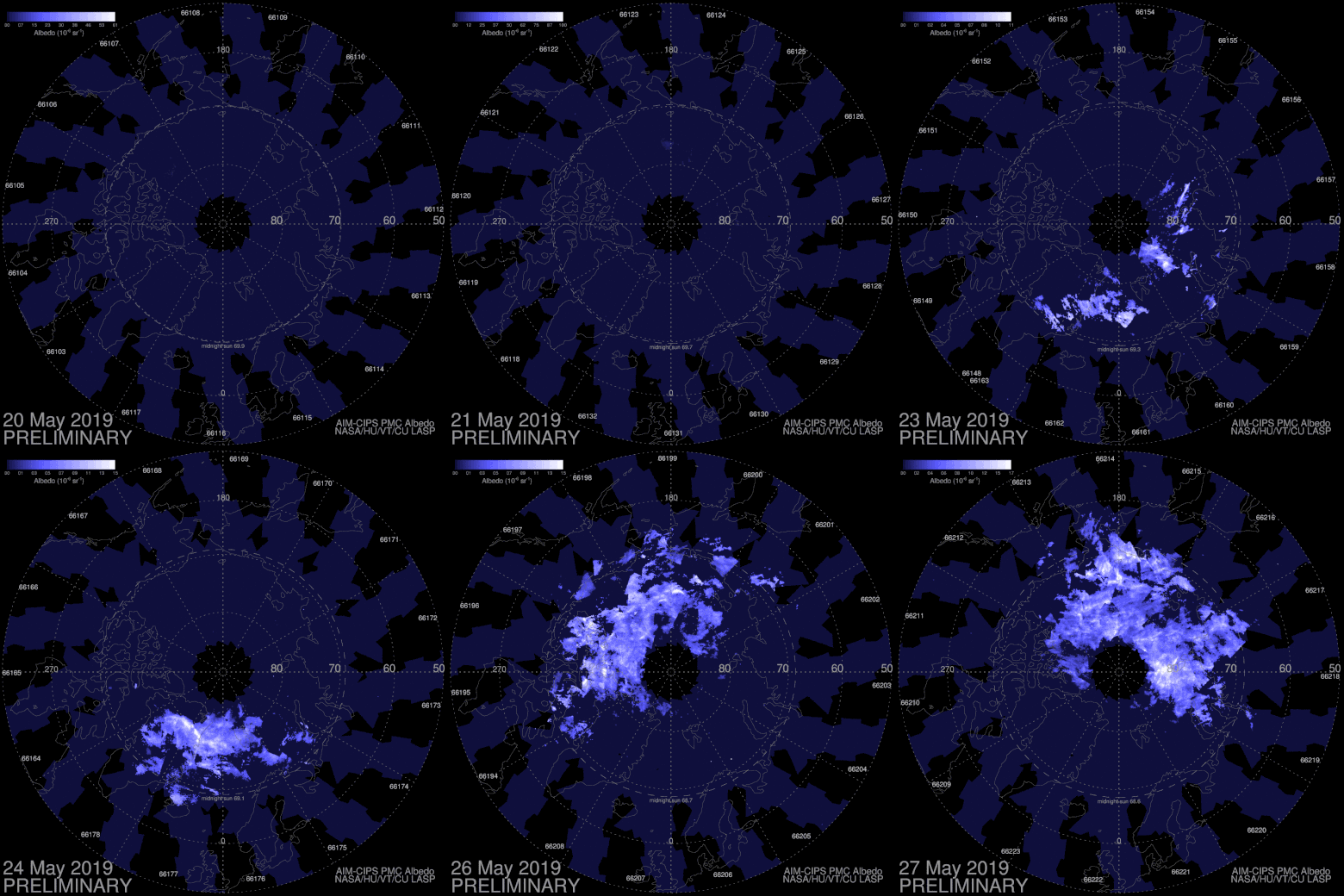
NLCs are Earth's highest clouds. Seeded by meteoroids, they float at the edge of space more than 80 km above the planet's surface. The clouds are very cold and filled with tiny ice crystals. When sunbeams hit those crystals, they glow electric-blue.
Previous data from AIM have shown that NLCs are like a great "geophysical light bulb." They turn on every year in late spring, reaching almost full intensity over a period of 10 days. This is happening now, and observers on the ground are beginning to see them.
On May 29th in Kiel, Germany, Laura Kranich witnessed bright electric-blue tendrils reaching up from the northern horizon. "Wow, I'm really stunned!" says Kranich. "The clouds covered a huge area of the sky."
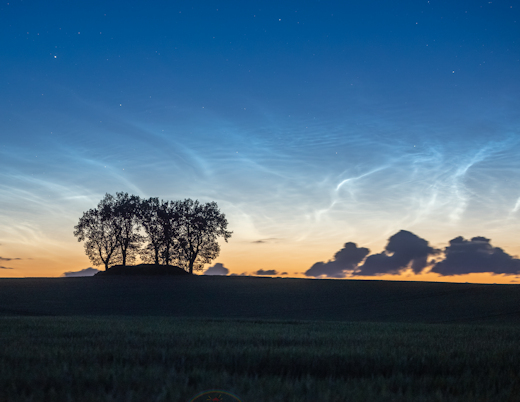
"This is my earliest observation of noctilucent clouds and, considering the fact that it's only May, they were exceptionally bright and well structured," says Kranich. "Seems like this is going to become a great season!"
Previous studies have shown that noctilucent clouds sometimes intensify during solar minimum. Solar minimum conditions are in effect now as the sun has been without spots for 11 consecutive days--a situation that may favor the frosting of meteor smoke high above Earth. Monitor the NLC photo gallery for more sightings.
Realtime Noctilucent Cloud Photo Gallery
Free: Spaceweather.com Newsletter
Realtime Space Weather Photo Gallery
Free: Spaceweather.com Newsletter