HUGE BLUE CLOUD CIRCLES THE NORTH POLE: A huge blue cloud of frosted meteor smoke is pinwheeling around the Arctic Circle. NASA's AIM spacecraft spotted its formation on May 20th, and it has since circled the North Pole one and a half times, expanding in size more than 200-fold.
"These are noctilucent clouds," says Cora Randall of the AIM science team at the University of Colorado. "And they are going strong."

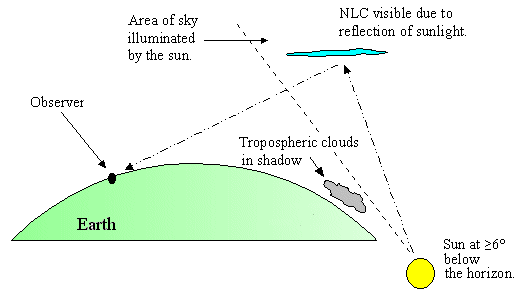
Noctilucent clouds (NLCs) in May are nothing unusual. They form every year around this time when the first wisps of summertime water vapor rise to the top of Earth's atmosphere. Molecules of H2O adhere to specks of meteor smoke, forming ice crystals 80 km above Earth's surface. When sunbeams hit those crystals, they glow electric-blue.
But these NLCs are different. They're unusually strong and congregated in a coherent spinning mass, instead of spreading as usual all across the polar cap.
"This is most likely a sign of planetary wave activity," says Randall.
Planetary waves are enormous ripples of temperature and pressure that form in Earth's atmosphere in response to Coriolis forces. They are responsible in part for undulations in the jet stream and can have a major influence on global weather. All rotating planets with atmospheres have these kind of waves.
Data from NASA's Microwave Limb Sounder (MLS) instruments show that, indeed, a planetary wave is circling the North Pole in sync with the blue cloud:

"The region of coldest temperatures migrates clockwise around the hemisphere, making one complete lap in about 5 days," notes Lynn Harvey of the AIM science team who processed the data. "This is where the NLCs are forming."
Because of planetary wave activity, the 2019 season is shaping up to be unusually good. The clouds have already made an appearance in the USA–something that usually doesn't happen until late June or July.
"Last night, I took my dog out an hour and twenty minutes after sunset and was happily surprised to see these noctilucent clouds," reports Shelley Johnson of Anacortes, Washington, who took this picture on May 30th:

NLCs have also been sighted in Europe–highlighted by a bright display in Germany. "This is my earliest observation of noctilucent clouds and, considering the fact that it's only May, they were exceptionally bright and well structured," reports Laura Kranich of Kiel, Germany. "Seems like this is going to become a great season!"
If the 2019 NLC season continues to develop this quickly, even mid-latitude observers may soon be seeing this polar phenomenon. Observing tips: Look west 30 to 60 minutes after sunset when the sun has dipped below the horizon. If you see luminous blue-white tendrils spreading across the sky, you may have spotted a noctilucent cloud.
Realtime Noctilucent Cloud Photo Gallery
Free: Spaceweather.com Newsletter
FISHING IN THE STRATOSPHERE: Father's Day is less than 3 weeks away. Just in time for giftgiving, we present the first fishing lure in space. This unique hook, inscribed with the message "I love you more than you love fishing," hitched a ride onboard an Earth to Sky Calculus cosmic ray balloon on May 17, 2019, reaching an altitude of 117,454 feet:
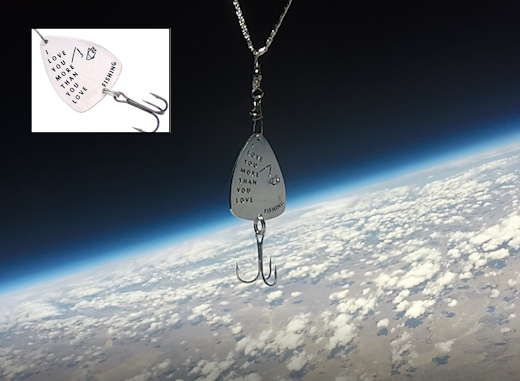
You can have it for $99.95. The students are selling these lures to support their cosmic ray ballooning program--an increasing necessity because of the worldwide helium shortage. Each hook comes with a greeting card showing the item in flight and telling the story of its journey to the edge of space and back.
Far Out Gifts: Earth to Sky Store
All sales support hands-on STEM education
MAMMATUS CLOUDS OVER SAO PAULO: It is a curious fact of Nature that the underbelly of an exhausted thunderstorm resembles the underbelly of a cow. These are called "mammatus clouds":

Willian Souza took the picture yesterday in Sao Paulo, Brazil--"just after sunset," he says. It was once thought that this type of cloud signaled the approach of bad weather, but research shows the opposite is true. Mammatus clouds are most often seen when storms are breaking up. Indeed, the Sao Paulo display came at the end of a thunderstormy day.
What exactly causes mammatus clouds? It's a big undulating mystery. For details, see "The Mysteries of Mammatus Clouds," D. M. Schultz et al, Journal of the Atmospheric Sciences, Volume 63, Issue 10 (October 2006).
Realtime Space Weather Photo Gallery
Free: Spaceweather.com Newsletter