SOLAR MINIMUM CONDITIONS ARE IN EFFECT: The sun has been without spots for 15 consecutive days--a sign that Solar Minimum is underway. Many people think Solar Minimum is uninteresting. Not so. This phase of the solar cycle brings extra cosmic rays, long-lasting holes in the sun's atmosphere, and a possible surplus of noctilucent clouds. Aurora Alerts: SMS text, email.
NOCTILUCENT CLOUDS OVER POLAND:For the past 2 weeks, a huge blue noctilucent cloud has been pinwheeling around the Arctic Circle, shaped and controlled by a 5-day planetary wave. On June 3rd, the wave swept across Europe and voilà!--electric blue ripples appeared in the continent's pre-dawn skies. Marek Nikodem photographed the display from Szubin, Poland:

"As predicted by Spaceweather.com, 5 days after the last bright European display on May 28th and 29th, NLCs reappeared over Europe," says Nikodem.
Tomasz Adam of Kraków, Poland, saw them, too. "The NLC forecast issued by SpaceWeather.com over the weekend turned out to be remarkably accurate save for one tiny detail - the latitude," says Adam. "Noctilucent clouds were expected to appear today over northern Europe. In fact, they descended much further south. I've never seen NLCs this early from my latitude of 50° N since I started looking for them 14 years ago. This is going to be a great year for observing these elusive electric blue clouds!"
Previous studies have shown that noctilucent clouds sometimes intensify during Solar Minimum. Solar Minimum conditions are in effect now, and this could be partly responsible for the unusual early-season sightings. "I have been observing noctilucent clouds for almost 30 years, and I can say that the best displays are always during Solar Minimum," notes Nikodem. Stay tuned!
Realtime Noctilucent Cloud Photo Gallery
Free: Spaceweather.com Newsletter
A WILD DISPLAY OF AIRGLOW: Last week on May 30th, MaryBeth Kiczenski of Munising, Michigan, drove to the Pictured Rocks National Lakeshore in search of auroras. A stream of solar wind was buffeting Earth's magnetic field, and Northern Lights were a definite possibility. Instead of auroras, however, "I saw some pretty wild airglow!" she says.

"I was in awe over how surreal it looked!!" says Kiczenski.
Although airglow looks like the aurora borealis, it is not. Auroras are caused by gusts of solar wind. Airglow is caused by a complex assortment of chemical reactions in the upper atmosphere. These reactions get started during daylight hours when the atmosphere is bathed in strong UV radiation from the sun. At night we see the afterglow, colored green by oxygen atoms 90-100 km high or sometimes red by hydroxyl ions 86-87 km high.
Kiczenski saw both--red and green. Gravity waves propagating upward from the lower atmosphere impressed the colorful lights with a dramatic rippling structure. Browse the airglow gallery for more examples.
Realtime Airglow Cloud Photo Gallery
Free: Spaceweather.com Newsletter
A GIFT FROM THE EDGE OF SPACE: Last month, the students of Earth to Sky Calculus launched the starship Enterprise to the stratosphere. Riding onboard a high-altitude cosmic ray balloon, the laser-etched crystal spaceship traveled 34.7 km (113,845 feet) above Earth's surface:
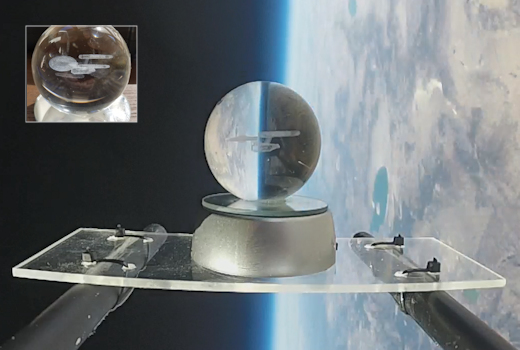
You can have it for $149.95. The students are selling the Enterprise to support their cosmic ray ballooning program. Each starship comes with a greeting card showing the item in flight and telling the story of its journey to the edge of space. Also included is a multi-colored LED illuminated stand (shown in the picture above). This creates a colorful visual effect and allows the Enterprise to be used as a far-out night light.
Far Out Gifts: Earth to Sky Store
All sales support hands-on STEM education
Realtime Space Weather Photo Gallery
Free: Spaceweather.com Newsletter