STARLINK VS. ASTRONOMY: Warning. If you love astronomy, this picture may upset you. It shows 25 Starlink satellites ruining a photo of the NGC 5353/4 galaxy group. The long exposure was made by astronomers at the Lowell Observatory on May 25th, two nights after the Starlink satellites were launched. This week, the International Astronomical Union issued a statement raising scientific concerns about the effect constellations of satellites such as Starlink could have on astronomical research. Read it here.
A DAYTIME METEOR SHOWER IS UNDERWAY: Most people don't know it, but some of the strongest meteor showers of the year happen when the sun is up. One of them is underway now. Canada's Meteor Orbit Radar (CMOR) in western Ontario is pinging with activity on June 5th in response to a source only 20 degrees from the sun:

"These are Arietid meteors," says professor Peter Brown of the University of Western Ontario. "We believe they come from sungrazing Comet 96P/Machholz."
When the shower peaks on June 7th, Brown expects his radar to detect one Arietid every 20 seconds--a rate which ranks the Arietids among the top meteor showers of the year.
It is possible to see these meteors. The trick is knowing when to look.The best time, Brown advises, is just before dawn when the shower's radiant is barely above the horizon and the sun is barely below. "The Arietids an observer would see before dawn are quite impressive as they are all Earthgrazers, skimming the atmosphere almost horizontally overhead," he says.

It turns out that June is the best month of the year for daytime meteor showers. When the Arietids subside, another daytime shower will take over: The zeta Perseids peak on June 13th. And then another: The beta Taurids on June 29th.
The beta Taurids are particularly interesting because researchers suspect it may be responsible for the Tunguska Event of June 30, 1908, when a meteoroid leveled a forest in Russia. This June the Taurid debris swarm will make its closest approach to Earth since 1975. Many astronomers, including Brown, will use large telescopes to search for signs of hazardous objects as the swarm passes by.
A sharable version of this story is available here.
Realtime Space Weather Photo Gallery
Free: Spaceweather.com Newsletter
DEEP-SKY AURORAS OVER THE USA: On June 4th, a tiny crack opened in Earth's magnetic field. Solar wind squeezed through the gap--just enough to spark a display of deep-sky auroras. John Ashley photographed the lights from Montana:

"I was in the Glacier National Park on the North Fork of the Flathead River," says Ashley. "My camera was set for a long exposure to capture the Milky Way."
He caught that ... and more. In addition to the MIlky Way, there is the Andromeda galaxy on the left, Jupiter to the right, and a broad band of green airglow surmounting a red and yellow band of faint auroras.
Deep-sky auroras are barely visible to the naked eye, but look great in photographic exposures of a few seconds or more. They occur mainly during weak geomagnetic storms and may be photographed when the Moon is New. Observing tip: Sign up for the Pro Plan of Space Weather Alerts. When you receive a text message saying that the K-index is 4 or 5, deep-sky auroras may be waiting outside.
GIFTS FROM THE EDGE OF SPACE: What do you get the dad who has everything? Consider a gift from the edge of space! Every item in the Earth to Sky Store has flown to the top of Earth's atmosphere onboard a cosmic ray balloon, and they're all 10% off between now and Father's Day.
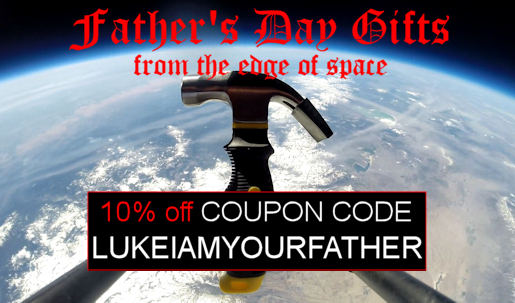
Each gift comes with a unique greeting card showing the item in flight and telling the story of its journey to the stratosphere and back again. Cosmic ray data collected during the flights form a unique record of radiation in Earth's atmosphere--100% gathered and analyzed by young scientists. All sales support the students and their high-altitude ballooning program. Thanks!
Far Out Gifts: Earth to Sky Store
All sales support hands-on STEM education
Realtime Noctilucent Cloud Photo Gallery
Free: Spaceweather.com Newsletter