A DAYTIME METEOR SHOWER IS UNDERWAY: This week, pieces of debris from sungrazing comet Comet 96P/Machholz are flying out of the constellation Aries, causing one of the most intense meteor showers of the year. Most of the meteors go unnoticed, however, because they are so close to the sun. The best time to look is on June 7th, when the shower peaks, just before sunrise when earthgrazing fireballs may streak overhead. [Learn more] [sky map]

STARLINK VS. ASTRONOMY: A long time ago in a galaxy far, far away.... a star exploded. Light from the supernova reached Earth in May 2019 following a journey of 110 million years across the cosmos. Astronomers saw it--a tiny bloom of light on the edge of lenticular galaxy NGC5353--and immediately began to monitor its light curve. Then this happened:
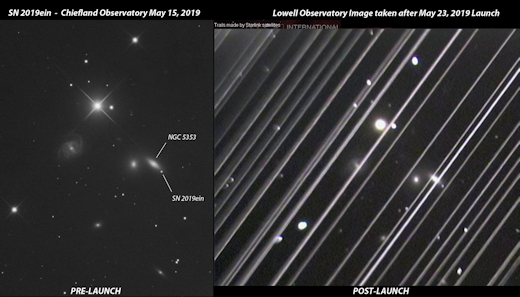
Bill Williams of the Chiefland Astronomy Village in Florida created this composite image. "It shows my photo of the supernova on May 15th (left), one week before the launch of SpaceX's Starlink satellites, alongside a similar photo taken at the Lowell Observatory after the launch (right)," explains Williams. The difference is, Starlink ruined the Lowell Observatory image.
SN2019ein is a Type 1a supernova. It happened when matter from one star fell onto another--a nearby white dwarf, pushing the mass of the dwarf over the threshold for a supernova explosion. This special kind of supernova is a "standard candle," which cosmologists have used to show that the expansion of the universe is accelerating. Monitoring the light curves of Type 1a supernova literally helps us understand the fate of the cosmos.
"To me as a dedicated observer of the night sky for over 50 years and an avid underwater photographer, satellite megaconstellations such as Starlink are the equivalent of polluting our oceans with plastics," notes Williams. "I hope we take every measure possible to mitigate the effects of satellite light pollution of our night skies."
The International Astronomical Union agrees. Read their statement here.
Realtime Space Weather Photo Gallery
Free: Spaceweather.com Newsletter
GIFTS FROM THE EDGE OF SPACE: What do you get the dad who has everything? Consider a gift from the edge of space! Every item in the Earth to Sky Store has flown to the top of Earth's atmosphere onboard a cosmic ray balloon, and they're all 10% off between now and Father's Day (June 16th).
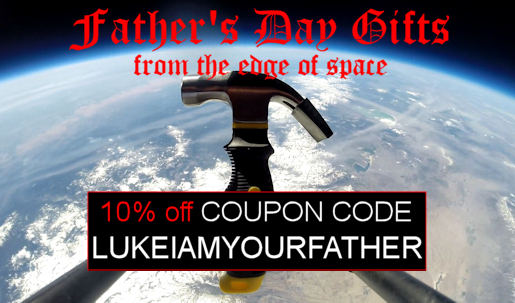
Each gift comes with a unique greeting card showing the item in flight and telling the story of its journey to the stratosphere and back again. Cosmic ray data collected during the flights form a unique record of radiation in Earth's atmosphere--100% gathered and analyzed by young scientists. All sales support the students and their high-altitude ballooning program. Thanks!
Far Out Gifts: Earth to Sky Store
All sales support hands-on STEM education
Realtime Noctilucent Cloud Photo Gallery
Free: Spaceweather.com Newsletter