BE ALERT FOR THE "LUNAR X": Have you seen the Lunar X? Once a month when the sun rises over Crater Werner in the Moon's southern hemisphere, sunlight floods the region's high terrain and makes a luminous criss-cross shape. The "X" is due to appear on Sunday, June 9th, between 20.4h and 22.4h Pacific Daylight Time. Submit your X's here.
POSSIBLE CME IMPACT: Today, Saturday, June 8th, a dense and strongly-magnetized cloud of plasma hit Earth's magnetic field. The gaseous material appears to be the flank of a coronal mass ejection (CME). The solar storm cloud left the sun on June 3rd, shown here in a movie from NASA's STEREO-A spacecraft:

This is a small, slow-moving CME. Indeed, it has taken more than 5 days to cross the sun-Earth divide. Typical CMEs cross the same distance in half the time. Nevertheless, it has been geoeffective because it is opening cracks in Earth's magnetosphere. Solar wind pouring through the gaps sparked a minor G1-class geomagnetic storm on June 8th.

NOAA forecasters have issued a watch for more G1-class activity on June 9th as Earth's magnetic field reverberates from the glancing blow. Auroras may be observed in parts of Canada and other high-latitude places where the midnight sun has not yet wiped out the night. Aurora alerts: SMS Text, Email.
Realtime Aurora Photo Gallery
Free: Spaceweather.com Newsletter
FATHER'S DAY GIFTS FROM THE EDGE OF SPACE: What do you get the dad who has everything? Consider a gift from the edge of space! Every item in the Earth to Sky Store has flown to the top of Earth's atmosphere onboard a cosmic ray balloon, and they're all 10% off between now and Father's Day (June 16th).

Each gift comes with a unique greeting card showing the item in flight and telling the story of its journey to the stratosphere and back again. Cosmic ray data collected during the flights form a unique record of radiation in Earth's atmosphere--100% gathered and analyzed by young scientists. All sales support the students and their high-altitude ballooning program. Thanks!
Far Out Gifts: Earth to Sky Store
All sales support hands-on STEM education
WHAT'S HAPPENING TO THE GREAT RED SPOT? The biggest storm in the solar system is shrinking. Since mid-May, Jupiter's Great Red Spot has contracted a startling 3000 km, reducing the size of the anti-cyclone by more than 20%. This 10-day movie created by Marco Vedovato of the JUPOS Project shows what's happening:
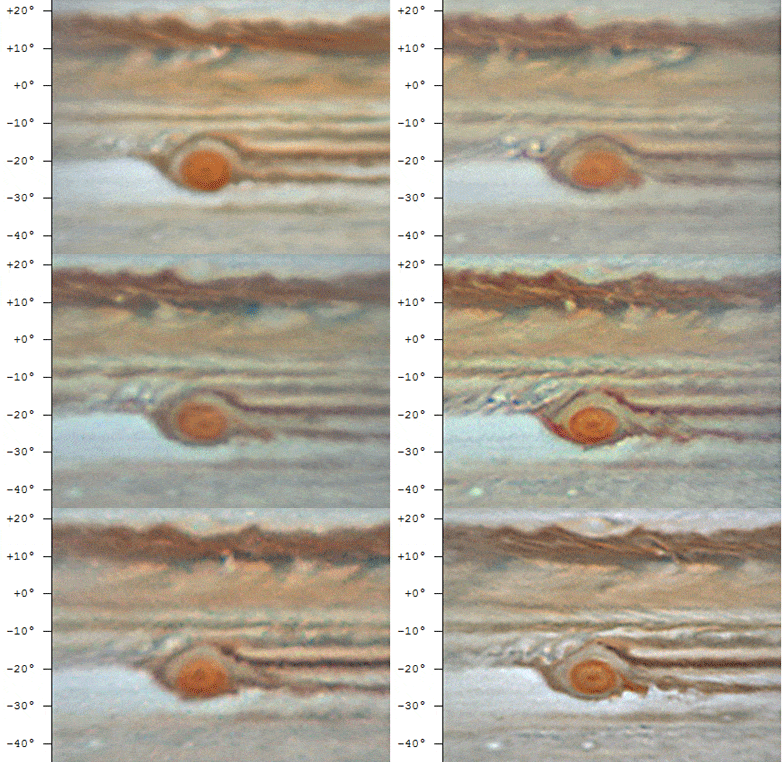
Enormous rivulets of red gas are streaming away from the storm as it spins. "This is something we've never seen before," says Vedovato, who assembled the animation by stitching together images from nearly a dozen amateur astronomers.
Experienced observers say the storm is "getting a new shape every day" in a "dramatic metamorphasis" as the Red Spot "appears to be unravelling."
Consider it a case of perfect timing. Jupiter is about to make its annual closest approach to Earth--"only" 641 million km away on June 12th. Proximity makes the planet big and bright, shining almost four times brighter than Sirius, the brightest star in the sky. Astrophotographers are therefore getting a fantastic view of the GRS.

Jupiter rising over Bluff, Utah. Photo credit: Paul Martini
"The JUPOS Project manages the largest Jupiter database in the world," says Vedovato. "So far we have collected more than 1 million measurements, including old images and drawings from the 18th century, allowing us to plot very precise trends in the Great Red Spot." This plot, for instance, shows the sudden decrease in the storm's diameter since early May.

Observing tips: Finding Jupiter is easy. Because the giant planet is at opposition, it rises in the east at sunset and stays up all night long. The best time to look is around local midnight when Jupiter is hanging relatively high in the southern sky. Even small telescopes will reveal the planet's oblate disk and stormy cloud belts. And Jupiter's 4 largest moons can be seen using no more than handheld binoculars: sky map.


Realtime Space Weather Photo Gallery
Free: Spaceweather.com Newsletter