BE ALERT FOR THE "LUNAR X": Have you seen the Lunar X? Once a month when the sun rises over Crater Werner in the Moon's southern hemisphere, sunlight floods the region's high terrain and makes a luminous criss-cross shape. The "X" is due to appear on Sunday, June 9th, between 20.4h and 22.4h Pacific Daylight Time. Submit your X's here.
HUGE OUTBREAK OF NOCTILUCENT CLOUDS: Last night, a huge outbreak of noctilucent clouds (NLCs) occurred as tendrils of frosted meteor smoke were sighted in Europe and the USA as far south as Oregon and Utah. "What a surprise," says Andrew Robb of Beaverton OR. "It's been almost 10 years since I've seen NLCs here in Oregon. They're back!"

Robb took the picture, above, just after sunset on June 8th. "NLCs stretched the length of the whole horizon," he says. "Their rippling waves and other structures were fascinating."
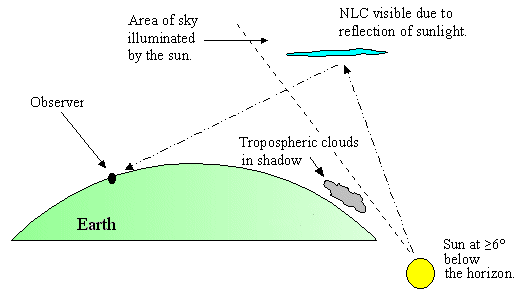
NLCs are Earth's highest clouds. Seeded by meteoroids, they float at the edge of space more than 80 km above the planet's surface. The clouds are very cold and filled with tiny ice crystals. When sunbeams hit those crystals, they glow electric-blue.
Normally, NLCs are confined to polar regions, but this year people are seeing them at middle latitudes, too. Last night alone the clouds appeared in Utah, Minnesota, Wisconsin, Washington, Montana, Iowa, Oregon and Maine. Electric-blue ripples also blanketed much of northern to central Europe. This is what sunrise over Poland looked like on June 9th:

"It was such a beautiful display of noctilucent clouds," says photographer Marek Nikodem of Szubin, Poland.
Why are noctilucent clouds suddenly so bright? Previous studies have shown that noctilucent clouds sometimes intensify during solar minimum. Solar minimum conditions are in effect now as the sun has been without spots for 21 consecutive days--a situation that may favor the frosting of meteor smoke high above Earth.
At present, no one can predict exactly when noctilucent clouds will appear. Last night's display, however, suggests that more of the clouds may be in the offing even at mid-latitudes. Observing tips: Look west 30 to 60 minutes after sunset when the sun has dipped below the horizon. If you see luminous blue-white tendrils spreading across the sky, you may have spotted a noctilucent cloud.
Realtime Noctilucent Cloud Photo Gallery
Free: Spaceweather.com Newsletter
FATHER'S DAY GIFTS FROM THE EDGE OF SPACE: What do you get the dad who has everything? Consider a gift from the edge of space! Every item in the Earth to Sky Store has flown to the top of Earth's atmosphere onboard a cosmic ray balloon, and they're all 10% off between now and Father's Day (June 16th).

Each gift comes with a unique greeting card showing the item in flight and telling the story of its journey to the stratosphere and back again. Cosmic ray data collected during the flights form a unique record of radiation in Earth's atmosphere--100% gathered and analyzed by young scientists. All sales support the students and their high-altitude ballooning program. Thanks!
Far Out Gifts: Earth to Sky Store
All sales support hands-on STEM education
UNEXPECTED CME IMPACT: On Saturday, June 8th, a dense and strongly-magnetized cloud of plasma hit Earth's magnetic field. It was, apparently, the flank of a coronal mass ejection (CME). The solar storm cloud left the sun with little fanfare on June 3rd. Coronagraphs on NASA's STEREO-A spacecraft barely detected it:

The slow-moving CME took more than 5 days to cross the sun-Earth divide. Typical CMEs cross the same distance in half the time. Despite its low velocity, the CME was geoeffective. Strong south-pointing magnetic fields inside the CME opened cracks in Earth's magnetosphere. Solar wind poured through the gaps to spark a G1-class geomagnetic storm on June 8th.

The effects of the CME are subsiding now and no further storms are expected this weekend. Aurora alerts: SMS Text, Email.
Realtime Aurora Photo Gallery
Free: Spaceweather.com Newsletter
Realtime Space Weather Photo Gallery
Free: Spaceweather.com Newsletter