SOLAR WIND, INCOMING: A solar wind stream flowing from a northern hole in the sun's atmosphere could graze Earth's magnetic field today. The impact is expected to cause geomagnetic activity just below the level of a G1-class storm. Faint auroras may be seen at high latitudes. Aurora alerts: SMS Text.

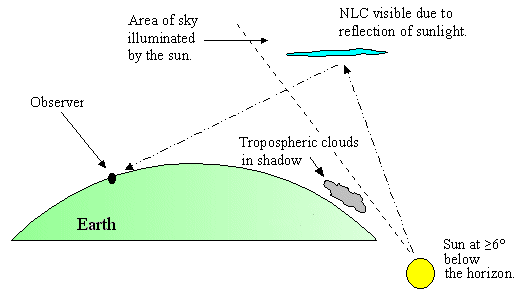
NOCTILUCENT CLOUDS VISIT EUROPE: The best season for noctilucent clouds in many years--and perhaps ever--is now underway. Electric blue clouds of frosted meteor smoke are swirling around the Arctic Circle, occasionally dipping down to low latitudes where they have rarely been seen before. Last night, there were widespread sightings in Europe, including this display in the Netherlands:

"We haven't seen NLCs here for many years," says photographer Jan Koeman. "Last night they were incredibly bright."
Europeans saw the same display in Germany, Belgium and France. This follows an even bigger outbreak of NLCs in the USA on June 8th and 9th that produced sightings as far south as California, Utah, Oklahoma, and New Mexico.
What's happening? Previous studies have shown that noctilucent clouds sometimes intensify during solar minimum. Solar minimum conditions are in effect now as the sun has been without spots for 25 consecutive days--a situation that may favor the frosting of meteor smoke high above Earth.
Observing tips: Look west 30 to 60 minutes after sunset when the sun has dipped below the horizon. If you see luminous blue-white tendrils spreading across the sky, you may have spotted a noctilucent cloud.
Realtime Noctilucent Cloud Photo Gallery
Free: Spaceweather.com Newsletter
HALOBACTERIA CHANGE COLOR WHEN THEY TOUCH SPACE: Picture this: An astronaut climbs aboard his spacecraft and blasts off from Earth. At the apex of the flight, he experiences something strange. Weightlessness? Space sickness? No. He changes color! This doesn't happen to human astronauts, but it does happen to halobacteria, an extreme-loving microbe from Earth that might be able to live on Mars.

In recent weeks, Spaceweather.com and the students of Earth to Sky Calculus have been flying halobacteria to the stratosphere. Why? To see if the salt-loving microbes might be able to survive on the Red Planet. The stratosphere is a good place to find out because conditions in Earth's stratosphere are remarkably similar to conditions on the surface of Mars.
The quick answer is YES. Halobacteria do survive--for brief trips, at least. Halobacteria that we launch into the stratosphere come back alive a few hours later, and we can easily culture them in an incubator.
But they don't come back unchanged. We find that halobacteria color-shift during their trip to the edge of space. On Earth, they're pink. When they reach the stratosphere, they turn yellow--and they remain yellow even after they return to the ground. Just by looking at the color of a sample, we can tell if it has been to the stratosphere.

Above: The many colors of halobacteria. The yellow varieties have all flown to the stratosphere. The pinkest forms are descendents of the yellows.
Back in the lab, something even more interesting happens. When we culture the "space-traveling" yellow halobacteria, allowing them to feed and multiply, their descendants turn pink again! The descendants undo the effects of the balloon flight, resetting themselves for another trip.
What's happening? We think we know the answer. Get the full story here.
APOLLO 11 PROOF SILVER DOLLAR: To celebrate the 50th anniversary of the Apollo 11 Moon landing, the United States Mint has created a commemorative 2019 Proof Silver Dollar. We decided to celebrate even more by flying the coins to the edge of space. On June 8th, the students of Earth to Sky Calculus launched this 99.9% silver dollar 111,222 feet above Earth's surface:
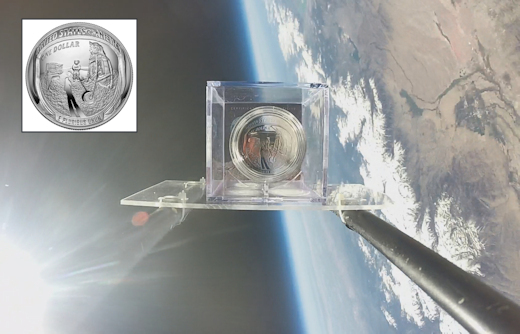
You can have it for $179.95. The students are selling the coins to support their cosmic ray ballooning program. The silver dollar is curved and reproduces the helmet of astronaut Buzz Aldrin. Reflected in Buzz's visor are Neil Armstrong, the United States flag, and the lunar lander. The opposite side of the coin shows Neil's first footprint on the Moon. Each of these coins comes with a greeting card showing the item in flight and a certificate of authenticity.


Far Out Gifts: Earth to Sky Store
All sales support hands-on STEM education
Realtime Aurora Photo Gallery
Free: Spaceweather.com Newsletter
Realtime Space Weather Photo Gallery
Free: Spaceweather.com Newsletter