AURORA AUSTRALIS WATCH: Earth's magnetic field could become unsettled on June 18th and 19th when an incoming stream of solar wind reaches our planet. The gaseous material is flowing from a large hole in the sun's atmosphere. Polar sky watchers should be alert for auroras, especially in the southern hemisphere where winter darkness favors their visibility. Aurora alerts: SMS Text.

RED SPRITES AT THE EDGE OF SPACE: We all know what comes out of the bottom of thunderclouds: lightning. But what comes out of the top? Red sprites. High above Earth on May 10th, astronauts onboard the International Space Station watched a cluster of the red forms explode from the top of a powerful thunderstorm located between Los Angeles and Las Vegas:

Spaceweather.com reader Frankie Lucena of Cabo Rojo, Puerto Rico, noticed the sprites in a time lapse video of lightning NASA released last week. "The space station was over California and traveling northeast when they took the picture," notes Lucena.
The photo shows how high sprites can go, reaching all the way from the thunderstorm to a layer of green airglow 100 km above Earth's surface. This means sprites touch the edge of space, alongside auroras, meteors and noctilucent clouds. They are a true space weather phenomenon.
Solar Minimum may be boosting sprites. During this phase of the solar cycle, cosmic rays from deep space penetrate Earth's atmosphere more than usual--a result of the sun's weakening magnetic field. Some researchers believe that cosmic rays may provide the ionizing "spark" that triggers many sprites. If so, stay tuned for more as Solar Minimum deepens.
Realtime Aurora Photo Gallery
Free: Spaceweather.com Newsletter
APOLLO 11 PROOF SILVER DOLLAR: To celebrate the 50th anniversary of the Apollo 11 Moon landing, the United States Mint has created a commemorative 2019 Proof Silver Dollar. We decided to celebrate even more by flying the coins to the edge of space. On June 8th, the students of Earth to Sky Calculus launched this 99.9% silver dollar 111,222 feet above Earth's surface:
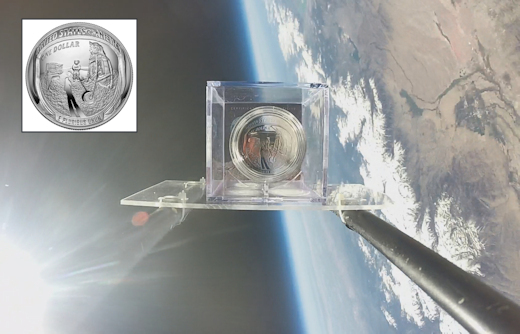
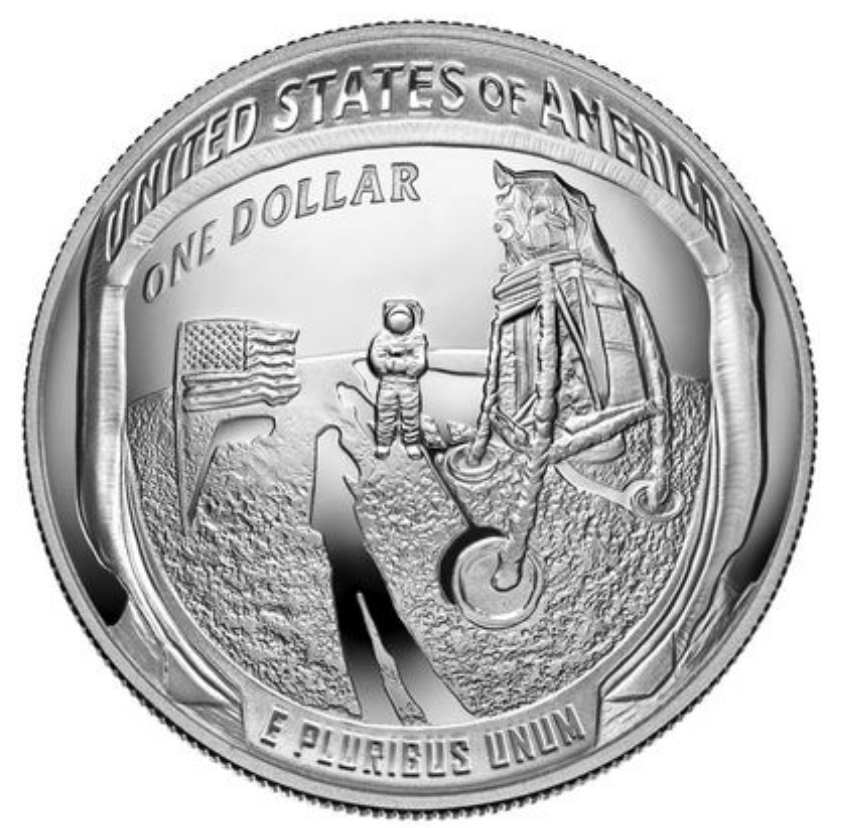
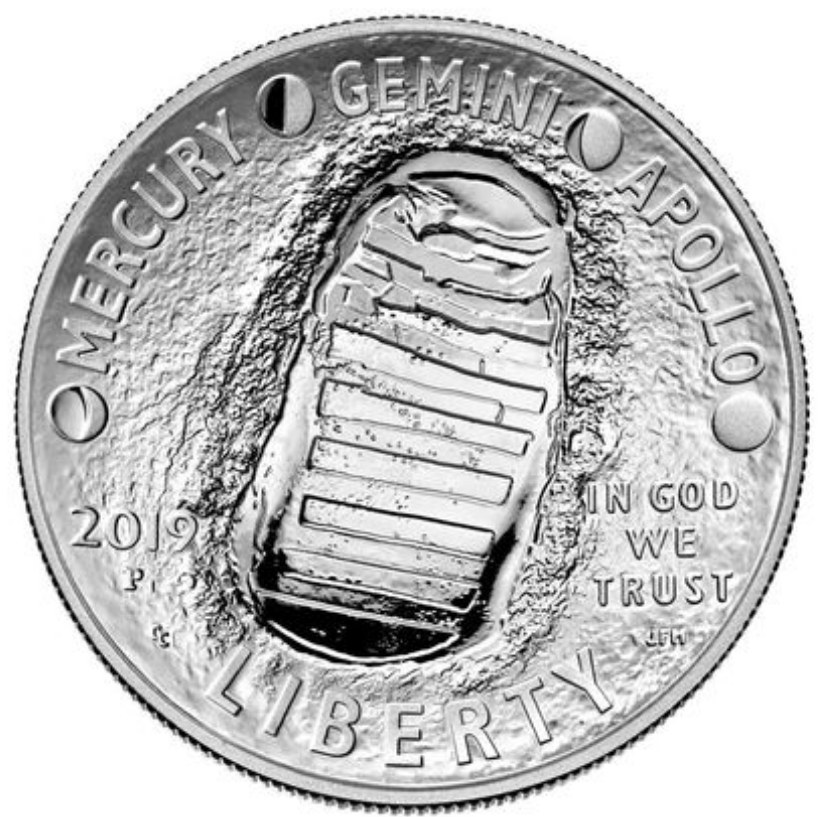
You can have it for $179.95. The students are selling the coins to support their cosmic ray ballooning program. The silver dollar is curved and reproduces the helmet of astronaut Buzz Aldrin. Reflected in Buzz's visor are Neil Armstrong, the United States flag, and the lunar lander. The opposite side of the coin shows Neil's first footprint on the Moon. Each of these coins comes with a greeting card showing the item in flight and a certificate of authenticity.
Far Out Gifts: Earth to Sky Store
All sales support hands-on STEM education
RECORD-SETTING NOCTILUCENT CLOUDS: If you've never seen a cloud of frosted meteor smoke, now is the time to look. 2019 is shaping up to be the best year for noctilucent clouds (NLCs) ... maybe ever. Normally confined to near-Arctic latitudes, NLCs have been seen this month in most US states. On Friday morning, June 14th, Don Davis saw them, astonishingly, from the city of Joshua Tree not far from Los Angeles CA:
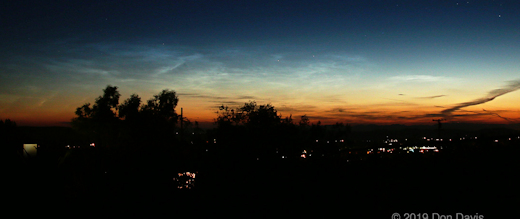
Noctilucent clouds over Joshua Tree CA on June 14, 2019
"They were dim but distinct," says Davis. "I photographed them easily using a 4 second exposure at ISO 400."
Davis's sighting at +34.1 degrees sets the record for low-latitude observations of NLCs, breaking the previous record set only five days earlier by Brian Guyer at the National Weather Service in Albuquerque, New Mexico (+35.1 degrees).
"I'm shocked to report that I saw the noctilucent clouds while venturing outdoors for a weather observation shortly after sunset," says Guyer, who is a senior meteorologist. "When I noticed the faint blue wavy tendrils far off to the north, I asked myself, 'am I really seeing noctilucent clouds from here?' I'm happy to see that other folks are also seeing these beautiful spectacles of nature at lower latitudes."
Noctilucent clouds form every year when wisps of summertime water vapor rise to the top of Earth's atmosphere and crystallize around specks of meteor smoke. The season typically starts in late May, peaks in July, and peters out in August. If NLCs are being seen in California and New Mexico in June, the season's peak in early July could be very special indeed.
Noctilucent clouds have been creeping south for years--a possible result of climate change and/or the solar cycle. 2019 has broken all the old records for southern sightings, bringing the clouds into the mainstream of mid- to low-latitude sky watching. Now everyone should be alert for NLCs.
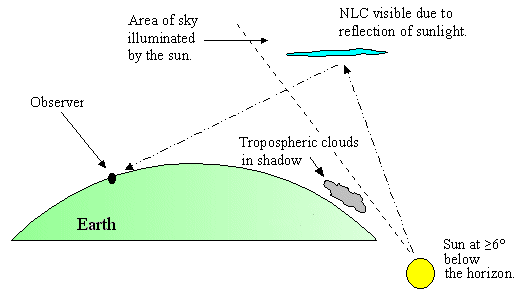
Observing tips: Look west 30 to 60 minutes after sunset (or before sunrise) when the sun is just below the horizon. If you see luminous blue-white tendrils spreading across the sky, you may have spotted a noctilucent cloud.
Realtime Noctilucent Cloud Photo Gallery
Free: Spaceweather.com Newsletter
Realtime Aurora Photo Gallery
Free: Spaceweather.com Newsletter
Realtime Space Weather Photo Gallery
Free: Spaceweather.com Newsletter