THE SUN IS UTTERLY BLANK: Today marks the 30th consecutive day that the sun has been without spots. Images of the sun look like a big orange billiard ball--utterly blank. This is a sign of Solar Minimum, a phase of the solar cycle that brings extra cosmic rays, long-lasting holes in the sun's atmosphere, and a possible surplus of noctilucent clouds.

WHY ARE NOCTILUCENT CLOUDS GOING CRAZY? Another night, another bright display of noctilucent clouds. "On the evening of June 17th, a large area of our sky was covered by noctilucent clouds, even directly overhead," reports Marek Nikodem of Szubin, Poland. "Simply mysterious, beautiful, stunning, unpredictable and photogenic--this season is unbelievable."

Noctilucent clouds over Szubin, Poland, on June 17. Credit: Marek Nikodem
Heiko Ulbricht witnessed the same display from Herzogswalde, Germany. "I have been observing noctilucent clouds for 21 years. Never before have I seen such a stunning mega-outburst! The electric-blue waves extended 50° above the horizon with many rippling structures. I was speechless."
"What is different this year in the mesosphere?" he wonders.
The most likely answer is "Solar Minimum." The solar cycle is currently swinging low through one of the deepest minima of the past century. Extreme ultraviolet (EUV) radiation from the sun is at its lowest level in a decade--a deficit that can lead directly to more noctilucent clouds.

Noctilucent clouds over Herzogswalde, Germany on June 17th. Credit: Heiko Ulbricht
Noctilucent clouds form when summertime wisps of water vapor rise to the top of the atmosphere. Water molecules stick to specks of meteor smoke, gathering into icy clouds that glow electric blue when they are hit by high altitude sunlight. EUV radiation can destroy those water molecules before they freeze. Less EUV during Solar Minimum could therefore give us more noctilucent clouds.
Coincidentally, the 2019 season for noctilucent clouds began in late May just as the sun entered a period of sustained spotlessness. There hasn't been a sunspot for the past 30 days--a span that overlaps the recent record-setting displays. Apparently, no sunspots = a lot of electric blue.
Realtime Noctilucent Cloud Photo Gallery
Free: Spaceweather.com Newsletter
APOLLO 11 PROOF SILVER DOLLAR: To celebrate the 50th anniversary of the Apollo 11 Moon landing, the United States Mint has created a commemorative 2019 Proof Silver Dollar. We decided to celebrate even more by flying the coins to the edge of space. On June 13th, the students of Earth to Sky Calculus launched this 99.9% silver dollar 99,022 feet above Earth's surface:
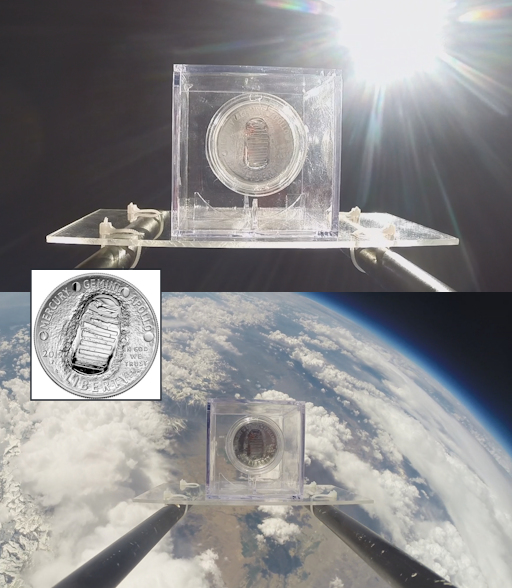
You can have it for $179.95. The students are selling the coins to support their cosmic ray ballooning program. The silver dollar is curved and reproduces the helmet of astronaut Buzz Aldrin. Reflected in Buzz's visor are Neil Armstrong, the United States flag, and the lunar lander. The opposite side of the coin shows Neil's first footprint on the Moon. Each of these coins comes with a greeting card showing the item in flight and a certificate of authenticity.


Far Out Gifts: Earth to Sky Store
All sales support hands-on STEM education
Realtime Aurora Photo Gallery
Free: Spaceweather.com Newsletter
Realtime Space Weather Photo Gallery
Free: Spaceweather.com Newsletter