THE SUN LOOKS LIKE A GIANT ORANGE BILLIARD BALL: Today marks the 31st consecutive day that the sun has been without spots. Images of the sun look like a big orange billiard ball--utterly blank. This is a sign of Solar Minimum, a phase of the solar cycle that brings extra cosmic rays, long-lasting holes in the sun's atmosphere, and a possible surplus of noctilucent clouds. Aurora alerts: SMS Text

MYSTERIOUS MOISTURE IN THE MESOSPHERE: The 2019 season for noctilucent clouds (NLCs) has been remarkable, maybe the best ever, with NLCs appearing as far south as Los Angeles CA and Albuquerque NM. What's going on? Researchers aren't sure, but Lynn Harvey of the University of Colorado's Laboratory for Atmospheric and Space Physics has just found an important clue.
"The mesosphere is quite wet," she says. "Water vapor concentrations are at their highest levels for the past 12 years."
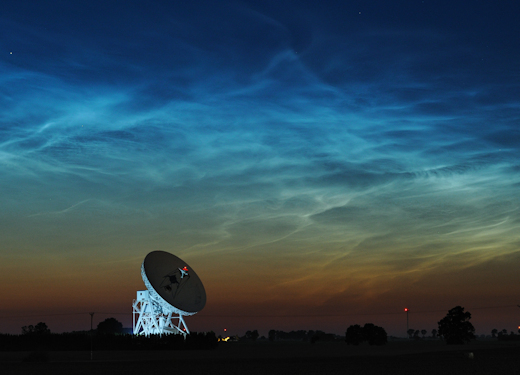
Noctilucent clouds over Piwnice, Poland, on June 18th. Credit: Piotr Majewski
Noctilucent clouds form when summertime wisps of water vapor rise to the top of the atmosphere. Water molecules stick to specks of meteor smoke, gathering into icy clouds that glow electric blue when they are hit by high altitude sunlight.
When noctilucent clouds began appearing at unusually low latitudes in early June, Harvey took a look at data from NASA's Microwave Limb Sounder--a satellite-based sensor that can measure water in the upper atmosphere. Her results are shown in the animated plot below.
"The red line is 2019, while other colors trace previous years," explains Harvey. "The plot cycles from low to high latitudes," showing a wave of moisture in the mesosphere.
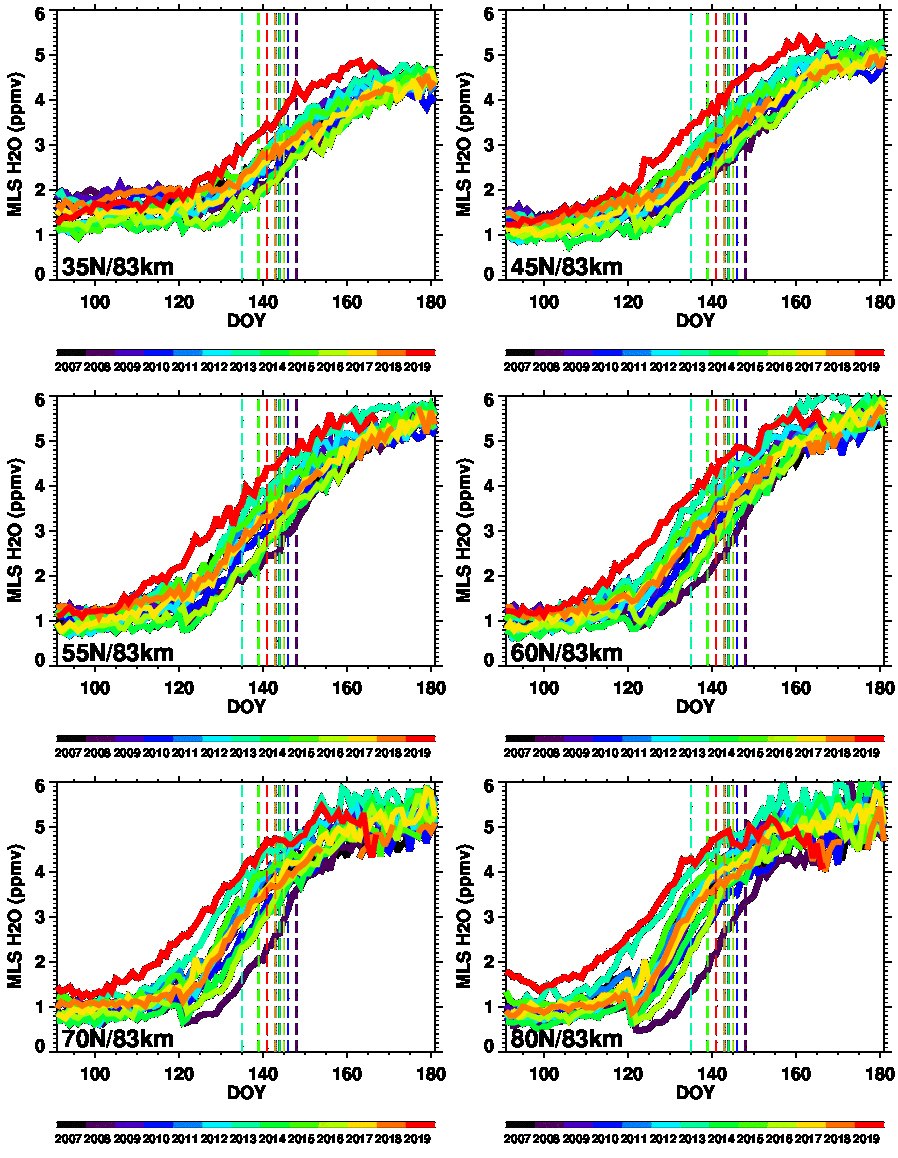
It's a veritable tidal wave. Water vapor concentrations at lower latitudes (35 to 45 N) have nearly doubled their normal values, providing a surplus of H2O molecules for noctilucent clouds. Researchers aren't sure where the water is coming from, though.
"Planetary wave activity could be transporting cold air and high water vapor to the 'noctilucent zone,'" speculates James Russell of Hampton University's Center for Atmospheric Sciences. "We've seen this happen before during mid-latitude outbreaks of noctilucent clouds."
The solar cycle may be helping, too. Right now a deep Solar Minimum is underway. Ultraviolet radiation that would normally destroy water in the mesosphere is at low ebb.
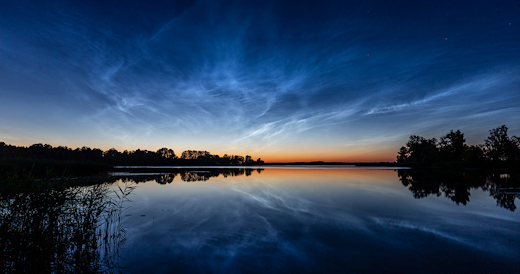
Noctilucent clouds over Riga, Latvia,on June 18th. Credit: Ivo Dinsbergs
The wave appears to be breaking. "As we enter the 3rd week of June, the water has stopped increasing," notes Harvey. "Poleward of 70N the water content has been dropping for a few weeks, and right around the north pole it's getting quite dry. At mid-latitudes (35-65N), water content is still high, but it's leveling off."
No one knows what will happen next. Another wave could bring renewed sightings of NLCs at low latitudes. Or conditions could return to normal, restoring the clouds to their usual habitat near the Arctic Circle. Says Russell, "this all points to mysteries of the atmosphere that have not been solved." Stay tuned!
Realtime Noctilucent Cloud Photo Gallery
Free: Spaceweather.com Newsletter
APOLLO 11 PROOF SILVER DOLLAR: To celebrate the 50th anniversary of the Apollo 11 Moon landing, the United States Mint has created a commemorative 2019 Proof Silver Dollar. We decided to celebrate even more by flying the coins to the edge of space. On June 13th, the students of Earth to Sky Calculus launched this 99.9% silver dollar 99,022 feet above Earth's surface:
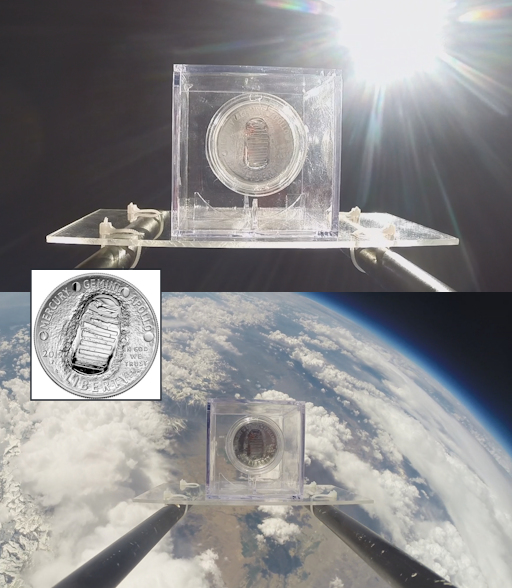
You can have it for $179.95. The students are selling the coins to support their cosmic ray ballooning program. The silver dollar is curved and reproduces the helmet of astronaut Buzz Aldrin. Reflected in Buzz's visor are Neil Armstrong, the United States flag, and the lunar lander. The opposite side of the coin shows Neil's first footprint on the Moon. Each of these coins comes with a greeting card showing the item in flight and a certificate of authenticity.


Far Out Gifts: Earth to Sky Store
All sales support hands-on STEM education
Realtime Aurora Photo Gallery
Free: Spaceweather.com Newsletter
Realtime Space Weather Photo Gallery
Free: Spaceweather.com Newsletter