HAPPY SOLSTICE: Today is the June solstice--the longest day of the year in the northern hemisphere, and the shortest day in the south. The exact moment of the solstice is 11:54 am EDT, when the sun reaches its highest declination on the celestial sphere (+23.5o). Northern summer and southern winter are underway. Wherever you live, happy solstice!
THE SUN IS SO BLANK, IT LOOKS LIKE A BILLIARD BALL: The sun is blank--really blank. No sunspots have appeared for the past 33+ days, giving the sun the appearance of a giant orange billiard ball. This is a sign that Solar Minimum is underway. Earlier this year, a panel of experts from NOAA and NASA predicted that the solar cycle would reach its nadir sometime between July 2019 and Sept 2020. The current stretch of spotless suns is consistent with their forecast.
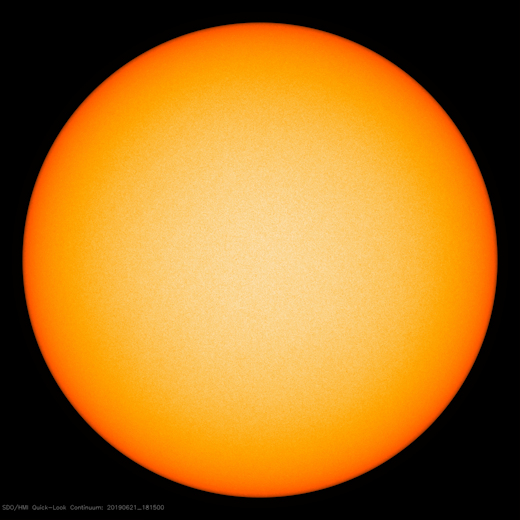
Above: The sun on June 21, 2019. Credit: NASA's Solar Dynamics Observatory
What happens when sunspots vanish? For one thing, solar flares stop happening. No big explosions means no shortwave radio blackouts and fewer geomagnetic storms. Also, the sun dims. Sunspots are sources of extreme ultraviolet radiation (EUV). Without sunspots, EUV levels decrease, causing Earth's upper atmosphere to cool and contract. Satellites and space junk stay in orbit longer as aerodynamic drag subsides.
During this phase of the solar cycle, the solar wind slows and the sun's magnetic field weakens--shields down! This allows extra cosmic rays from deep space to penetrate the solar system. Indeed, recent high altitude balloon flights show increased radiation in Earth's atmosphere. Extra cosmic rays can trigger lightning, alter the electro-chemistry of the upper atmosphere, and boost dose rates on commercial airplane flights.
Solar Minimum won't last forever. Forecasters expect sunspot numbers to increase after 2019-2020, climaxing in a new Solar Maximum around 2023-2026. Meanwhile, stay tuned for more blank suns.

Realtime Space Weather Photo Gallery
Free: Spaceweather.com Newsletter
GIANT 'PALM TREE' SPRITE: On Wednesday night in Texas, a flurry of red sprites exploded from the top of a powerful thunderstorm. One of the the red forms was so tall and bright, people saw it 200 miles away in Oklahoma. "My boys and I saw it with our unaided eyes," reports Paul Smith, who photographed the event from the shores of Lake Thunderbird, OK. This may be the first time that a sprite's reflection has been captured in water:
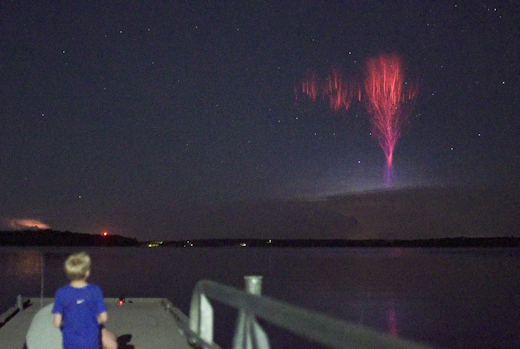
Naked-eye sightings of sprites are rare, mainly because they are so fleeting. But this one left an impression. "My eleven-year-old son Thomas described it as a 'huge orange-y-brown flash of lines high in the sky,'" says Smith. "My seven-year-old James just exclaimed 'what the heck was that?'"
At first glance, Smith's capture resembles a Gigantic Jet--that is, a type of "sprite on steroids." But lightning expert Oscar van der Velde of the Universitat Politècnica de Catalunya thinks it may be something else:
"In early days of sprite research, they were called 'palm trees' by researchers from the University of Alaska," van der Velde explains. "It is, basically, a bushy group of red sprites on top, with a secondary purple discharge hanging below. These types of events are quite rare. You need a big, active mesoscale convective system to produce them."
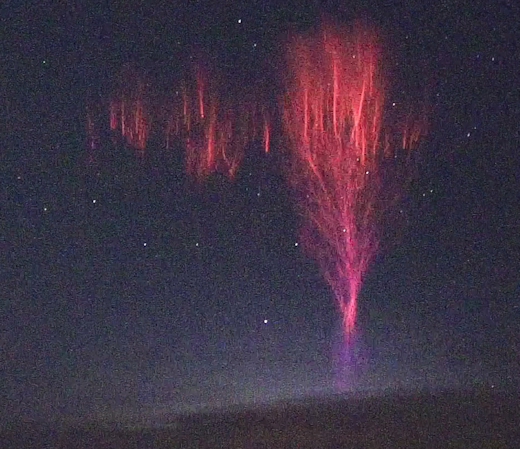
Palm tree sprites are a topic of cutting edge research. "We haven't even been able to confirm that they indeed originate from the thundercloud," says van der Velde.
"Last night was so much fun," adds Smith. "In addition to the sprites, my son Thomas photographed Jupiter and our Moon with the Nikon coolpix 80x zoom camera. We also saw a nice bolide exploding over the storms. The kid's reactions were priceless."
Realtime Sprite Photo Gallery
Free: Spaceweather.com Newsletter
APOLLO 11 PROOF SILVER DOLLAR: To celebrate the 50th anniversary of the Apollo 11 Moon landing, the United States Mint has created a commemorative 2019 Proof Silver Dollar. We decided to celebrate even more by flying the coins to the edge of space. On June 13th, the students of Earth to Sky Calculus launched this 99.9% silver dollar 99,022 feet above Earth's surface:
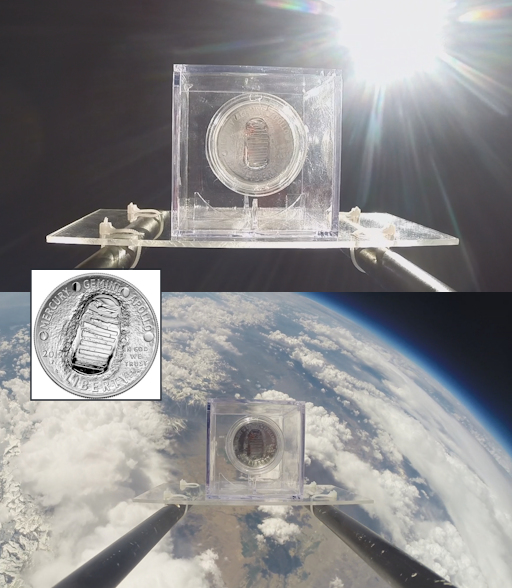
You can have it for $179.95. The students are selling the coins to support their cosmic ray ballooning program. The silver dollar is curved and reproduces the helmet of astronaut Buzz Aldrin. Reflected in Buzz's visor are Neil Armstrong, the United States flag, and the lunar lander. The opposite side of the coin shows Neil's first footprint on the Moon. Each of these coins comes with a greeting card showing the item in flight and a certificate of authenticity.


Far Out Gifts: Earth to Sky Store
All sales support hands-on STEM education
Realtime Aurora Photo Gallery
Free: Spaceweather.com Newsletter
Realtime Noctilucent Cloud Photo Gallery
Free: Spaceweather.com Newsletter