MINOR SOLAR WIND STREAM: A minor stream of solar wind is grazing Earth today, slightly unsettling our planet's polar magnetic field. High-latitude sky watchers should be alert for auroras, especially in the southern hemisphere where winter darkness favors their visibility. Aurora alerts: SMS Text
THE CITY OF NOCTILUCENT LIGHTS: The current season for noctilucent clouds (NLCs) is extraordinary, with repeated sightings as far south as New Mexico and southern California. Frosted meteor smoke has never before drifted so far away from the poles. We've received hundreds of photos of NLCs since June began. This shot, perhaps, summarizes the season better than any other:

Bulik Bertrand took this picture from Paris at midnight on June 21st--the first night of northern summer. For a few hours, the City of Lights became the City of Noctilucent Lights. "The clouds were rare and amazing," says Bertrand.
NLCs are Earth's highest clouds. They form every year around this time when wisps of summertime water vapor rise to the top of Earth's atmosphere. Molecules of H2O adhere to specks of meteor smoke, forming ice crystals ~83 km high. When sunbeams hit those crystals, they glow electric-blue.
Normally, noctilucent clouds gather around the Arctic Circle, never straying too far south. This year, however, they have stunned observers at record-low latitudes. What's happening? For reasons researchers do not fully understand, the mesosphere is unusually wet, creating a surplus of water for NLC formation. This is a possible side-effect of Solar Minimum.
The surplus is especially notable at mid-latitudes. New data just received from NASA's Microwave Limb Sounder (MLS) show that water vapor concentrations in the mesosphere between 35N and 45N remain near their highest levels in at least 12 years. Note the red lines:

This is precisely the range of latitudes where the anomalous NLCs are being seen. No one can predict exactly when the next outbreak will occur. It is clear, however, that more displays are possible as summer unfolds. The best time to look is during the hours immediately after sunset or before sunrise. Here's why. If you've never seen an NLC, these low latitude examples may help you identify them: Summit Ridge, UT; Eugene, OR; Joshua Tree, CA; Las Vegas, NV.

Realtime Noctilucent Cloud Photo Gallery
Free: Spaceweather.com Newsletter
"ONE SMALL STEP"--ORIGINAL SPACE PAINTING: This artwork has touched space. Hand-painted by artist Dana Wilcher, a student member of Earth to Sky Calculus, "One Small Step" flew to the stratosphere on June 23, 2019, onboard a cosmic ray balloon. It shows Neil Armstrong's iconic footprint on the Moon made during the Apollo 11 mission 50 years ago:
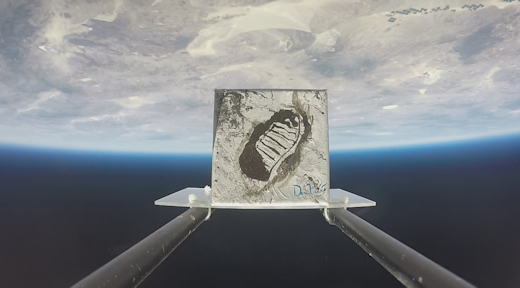
You can have it for $99.95. The students are selling these commemorative Apollo 11 paintings to support their cosmic ray ballooning program. Each signed 4x4inch canvas panel comes with a greeting card showing the painting in flight and telling the story of its journey to the edge of space and back. This makes a great gift for any enthusiast of space exploration.
Far Out Gifts: Earth to Sky Store
All sales support hands-on STEM education
Realtime Aurora Photo Gallery
Free: Spaceweather.com Newsletter
Realtime Space Weather Photo Gallery
Free: Spaceweather.com Newsletter