SOLAR MINIMUM CONDITIONS ARE IN EFFECT: Solar Minimum is underway, and it's one of the deepest minima of the past century. During this low phase of the solar cycle we experience fewer sunspots and solar flares, but get more cosmic rays and noctilucent clouds. NOAA forecasters expect the nadir to last until 2020. Aurora alerts: SMS Text
DSX SPACECRAFT FOUND: Earlier this week, SpaceX launched a new spacecraft named "DSX" into Earth orbit. Assembled and managed by the US Air Force, DSX is on a mission to explore a poorly understood region of space: the gap between the two Van Allen Belts. Last night, the spacecraft passed over the British Columbia home of amateur astronomer Scott Tilley, and he received a loud S-band radio transmission:
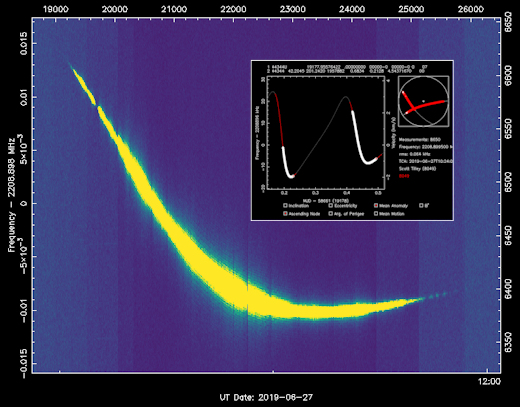
"A great signal from a spacecraft 8000 km away!" says Tilley, who is famous for tracking and finding satellites using radio. "Based on the timing and Doppler shift of the signal, DSX appears to have reached its proper orbit."
DSX is now circling Earth in a region once thought to be safe--but maybe not. Earth is surrounded by two radiation belts seething with energetic particles. The gap between those belts, called the "slot region," is usually empty. In 2013, NASA spacecraft discovered that's not always so. During some solar storms, it can flood with radiation from the adjacent belts, sometimes forming a third belt. How much the slot region changes, and how quickly, remains uncertain.
"There haven't been too many measurements to tell us how bad things get in the slot region," says Michael Xapsos of NASA's Goddard Space Flight Center. "That's why we're going there."
DSX will investigate conditions in the slot region using a variety of onboard sensors and experiments. NASA's tagalong SET experiment, for instance, will expose sample circuit boards to the environment, monitoring accumulated damage to see what might happen to computers on future spacecraft. Another experiment, WPIx, is even more interesting. It will study wave-particle interactions to discover if VLF (very low frequency) radio signals transmitted from Earth could be used to control or eliminate particles in the slot region.
Realtime Space Weather Photo Gallery
Free: Spaceweather.com Newsletter
"ONE SMALL STEP"--ORIGINAL SPACE PAINTING: This artwork has touched space. Hand-painted by artist Dana Wilcher, a student member of Earth to Sky Calculus, "One Small Step" flew to the stratosphere on June 23, 2019, onboard a cosmic ray balloon. It shows Neil Armstrong's iconic footprint on the Moon made during the Apollo 11 mission 50 years ago:
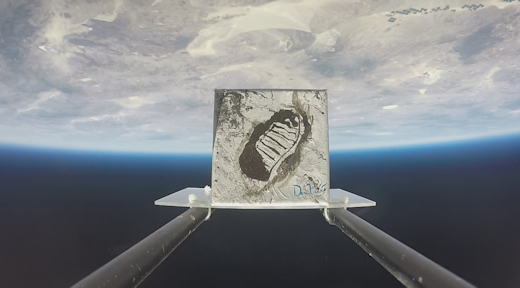
You can have it for $99.95. The students are selling these commemorative Apollo 11 paintings to support their cosmic ray ballooning program. Each signed 4x4inch canvas panel comes with a greeting card showing the painting in flight and telling the story of its journey to the edge of space and back. This makes a great gift for any enthusiast of space exploration.
Far Out Gifts: Earth to Sky Store
All sales support hands-on STEM education
Realtime Aurora Photo Gallery
Free: Spaceweather.com Newsletter
Realtime Noctilucent Cloud Photo Gallery
Free: Spaceweather.com Newsletter