NASA TO SEND HELICOPTER TO ANOTHER PLANET: This could be NASA's most exciting mission--ever. The space agency announced yesterday that they will send a heliocopter to Titan, Saturn's largest moon. Titan is in many ways more like Earth than any other place in the solar system. It has rivers and lakes, a thick atmosphere, and organic compounds that could support the genesis of life. The quad-chopper, named "Dragonfly," will fly between sites on interest, covering more than twice the distance of every Mars rover combined. Get the full story from nasa.gov.
RARE SUNSET ECLIPSE OF THE SUN: Residents of Chile and Argentina are about to witness a rare total eclipse of the sun. On July 2, 2019, the new Moon will pass across the solar disk, creating a black hole in the sky just before sunset in the two South American countries. This animated map, created by space artist Larry Koehn, includes a detailed local timetable of events:
The path of totality cuts across ESO's La Silla Observatory in Chile and barely misses the center of Buenos Aires in Argentina. The Moon's elongated sunset shadow will swallow observers for 1 to 2 minutes depending on their exact location.
Outside the path of totality, the eclipse is partial with significant coverage in large cities such as Santiago, Chile (93%); Montevideo, Uruguay (94%); La Paz, Bolivia (63%); and Lima, Peru (54%). During the partial phase of the eclipse, the sun looks like a crescent, and it casts crescent-shaped shadows on the ground. South Americans should look for them underneath the canopies of leafy trees. Using safe eclipse glasses, it is possible to view the crescent sun directly.
The sun and Moon align for an eclipse once or twice every year. Aligning directly over a major observatory, however, is very rare. This video shows what the eclipse will look like over La Silla:
La Silla is home to some of the world's biggest telescopes and many skilled observers. Observatory staff will host more than a thousand members of the public in a viewing party among the telescope domes. A live high-definition webcast of the eclipse will be available on ESO's website and on ESO's Youtube Channel. The action begins on Tuesday, July 2nd. Stay tuned!
More live webcasts: from Chile; from Argentina; from La Silla.
Realtime Solar Eclipse Photo Gallery
Free: Spaceweather.com Newsletter
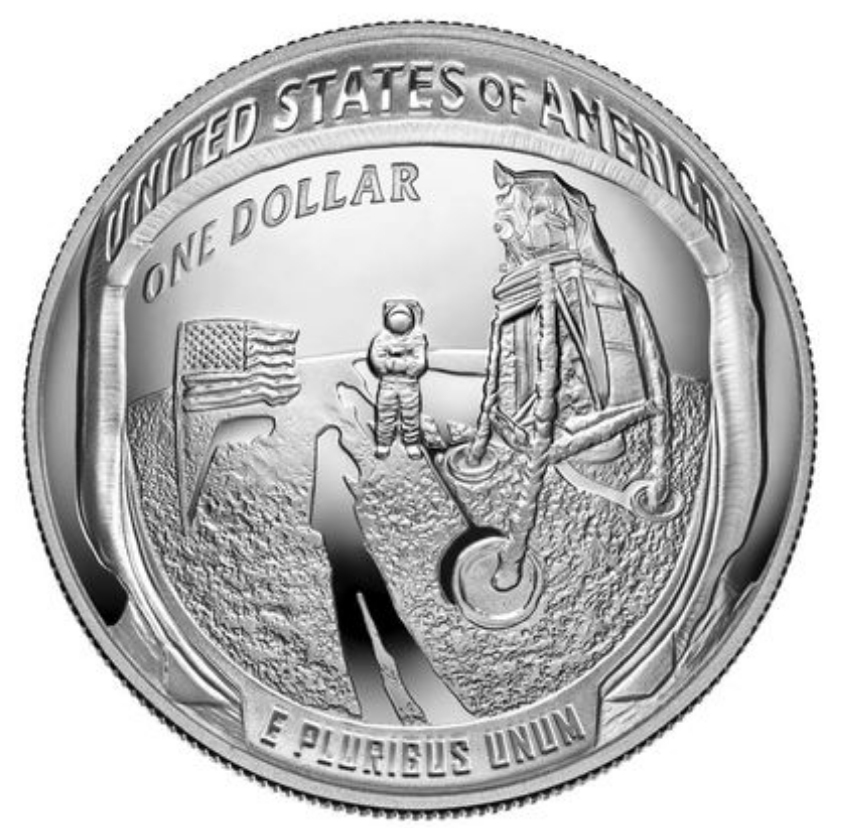
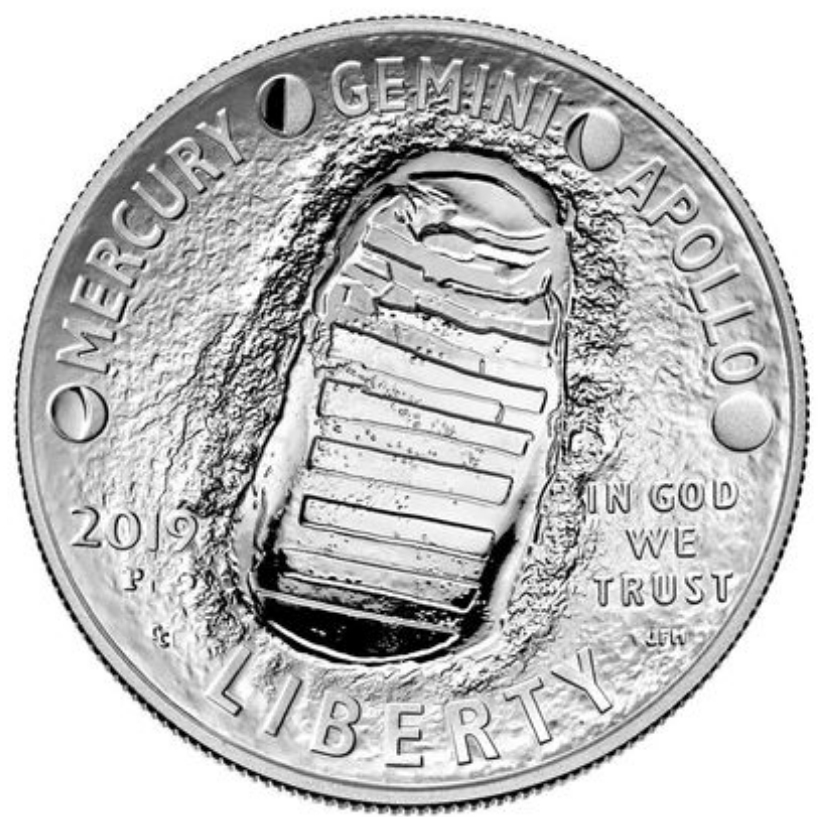
APOLLO 11 PROOF SILVER DOLLAR To celebrate the 50th anniversary of the Apollo 11 Moon landing, the United States Mint has created a commemorative 2019 Proof Silver Dollar. We decided to celebrate even more by flying the coins to the edge of space. On June 23rd, the students of Earth to Sky Calculus launched this 99.9% silver dollar 102,034 feet above Earth's surface:

You can have it for $197.95. The students are selling the coins to support their cosmic ray ballooning program. The silver dollar is curved and reproduces the helmet of astronaut Buzz Aldrin. Reflected in Buzz's visor are Neil Armstrong, the United States flag, and the lunar lander. The opposite side of the coin shows Neil's iconic footprint on the Moon. Each of these coins comes with a greeting card showing the item in flight and a certificate of authenticity.
Far Out Gifts: Earth to Sky Store
All sales support hands-on STEM education
A NEW SPACE WEATHER SPACECRAFT: There's a new spacecraft in Earth orbit, and it's going where few spacecraft have gone before. Launched by SpaceX on June 25th, DSX is on a mission to explore the gap between the two Van Allen Radiation Belts. Last night, DSX passed over the home of amateur astronomer Scott Tilley in British Columbia, and he received a loud S-band radio transmission:
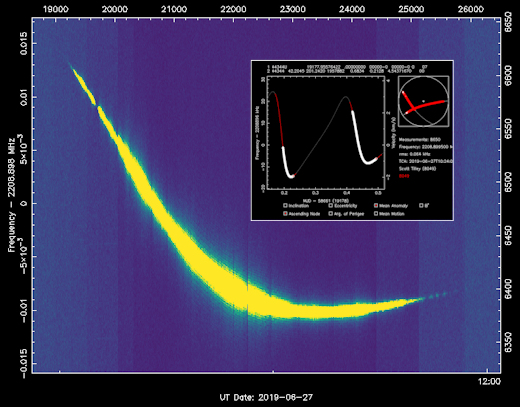
"A great signal from a spacecraft 8000 km away!" says Tilley, who is famous for tracking and finding satellites using their radio transmissions. "Based on the timing and Doppler shift of the signal, DSX appears to have reached its proper orbit."
DSX is now circling Earth in a region once thought to be safe--but maybe not. Earth is surrounded by two radiation belts seething with energetic particles. The gap between those belts, called the "slot region," is usually empty. In 2013, NASA spacecraft discovered that's not always so. During some solar storms, it can flood with radiation from the adjacent belts, sometimes forming a third belt. How much the slot region changes, and how quickly, remains uncertain.
"There haven't been too many measurements to tell us how bad things get in the slot region," says Michael Xapsos of NASA's Goddard Space Flight Center. "That's why we're going there."
DSX will investigate conditions in the slot region using a variety of onboard sensors and experiments. NASA's tagalong SET experiment, for instance, will expose sample circuit boards to the environment, monitoring accumulated damage to see what might happen to computers on future spacecraft. Another experiment, WPIx, is even more interesting. It will study wave-particle interactions to discover if VLF (very low frequency) radio signals transmitted from Earth could be used to control or eliminate particles in the slot region.
Realtime Space Weather Photo Gallery
Free: Spaceweather.com Newsletter
Realtime Aurora Photo Gallery
Free: Spaceweather.com Newsletter
Realtime Noctilucent Cloud Photo Gallery
Free: Spaceweather.com Newsletter