SLIGHT CHANCE OF STORMS: A stream of solar wind is expected to reach Earth on July 9-10, bringing with it a slight chance of G1-class geomagnetic storms. High-latitude sky watchers should be alert for auroras, especially in the southern hemisphere where winter darkness favors visibility. Aurora alerts: SMS Text.

ANOTHER SUNSPOT FROM THE NEXT SOLAR CYCLE: Solar Cycle 25 is coming to life. For the second time this month, a sunspot from the next solar cycle has emerged in the sun's southern hemisphere. Numbered "AR2744", it is inset in this magnetic map of the sun's surface from NASA's Solar Dynamics Observatory:
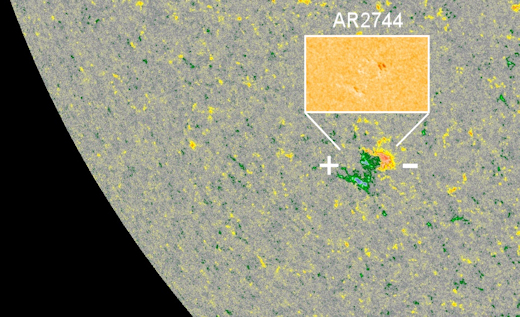
How do we know this sunspot belongs to Solar Cycle 25? Its magnetic polarity tells us so. Southern sunspots from old Solar Cycle 24 have a -/+ polarity. This sunspot is the opposite: +/-. According to Hale's Law, sunspots switch polarities from one solar cycle to the next. AR2744 is therefore a member of Solar Cycle 25.
Solar cycles always mix together at their boundaries. Right now we are experiencing the tail end of decaying Solar Cycle 24. AR2744 shows that we are simultaneously experiencing the first stirrings of Solar Cycle 25. The transition between Solar Cycle 24 and Solar Cycle 25 is underway.
Shortlived "ephemeral sunspots" belonging to Solar Cycle 25 have already been reported on Dec. 20, 2016; April 8, 2018; Nov. 17, 2018; May 28, 2019 and July 1, 2019. Today's sunspot is more important than those earlier examples because it has lasted long enough to receive a numerical designation: AR2744. Record-keepers will likely mark this as the first official sunspot of Solar Cycle 25.
This development does not mean Solar Minimum is finished. On the contrary, low solar activity will probably continue for at least another year as Solar Cycle 24 decays and Solar Cycle 25 slowly sputters to life. AR2744 is an important sign, however, that the next solar cycle is approaching.
Realtime Space Weather Photo Gallery
Free: Spaceweather.com Newsletter
A DRONE'S VIEW OF THE TOTAL ECLIPSE: On July 2, 2019, astronomer Matt Robinson was in the Elqui Valley in Chile when the Moon passed directly across the face of the sun. Most onlookers photographed the eclipse using cameras on tripods. Robinson, however, flew his optics through the air. "This is a drone video," he says.
"The eclipse experience was my first and absolutely incredible!" says Robinson. "A thin silvery light covered the whole landscape and the temperature dropped considerably. The animals thought it was night time. As totality hit I couldn't believe what I was seeing! It looked like a huge portal to another dimension."
Solar Eclipse Photo Gallery
Free: Spaceweather.com Newsletter
MILLENNIUM FALCON IN THE STRATOSPHERE: It's the ship that made the Kessel Run in less than twelve parsecs! On July 6, 2019, the students of Earth to Sky Calculus launched the Millennium Falcon to the stratosphere. Riding onboard a high-altitude cosmic ray balloon, the laser-etched crystal spaceship traveled 103,018 feet above Earth's surface:
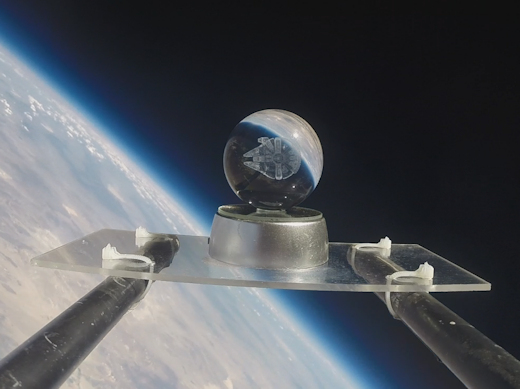
You can have it for $119.95. The students are selling the Falcon to fund the Earth to Sky ballooning program. Each one comes with a greeting card showing the Falcon in flight and telling the story of its journey to the edge of space. Also included: an LED-illuminated stand. This creates a colorful visual effect and allows the Falcon to be used as a far-out night light.
Far Out Gifts: Earth to Sky Store
All sales support hands-on STEM education
Realtime Aurora Photo Gallery
Free: Spaceweather.com Newsletter
Realtime Noctilucent Cloud Photo Gallery
Free: Spaceweather.com Newsletter