SPACEWEATHER PHOTO GALLERY OUTAGE: Today, our realtime photo gallery server experienced a catastrophic hardware failure. The gallery contains years of unique photos, preserving a record of noctilucent clouds, auroras, and many other phenomena. The good news: Most if not all of those images have been preserved. The bad news: Fixing the problem will take some days as we carefully migrate the gallery to a more capable platform, modernizing code in the process. In the meantime, if you have an image to share with readers of Spaceweather.com, please email it directly to Dr. Tony Phillips. Don't forget to include the time and location of the image + commentary about what you saw.
WHAT'S UP IN THE MESOSPHERE? Last month, people around the world who had never heard of noctilucent clouds (NLCs) suddenly found themselves seeing NLCs on a regular basis. The electric-blue clouds rippled to record low latitudes, with sightings as far south as New Mexico and southern California. As July unfolds, however, the clouds have subsided.
What's happening up there? Lynn Harvey of the Laboratory for Atmospheric and Space Physics at the University of Colorado has taken a look at NASA satellite data, and here are her findings:

"At mid-latitudes, the mesosphere remains quite wet, but temperatures have been rising this month," says Harvey. "The rising temperatures could be suppressing the formation of NLCs."
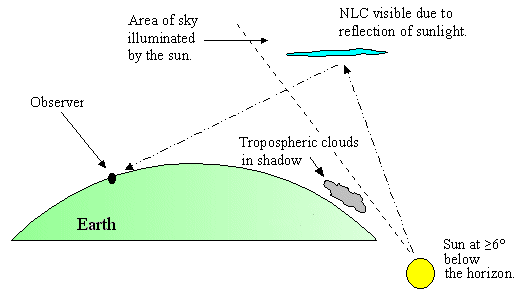
Noctilucent clouds form when summertime wisps of water vapor rise to the edge of space, frosting specks of meteor smoke. When sunlight hits those tiny ice crystals, they glow electric-blue. Moisture boosts NLCs, but warmth destroys them. The recent uptick in temperature may be responsible for their retreat.
Although fewer people are seeing NLCs as July unfolds, the season is not over. NASA's AIM satellite continues to see a bright ring of electric-blue circling Earth's north pole, and only two days ago Bertrand Kulik witnessed a display of NLCs over Paris, France:

"Noctilucent clouds were visible over the Eiffel tower around 4 o'clock in the morning on July 10th," says Kulik. "It was not a strong display, but still very nice."
The northern summer season for noctilucent clouds typically continues through mid-August. Observing tips: Look west 30 to 60 minutes after sunset (or before sunrise) when the sun is just below the horizon. If you see luminous blue-white tendrils spreading across the sky, you may have spotted a noctilucent cloud.
Realtime Noctilucent Cloud Photo Gallery
Note: The photo gallery is temporarily unavailable
MILLENNIUM FALCON IN THE STRATOSPHERE: It's the ship that made the Kessel Run in less than twelve parsecs! On July 6, 2019, the students of Earth to Sky Calculus launched the Millennium Falcon to the stratosphere. Riding onboard a high-altitude cosmic ray balloon, the laser-etched crystal spaceship traveled 103,018 feet above Earth's surface:

You can have it for $119.95. The students are selling the Falcon to fund the Earth to Sky ballooning program. Each one comes with a greeting card showing the Falcon in flight and telling the story of its journey to the edge of space. Also included: an LED-illuminated stand. This creates a colorful visual effect and allows the Falcon to be used as a far-out night light.
Far Out Gifts: Earth to Sky Store
All sales support hands-on STEM education
AURORAS SEEN FROM THE STRATOSPHERE: A solar wind stream hit Earth on July 9th and 10th. The view from the stratosphere was sublime. While the gaseous material from the sun was buffeting our planet's magnetic field, Ian Griffin photographed an outburst of auroras from NASA's Stratospheric Observatory for Infrared Astronomy (SOFIA), a specially modified Boeing 747 aircraft that can skim the bottom of the stratosphere for crystal-clear views of the heavens:

"It was the best aurora adventure ever," says Griffin. "I was lucky to be a guest on board SOFIA, which is presently flying out of Christchurch, New Zealand, during its annual trip to view the southern sky during austral winter. Last night, for almost the whole flight, the sky to the south was bathed by an amazing auroral display! Some of the forms were truly astonishing, and at times the aurora in the window was so bright it mesmerized all on board."

The solar wind stream that caused the display came from a northern hole in the sun's atmosphere. Normally, such a stream might not be enough to spark spectacular auroras. This time, however, Earth's magnetosphere was already 'charged up' by an unexpected CME impact on July 8th. The arrival of the solar wind stream only one day later tipped the magnetosphere into a state of glowing G1-class storminess. Aurora alerts: SMS Text.


Realtime Aurora Photo Gallery
Free: Spaceweather.com Newsletter
Realtime Space Weather Photo Gallery
Free: Spaceweather.com Newsletter