SPACEWEATHER PHOTO GALLERY OUTAGE: Yesterday, our realtime photo gallery server experienced a catastrophic hardware failure. The gallery contains years of unique photos, preserving a record of noctilucent clouds, auroras, and many other phenomena. The good news: Most if not all of those images have been preserved. The bad news: Fixing the problem will take some days as we carefully migrate the gallery to a more capable platform, modernizing code in the process. In the meantime, if you have an image to share with readers of Spaceweather.com, please email it directly to Dr. Tony Phillips. Don't forget to include the time and location of the image + commentary about what you saw.
MANHATTANHENGE: Twice a year at sunset, the concrete canyons of New York City turn into an urban simulacrum of an ancient astronomical observatory. Instead of Stonehenge, New York has Manhattanhenge. "Here is a photo I took at sunset on July 12th," reports Jim Haklar.
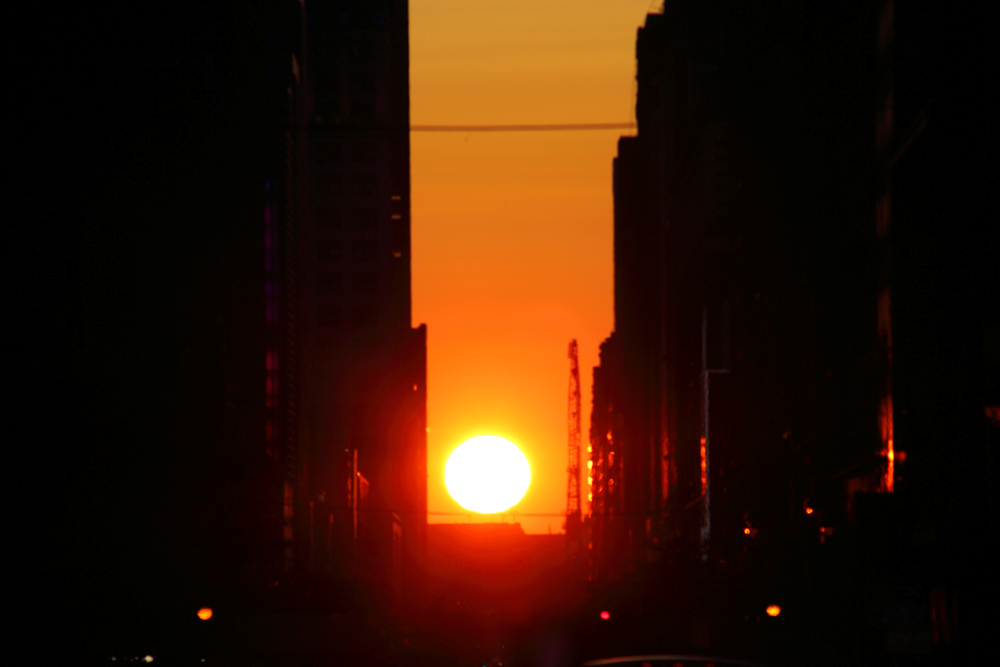
"I was one of many people who ventured out into the middle of 34th Street during a red light to take pictures," says Haklar. "The weather was perfect."
If Manhattan streets were truly east-west, this phenomenon would occur on the dates of the equinoxes. Instead, the street grid for most of Manhattan is rotated 29° clockwise from east-west. The sun therefore beams down the streets of the borough on dates which are offset: May 29-30 and July 12-13.
It's happening again tonight. Residents of the borough should be alert for another Manhattanhenge moment on July 13th at 8:21 pm local time.
WHAT'S UP IN THE MESOSPHERE? Last month, people around the world who had never heard of noctilucent clouds (NLCs) suddenly found themselves seeing NLCs on a regular basis. The electric-blue clouds rippled to record low latitudes, with sightings as far south as New Mexico and southern California. As July unfolds, however, the clouds have subsided.
What's happening up there? Lynn Harvey of the Laboratory for Atmospheric and Space Physics at the University of Colorado has taken a look at NASA satellite data, and here are her findings:

"At mid-latitudes, the mesosphere remains quite wet, but temperatures have been rising this month," says Harvey. "The rising temperatures could be suppressing the formation of NLCs."
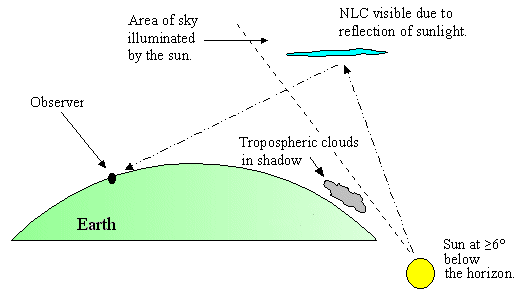
Noctilucent clouds form when summertime wisps of water vapor rise to the edge of space, frosting specks of meteor smoke. When sunlight hits those tiny ice crystals, they glow electric-blue. Moisture boosts NLCs, but warmth destroys them. The recent uptick in temperature may be responsible for their retreat.
Although fewer people are seeing NLCs as July unfolds, the season is not over. NASA's AIM satellite continues to see a bright ring of electric-blue circling Earth's north pole, and only two days ago Bertrand Kulik witnessed a display of NLCs over Paris, France:
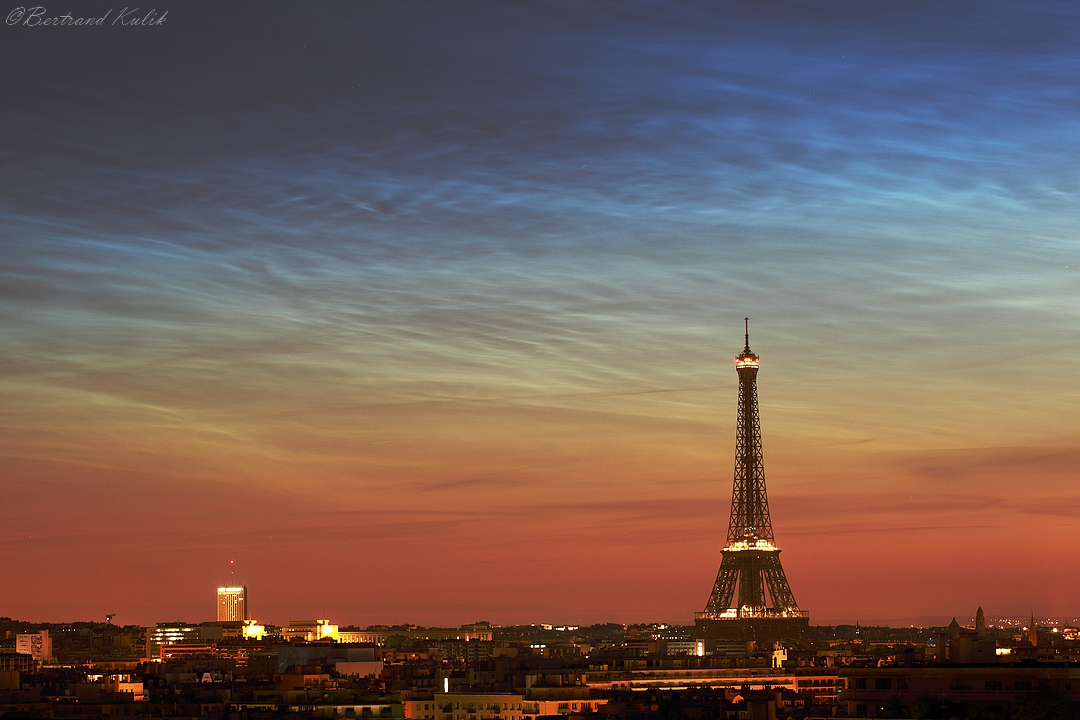
"Noctilucent clouds were visible over the Eiffel tower around 4 o'clock in the morning on July 10th," says Kulik. "It was not a strong display, but still very nice."
The northern summer season for noctilucent clouds typically continues through mid-August. Observing tips: Look west 30 to 60 minutes after sunset (or before sunrise) when the sun is just below the horizon. If you see luminous blue-white tendrils spreading across the sky, you may have spotted a noctilucent cloud.
Realtime Noctilucent Cloud Photo Gallery
Note: The photo gallery is temporarily unavailable
MILLENNIUM FALCON IN THE STRATOSPHERE: This artwork has touched space. Hand-painted by artist Dana Wilcher, a student member of Earth to Sky Calculus, "One Small Step" flew to the stratosphere on June 23, 2019, onboard a cosmic ray balloon. It shows Neil Armstrong's iconic footprint on the Moon made during the Apollo 11 mission 50 years ago:
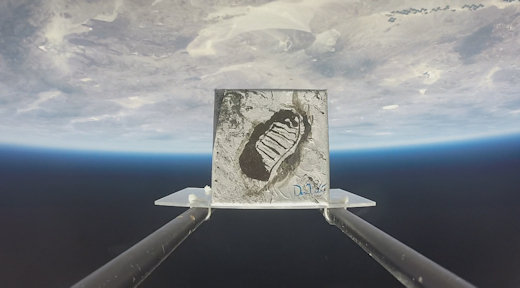
You can have it for $99.95. The students are selling these commemorative Apollo 11 paintings to celebrate the 50th anniversary of the Moon landing and to support their cosmic ray ballooning program. Each signed 4x4inch canvas panel comes with a greeting card showing the painting in flight and telling the story of its journey to the edge of space and back. This makes a great gift for any enthusiast of space exploration.
Far Out Gifts: Earth to Sky Store
All sales support hands-on STEM education
Realtime Space Weather Photo Gallery
Free: Spaceweather.com Newsletter