THE NEXT SOLAR WIND STREAM: A hole in the sun's atmosphere is facing Earth and it is spewing a stream of solar wind in our direction. Estimated time of arrival: July 19-20. Minor geomagnetic activity and high latitude auroras are possible when the gaseous material arrives. Aurora alerts: SMS Text

COSMIC RAY UPDATE--NEW RESULTS FROM THE MOON: Note to astronauts: 2019 is not a good year to fly into deep space. In fact, it's shaping up to be one of the worst of the Space Age. One of the deepest Solar Minima of the past century is underway now. As the sun's magnetic field weakens, cosmic rays from deep space are flooding into the solar system, posing potential health risks to space travelers.
NASA is monitoring the situation with a radiation sensor in lunar orbit. The Cosmic Ray Telescope for the Effects of Radiation (CRaTER) has been circling the Moon on NASA's Lunar Reconnaissance Orbiter spacecraft since 2009. Researchers have just published a paper in the journal Space Weather describing CRaTER's latest findings.

Above: An artist's concept of Lunar Reconnaissance Orbiter
"The overall decrease in solar activity in this period has led to an increased flux of energetic particles, to levels that are approaching those observed during the previous solar minimum in 2009/2010, which was the deepest minimum of the Space Age," write the authors, led by Cary Zeitlin of NASA's Johnson Space Flight Center. "The data have implications for human exploration of deep space."
This always happens during Solar Minimum. As solar activity goes down, cosmic rays go up. The last two Solar Minima have been unusually deep, leading to high cosmic ray fluxes in 2008-2010 and again in 2018-2019. These are the worst years since humans first left Earth in the 1960s.
The latest data from CRaTER show cosmic ray fluxes almost doubling since 2015:

Above: Since 2015, the flux of cosmic rays at the Moon has nearly doubled. Another plot shows the complete CRaTER record starting in 2010.

"It's a bit counterintuitive," says one of the authors, Nathan Schwadron, a space physicist at the University of New Hampshire. "Solar Minimum may actually be more dangerous than Solar Maximum."
In their paper, Zeitlin, Schwadron and co-authors describe an interesting experiment by NASA that highlights the relative peril of solar flares vs. cosmic rays. In 2011, NASA launched the Curiosity rover to Mars. Inside its spacecraft, the rover was protected by about as much shielding (20 gm/cm^2) as a human astronaut would have. A radiation sensor tucked inside kept track of Curiosity's exposure.
The results were surprising. During the 9-month journey to Mars, radiation from solar flares (including the strongest flare of the previous solar cycle) accounted for only about 5% of Curiosity's total dose. The remaining 95% came from cosmic rays.
As 2019 unfolds, Solar Minimum is still deepening. Cosmic rays haven't quite broken the Space Age record set in 2009-2010, but they're getting close, only percentage points from the highest values CRaTER has ever recorded.
"No one can predict what will happen next," says Schwadron. "However, the situation speaks for itself. We have to be prepared for strong cosmic rays."
A longer and sharable version of this story may be found here.
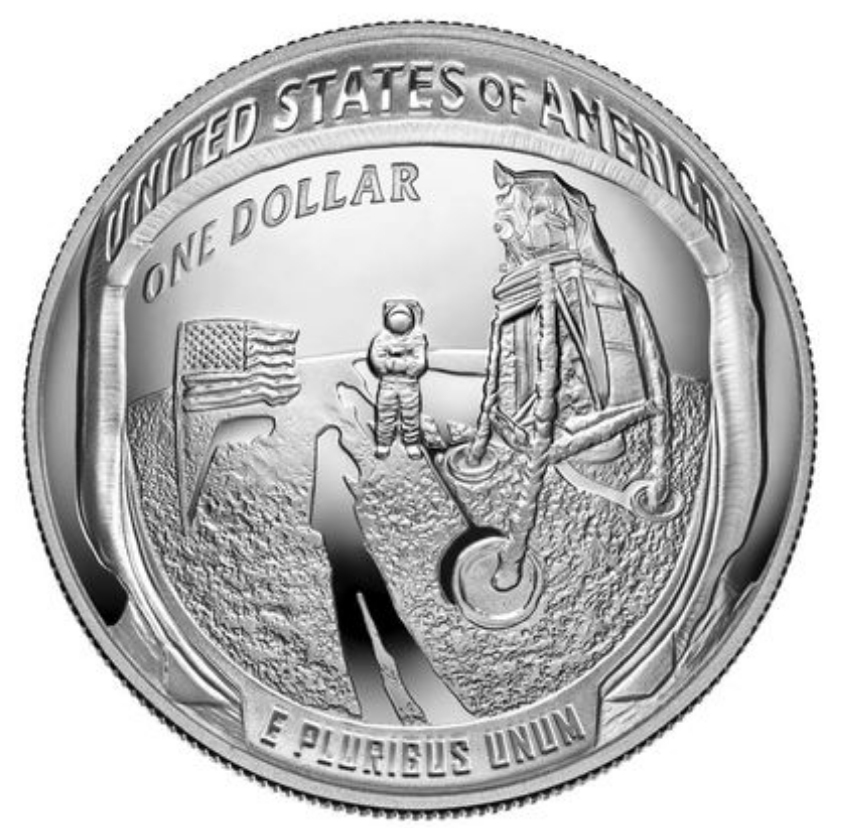
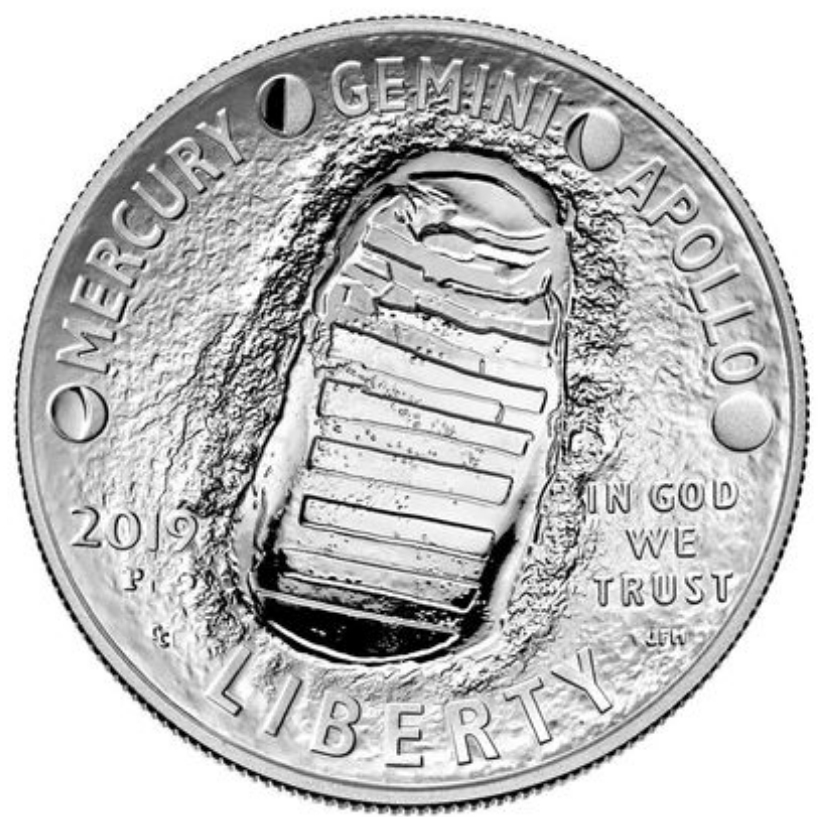
APOLLO 11 ANNIVERSARY SILVER DOLLAR: The 50th anniversary of the Apollo 11 Moon landing is only days away. To mark the occasion, the students of Earth to Sky Calculus have been flying commemorative Apollo 11 silver dollars to the stratosphere and selling them to support their cosmic ray balloon program. Buy one this week and we will fly it to the stratosphere on July 20, 2019, exactly 50 years after Neil Armstrong set foot on the Moon.

We plan to fly only a small number of these coins to the edge of space on July 20, 2019. Reserve yours for $197.95.
Created by the US Mint, the proof-quality 99% silver dollar is curved and reproduces the helmet of astronaut Buzz Aldrin. Reflected in Buzz's visor are Neil Armstrong, the United States flag, and the lunar lander. The opposite side of the coin shows Neil's iconic footprint on the Moon. Each coin comes with a greeting card showing the item in flight on the 50th anniversary of the Moon landing and a certificate of authenticity.
Far Out Gifts: Earth to Sky Store
All sales support hands-on STEM education
PARTIAL ECLIPSE OF THE MOON: Last night, when the Moon rose over Alange Castle in southern Spain, photographer Juan Manuel Pérez Rayego noticed a shadow falling across the lunar disk. It was a partial eclipse:

On July 16th, the full Moon passed through the shadow of Earth, plunging as much as 65% of the lunar disk into darkness. Only a small amount of the Moon was shadowed when Juan Manuel Pérez Rayego saw it, "but it was very beautiful," he says. Sky watchers in Africa, Europe, Asia, Australia and South America saw at least part of the 3 hour eclipse. Only North Americans were excluded.
The next significant lunar eclipse won't happen until May 2021, so if you missed this one ... Mark your calendar.
more images: from Peter Rosén of Stockholm, Sweden; from Heiko Ulbricht of Saxony, Germany; from Maximilian Teodorescu of Magurele, Romania; from P-M Hedén of Vallentuna, Sweden; from Z A Hartono of Kuala Lumpur, Malaysia; from Anders Jangö of Nynäshamn, Sweden.


submitting Eclipse photos: Spaceweather.com's Realtime Photo Gallery is temporarily down following a hardware failure on our image server. Repairs are underway. Meanwhile, if you have a picture of the eclipse, please email it directly to Dr. Tony Phillips. Please don't forget to mention your full name, location, time, and impressions of the event.
Realtime Eclipse Photo Gallery
Note: The photo gallery is temporarily unavailable
Realtime Space Weather Photo Gallery
Free: Spaceweather.com Newsletter