COSMIC RAY UPDATE: Note to astronauts: 2019 is not a good year to fly into deep space. In fact, it's shaping up to be one of the worst of the Space Age. According to a new paper just published in the journal Space Weather, cosmic rays are flooding into the solar system as the sun's magnetic field weakens, posing a health risk to space travelers. Full story.
THE CRATERS OF APOLLO 11: 50 years ago, astronauts Neil Armstrong, Buzz Aldrin, and Michael Collins were hurtling toward the Sea of Tranquility, preparing themselves for the first Moon landing. With memories of Apollo 11 on his mind, Australian amateur astronomer Dennis Simmons turned his telescope toward their landing site last night, and this is what he saw:

"I managed to pinpoint and image the craterlets Armstrong, Aldrin and Collins located in Mare Tranquillitatis, using my 201mm diameter telescope from my back yard in Brisbane," says Simmons.
These three craters were named after the astronauts following the successful Apollo 11 mission. They're all small, with diameters of 4.6 kilometers (Armstrong), 3.4 km (Aldrin) and 2.4 km (Collins). Amateur astronomers often use the craters as guides to find the landing site itself by "triangulating" it with, say, Armstrong and Aldrin.
"Was it really 50 years ago when I watched this stupendous achievement of my neighbor's B&W TV in the early hours of the morning…?" marvels Simmons. "What a moment in history."
NOCTILUCENT CLOUD SIGHTINGS: As the summer solstice recedes, darkness is slowly returning to far-northern skies--just enough to see noctilucent clouds (NLCs). P-M Hedén photographed this display over Vallentuna, Sweden, on July 18th:

"The NLCs were really strong ," says Hedén. "I went to a local lake with totally calm water and could capture the strings of NLC as reflections in the water. NLCs are peaking here in the middle of Sweden!"
NLCs are Earth's highest clouds. They form every year in June and July when wisps of summertime water vapor rise to the top of Earth's atmosphere. Molecules of H2O adhere to specks of meteor smoke, forming ice crystals ~83 km high. When sunbeams hit those crystals, they glow electric-blue.
2019 has been a remarkable year for NLCs, with sightings as far south as New Mexico and southern California. The retreat of Arctic twilight is now allowing Scandinavian observers a good view as well.
News! NASA's AIM spacecraft, launched in 2007 to study noctilucent clouds (NLCs), suffered a minor anomaly this week. Members of the science team are optimistic that normal operations will be restored soon. Meanwhile, there may be a gap in Spaceweather.com's "Daily Daisy" coverage of NLCs around the north pole. Aurora alerts: SMS Text

Realtime Noctilucent Cloud Photo Gallery
Note: Spaceweather.com Newsletter
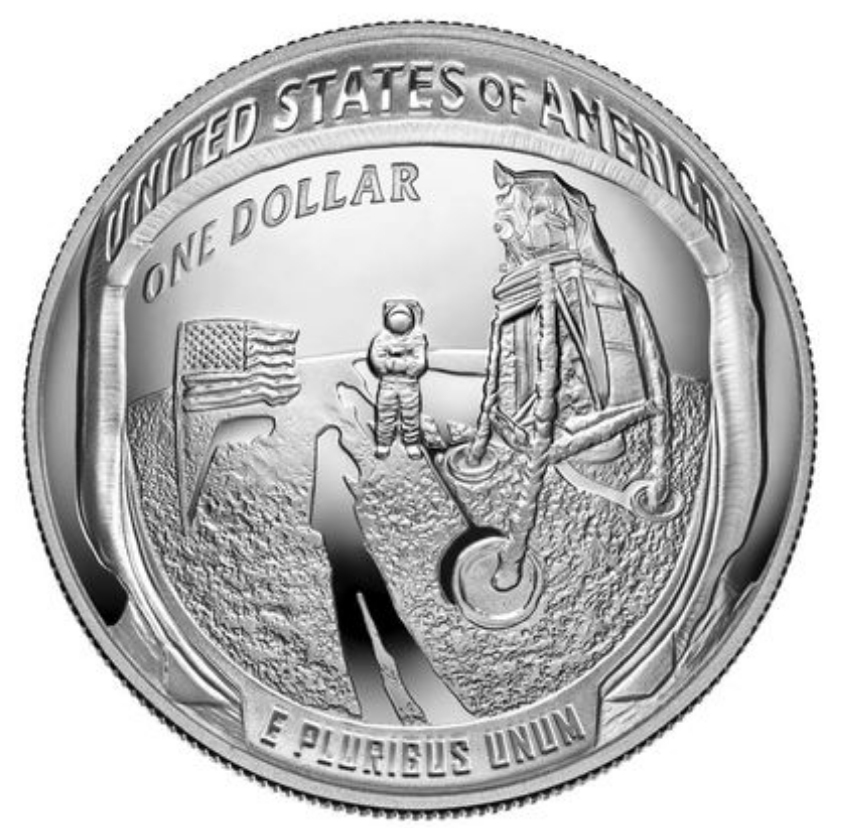
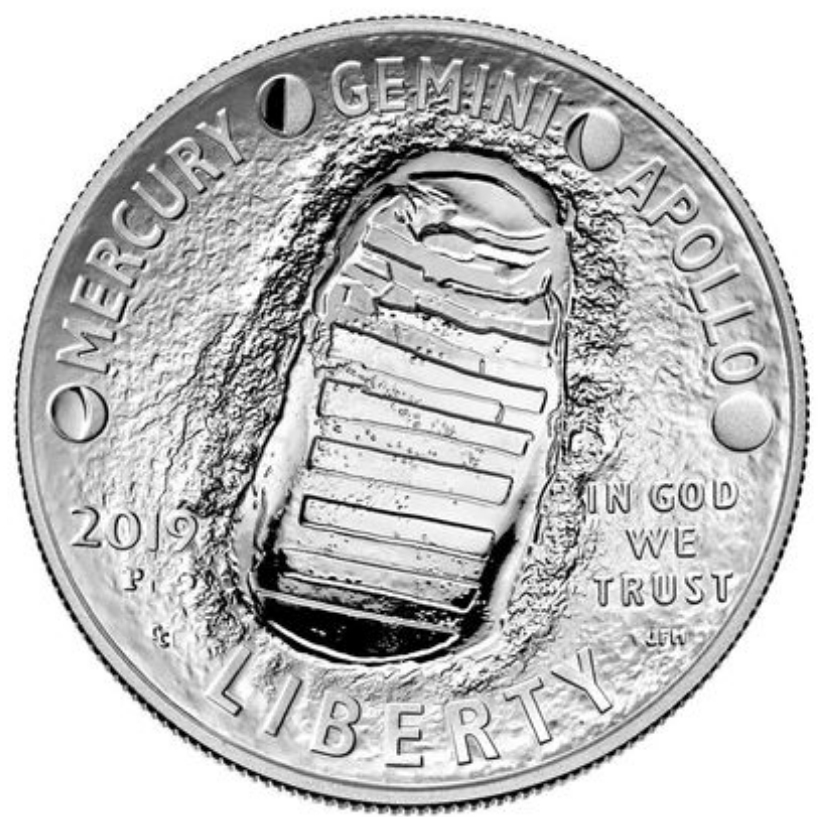
APOLLO 11 ANNIVERSARY SILVER DOLLAR: The 50th anniversary of the Apollo 11 Moon landing is only one day away. To mark the occasion, the students of Earth to Sky Calculus have been flying commemorative Apollo 11 silver dollars to the stratosphere and selling them to support their cosmic ray balloon program. Buy one this week and we will fly it to the stratosphere on July 20, 2019, exactly 50 years after Neil Armstrong set foot on the Moon.

We plan to fly only a small number of these coins to the edge of space on July 20, 2019. Reserve yours for $197.95.
Created by the US Mint, the proof-quality 99% silver dollar is curved and reproduces the helmet of astronaut Buzz Aldrin. Reflected in Buzz's visor are Neil Armstrong, the United States flag, and the lunar lander. The opposite side of the coin shows Neil's iconic footprint on the Moon. Each coin comes with a greeting card showing the item in flight on the 50th anniversary of the Moon landing and a certificate of authenticity.
Far Out Gifts: Earth to Sky Store
All sales support hands-on STEM education
Realtime Space Weather Photo Gallery
Free: Spaceweather.com Newsletter