SOLAR MINIMUM CONDITIONS ARE IN EFFECT: The sun has been blank (no sunspots) for 54 of the past 60 days. This is a sign that Solar Minimum is underway. During this phase of the solar cycle, sunspots and solar flares are rare, but we get plenty of holes in the sun's atmosphere and lots of extra cosmic rays. Solar Minimum conditions are expected to continue mostly uninterrupted for the remainder of 2019. Aurora alerts: SMS Text.
A GREEN FLASH AT SUNSET: For seaside photographers, nothing beats a green flash--that sudden pulse of verdant light at sunset as the sun vanishes beneath the ocean waves. Earlier this week, James W. Young was vacationing in Seaside, Oregon, so naturally he tried to catch the elusive flash. "Got it!" he says.

"At sunset from Ecola Park on the north coast of Oregon, a substantial green flash developed as the sun set into the Pacific Ocean," says Young. "I caught it just beyond the Tillamook Rock Lighthouse using a telephoto lens and my Canon 1Dx Mark II camera."
The Oregon coast is a good place to find green flashes at this time of year. Warm summer air overlying cold ocean water creates a temperature gradient in the coastal atmosphere. This gradient can have a magnifying effect on the usual prismatic action of the atmosphere, amplifying the green component of the sun's rays into an eye-catching flash.
EARLY PERSEID METEORS (WITH SOUND): Every summer, sky watchers around the northern hemisphere look forward to the Perseid meteor shower--the only major meteor shower of the year that occurs on warm, comfortable nights. News flash: It's begun. Frankie Lucena of Cabo Rojo, Puerto Rico, video recorded two Perseid meteors on July 22nd:
Turn up the volume and play it again. "The audio ping was obtained using a 500 foot long telephone wire connected to my PC sound card," explains Lucena. "This setup allows me to capture very low frequency radio emissions, which are caused by the temporary ionization of the atmosphere in a meteor's trail."
Perseid meteors are dusty debris from giant Comet Swift-Tuttle. Every year in late July and early August, Earth passes through the comet's debris zone, causing meteoroids to strike the atmosphere at speeds exceeding 133,000 mph, disintegrating in luminous streaks.
The Perseids Lucena saw are just the first of many to come. The shower's peak is expected on August 12th and 13th, when Earth passes through the densest part of the debris stream. Dozens of meteors per hour streaking across northern skies make those dates a great time to camp out under the stars.
Realtime Space Weather Photo Gallery
Free: Spaceweather.com Newsletter
STERLING SILVER MOONSTONE PENDANT: Are you looking for a far-out gift? Nothing says "I love you" like a moonstone from the edge of space. On Jan 27th, the students of Earth to Sky Calculus flew this moonstone wrapped in a hand-crafted sterling silver Celtic love knot 35.1 km (115,158 feet) above Earth's surface:
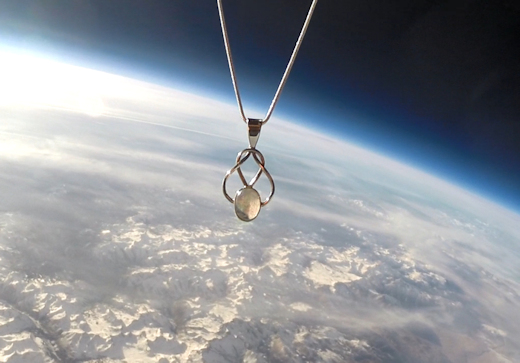
You can have it for $179.95. The students are selling these pendants to support their cosmic ray ballooning program. Each one comes with a greeting card showing the item in flight and telling the story of its journey to the edge of space. All sales support the Earth to Sky Calculus cosmic ray ballooning program and hands-on STEM research.
Far Out Gifts: Earth to Sky Store
All sales support hands-on STEM education