THE PHOTO GALLERY IS BACK: Spaceweather.com's Realtime Photo Gallery is (mostly) back following a hardware failure two weeks ago. All 123,000 images in the gallery were rescued, and we're ready for more. Submit your images here. Note that some minor bugs are still being squashed. The work should be complete by the end of this week. Thanks for your patience!
DEBRIS FROM A GIANT COMET: Earth is entering a stream of debris from giant Comet Swift-Tuttle, source of the annual Perseid meteor shower. Forecasters expect the shower to peak on Aug. 12-13 with many fireballs slicing through the light of a nearly full Moon. It's not even August yet, but NASA's network of all-sky cameras is already detecting a few Perseid fireballs every night over the USA.
Comet Swift-Tuttle has a huge nucleus--about 26 km in diameter. Most other comets are much smaller, with nuclei only a few kilometers across. As a result, Comet Swift-Tuttle produces a large number of meteoroids, many of which are hefty enough to produce fireballs.
Indeed, a 6-year study by NASA's Meteoroid Environment Office found that the Perseids produce more fireballs than any other annual shower. Check out their data.
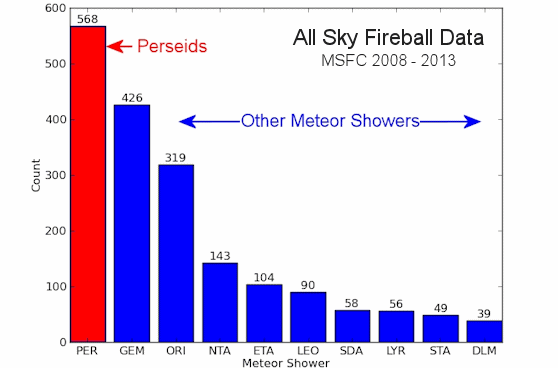
During the Perseid meteor shower, which lasts for weeks, comet debris particles a few cm wide hit the atmosphere with an average speed of 59.6 km/s (133,350 mph). The average magnitude of the resulting fireballs is -3.7, about as bright as Venus. More fireballs are in the offing as Earth moves deeper into the comet's debris stream. Generally speaking, the best time to look is during the dark hours before sunrise when the shower's radiant is high in the sky. [sky map]

Realtime Space Weather Photo Gallery
Free: Spaceweather.com Newsletter
HOLES IN THE SUN'S ATMOSPHERE: Earth is about to be strobed by three streams of solar wind--each flowing from a hole the sun's atmosphere. NASA's Solar Dynamics Observatory photographed the gaseous spigots on July 29th:
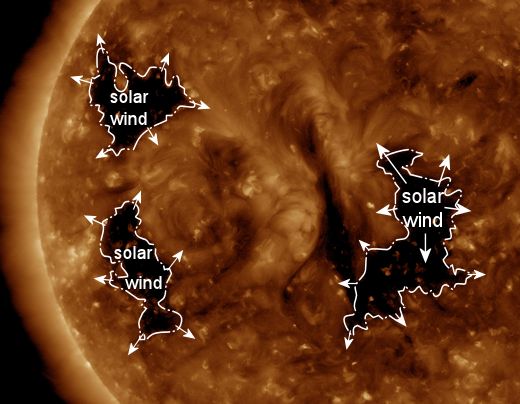
These are "coronal holes"--places where the sun's magnetic field peels back and allows solar wind to escape. Coronal holes look dark in extreme ultraviolet images of the sun because glowing-hot plasma normally contained there is missing.
The first of the streams is expected to arrive on Aug 1st, followed by two more in rapid succession on Aug. 4th. Polar geomagnetic unrest and possibly some minor magnetic storms are possible on those dates. High-latitude sky watchers should be alert for auroras, especially in the southern hemisphere where winter darkness favors visibility. Aurora alerts: SMS Text.
Realtime Aurora Photo Gallery
Free: Spaceweather.com Newsletter
THE GALAXY GLOBE: Once a week, the students of Earth to Sky Calculus launch a cosmic ray balloon to the stratosphere--a regular part of their atmospheric radiation monitoring program. Last week, a spiral galaxy went along for the ride, flying 113,517 feet above the Sierra Nevada mountains of central California:
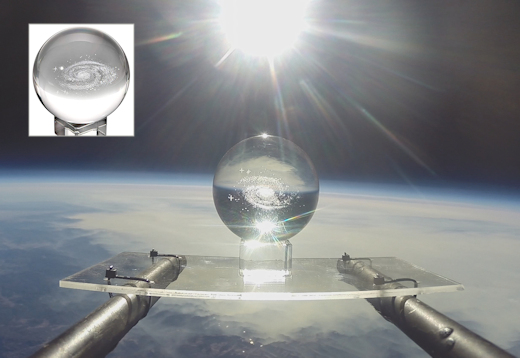
You can have it for $149.95. The students are selling Galaxy Globes to pay their helium bill. Each one comes with a greeting card showing the item in flight and telling the story of its journey to the edge of space. All sales support the Earth to Sky Calculus cosmic ray ballooning program and hands-on STEM research.
Far Out Gifts: Earth to Sky Store
All sales support hands-on STEM education