THE SOLAR WIND HAS ARRIVED: As predicted, a stream of solar wind has reached Earth on July 31st and is gently buffeting our planet's magnetic field. The gaseous material is flowing from a hole in the sun's atmosphere. High-latitude sky watchers should be alert for auroras, especially in the southern hemisphere where winter darkness favors visibility. Aurora alerts: SMS Text.

THE PERSEID METEOR SHOWER IS UNDERWAY: Earth is entering a stream of debris from Comet Swift-Tuttle, source of the annual Perseid meteor shower. Forecasters expect the shower to peak on Aug. 12-13 with many fireballs slicing through the light of a nearly full Moon. It's not even August yet, but NASA's network of all-sky cameras is already detecting a few Perseid fireballs every night--rates which will surely increase in the weeks ahead.
Comet Swift-Tuttle is a giant. It's nucleus is 26 km in diameter, or two-and-a-half times the size of the asteroid that wiped out the dinosaurs. Most other comets are much smaller, with nuclei only a few kilometers across. As a result of its size, Comet Swift-Tuttle produces a large number of meteoroids, many of which are hefty enough to produce fireballs.
Indeed, a 6-year study by NASA's Meteoroid Environment Office found that the Perseids produce more fireballs than any other annual shower:

During the shower, which lasts for weeks, debris particles a few cm wide hit the atmosphere with a speed of 59.6 km/s (133,350 mph). The average magnitude of the resulting fireballs is -3.7, about as bright as Venus.
The luminosity of Perseids is important this year. In 2019 the shower peaks only a few nights before the full Moon, so meteors need to be extra bright to be seen through the glare. Some experts recommend watching a bit earlier than usual, on Aug. 9th, 10th, and 11th when the Moon is less full. The peak nights of Aug. 12th and 13th will be tempered by lunar interference. Whatever night you select, the best time to look is during the hours before sunrise when the shower's radiant is high in the sky. [sky map]

Realtime Space Weather Photo Gallery
Free: Spaceweather.com Newsletter
A GOOD NIGHT FOR GREEN AIRGLOW: Nights around the New Moon are special to astrophotographers. They reveal things normally overwhelmed by moonlight. Last night, Ruslan Merzlyakov saw one of those things over Denmark--ripples of green airglow:

"The sky was filled with green airglow," says Merzlyakov. "It crissed-crossed the Milky Way above the island of Møn."
Airglow looks like the aurora borealis, but it is not the same. Airglow is caused by a complex assortment of chemical reactions in Earth's upper atmosphere. These reactions get started during daylight hours when the atmosphere is bathed in strong UV radiation from the sun. At night we see the afterglow, colored green by oxygen atoms 90-100 km high or sometimes red by hydroxyl ions 86-87 km high.
"The airglow was corrugated by gravity waves propagating upward from a nearby thunderstorm," adds Merzlyakov. This phenomenon is quite common during the season for summer storms, and gives most airglow a dramatic rippling structure.
"Now I can't wait for the first Perseids!" he says.
THE STARSHIP ENTERPRISE IN THE STRATOSPHERE: Last week, the students of Earth to Sky Calculus launched the starship Enterprise to the stratosphere. Riding onboard a high-altitude cosmic ray balloon, the laser-etched crystal spaceship traveled 34.7 km (113,845 feet) above Earth's surface:
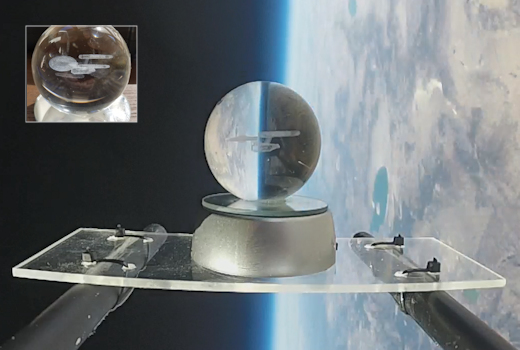
You can have it for $149.95. The students are selling the Enterprise to support their cosmic ray ballooning program. Each starship comes with a greeting card showing the item in flight and telling the story of its journey to the edge of space. Also included is a multi-colored LED illuminated stand (shown in the picture above). This creates a colorful visual effect and allows the Enterprise to be used as a far-out night light.
Far Out Gifts: Earth to Sky Store
All sales support hands-on STEM education