CHANCE OF STORMS: NOAA forecasters estimate a 20% to 25% chance of G1-class geomagnetic storms on Aug. 5th and 6th when a stream of solar wind is expected to hit Earth's magnetic field. The gaseous material is flowing from a large hourglass-shaped hole in the sun's atmosphere. High-latitude sky watchers should be alert for auroras, especially in the southern hemisphere where winter darkness favors visibility. Aurora alerts: SMS Text


THE EERIE CALMING OF EARTH'S MAGNETIC FIELD: Solar Minimum is having a calming effect on Earth's magnetic field. The deepening quiet is shown in these geomagnetic data, taken by Stuart Green of Preston, Lancashire, UK, during each of the past 3 summers:

"I've plotted the changing levels of geomagnetic activity for the months of May, June and July (between the equinoxes) for the years 2017, 2018 and 2019," explains Green. "The trend is clearly downward, with less frequent and intense storms in 2019, as the sun continues deeper into Solar Minimum."
His data show why minor G1-class geomagnetic storms, which would rarely be mentioned during Solar Maximum, are suddenly noteworthy. Any magnetic storm is news at this point in the solar cycle.
NOCTILUCENT CLOUDS IN AUGUST: Noctilucent clouds (NLCs) are an early-summertime phenomenon. Normally, the clouds begin to dim in late July, then fade away completely as August unfolds. It is their seasonal pattern. This year, though, things might be different. Just last night Göran Strand of Östersund, Sweden, witnessed a display of NLCs bright enough to see over the lights of a rock concert:

"On Aug. 3rd during our yearly Storsjöyran music festival, we got some really beautiful noctilucent clouds visible over the city center," says Strand, "It was quite hard to get the exposures balanced in this 3 shot panorama because the lights from the stage kept changing all the time. I think I was the only one watching the clouds instead of the band performing :-)"
2019 has been a very unusual year for noctilucent clouds, with sightings at record-low latitudes as far south as New Mexico and southern California. Why? NASA satellites have detected unusual amounts of water in the mesosphere. The extra moisture crystallized around specks of meteor smoke, creating an abundance of NLCs. If this trend continues, August might be a good month for NLCs contrary to normal seasonal patterns.
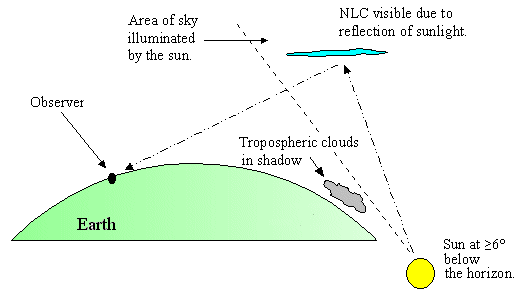
Observing tips: Look west 30 to 60 minutes after sunset (or before sunrise) when the sun is just below the horizon. If you see luminous blue-white tendrils spreading across the sky, you may have spotted a noctilucent cloud.
Realtime Noctilucent Cloud Photo Gallery
Free: Spaceweather.com Newsletter
FLY ME TO THE MOONSTONE: Are you looking for a far-out gift? Nothing says "I love you" like a moonstone from the edge of space. On June 12th, the students of Earth to Sky Calculus flew this moonstone wrapped in a sterling silver Celtic love knot 34.1 km (111,877 feet) above Earth's surface:

You can have it for $139.95. The students are selling these pendants to support their cosmic ray ballooning program. Each one comes with a greeting card showing the item in flight and telling the story of its journey to the edge of space. Sales support the Earth to Sky Calculus cosmic ray ballooning program and hands-on STEM research.
Far Out Gifts: Earth to Sky Store
All sales support hands-on STEM education