JUPITER-MOON CONJUNCTION: When the sun goes down tonight, step outside and look south. The waxing gibbous Moon is approaching Jupiter for a beautiful conjunction alongside the red giant star Antares. At closest approach on August 9th, Jupiter and the Moon will be only a few degrees apart. If you can, catch them before the evening sky fades to black. A bright conjunction framed by twilight blue is extra-beautiful. Sky maps: August 8, 9. Browse: photo gallery.


ATLAS V ROCKET LAUNCH: Yesterday morning over central Florida, the sky lit up in a symphony of artificial noctilucent clouds, rocket exhaust, and fiery contrails. Steve Rismiller photographed the pre-dawn display from Mims, FL:

"It was an Atlas V rocket," says Rismiller. "I photographed the launch on August 8th using a telephoto lens on my Canon T6i digital camera."
The massive rocket, which lifted off from Cape Canaveral at 6:13 AM local time, carried the fifth Advanced Extremely High Frequency (AEHF-5) communications satellite for the U.S. Air Force Space and Missile Systems Center. AEHF satellites provide secure, jam-proof connectivity for U.S. military forces. Atlas V rockets successfully launched the first four AEHF satellites in 2010, 2012, 2013 and 2018.
Realtime Space Weather Photo Gallery
Free: Spaceweather.com Newsletter
ALONG CAME A SPIDER (PERSEID UPDATE): Earth is moving deeper into the debris stream of Comet Swift-Tuttle, source of the annual Perseid meteor shower. According to the International Meteor Organization, 20 meteors per hour are currently visible at dark sky sites around the northern hemisphere. This spider watched one of them streaking over Arizona's Mt. Lemmon Observatory on August 6th:

The 8-legged observer was sitting atop the weather dome on a NASA meteor camera when the Perseid appeared. Moonlight + the glow of the meteor itself cast the arachnid silhouette onto the camera's CCD array.
Forecasters expect the Perseids to peak on August 12-13--only a few nights before the full Moon. Pro tip: Watch the skies on Aug. 9th, 10th, and 11th when the Moon is less full. The peak nights of Aug. 12th and 13th will be tempered by lunar interference. Whatever night you select, the best time to look is during the hours before sunrise when the shower's radiant is high in the sky. [sky map]

Realtime Space Weather Photo Gallery
Free: Spaceweather.com Newsletter
A FAR OUT GIFT: Nothing says "I Love You" like a heart-shaped pendant from the edge of space. Last week, the students of Earth to Sky Calculus flew an array of cosmic ray sensors to the stratosphere onboard a giant helium balloon. This purple heart went along for the ride:
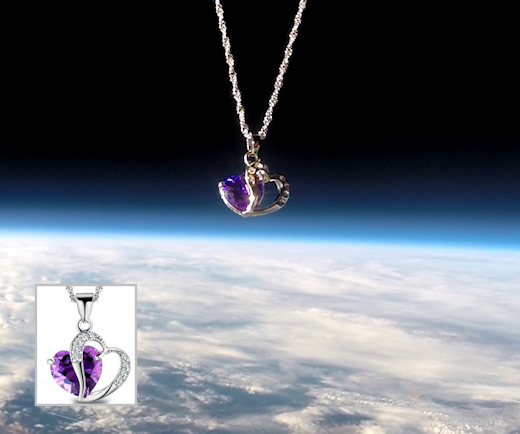
You can have it for $129.95. The students are selling these pendants as a fund-raiser for their cosmic ray monitoring program. They make great anniversary, birthday and Christmas gifts. Each pendant comes with a greeting card showing the jewelry in flight and telling the story of its journey to the stratosphere and back again.
Far Out Gifts: Earth to Sky Store
All sales support hands-on STEM education