PERSEID UPDATE: The Perseid meteor shower is underway. Dark-sky observers with the International Mete or Organization are counting as many as 20 Perseids per hour--rates which will increase as Earth moves deeper into the debris stream of Comet Swift Tuttle. Peak night will be Aug. 12-13, according to forecasters. The best time to look is during the dark hours before sunrise when the shower's radiant is high in the sky. [sky map]

ARCTIC AURORAS--THEY'RE BACK: Aurora season is beginning around the Arctic Circle. "The lights are back, you better believe it!" reports Thomas Kast from Oulu, Finland. "Here in Oulu the nights are barely dark enough, but this morning a ribbon of green aurora was in the sky for a few moments around 2am."

"Together with noctilucent clouds, the twilight and reflections in a lake, it was the perfect 'first date' with Lady Aurora for the new season," he says.
The display was sparked by a brief gust of solar wind that reached Earth on August 10th, apparently flowing from the ragged edge of a southern hole in the sun's atmosphere. Additional gusts are possible on August 11th as the hole rotates into a more geoeffective position. Stay tuned for more auroras mixed with Arctic twilight. Aurora alerts: SMS Text.

A NEW SOURCE OF SPACE RADIATION: Astronauts are surrounded by danger: hard vacuum, solar flares, cosmic rays. Researchers from UCLA have just added a new item to the list. Earth itself.
“A natural particle accelerator only 40,000 miles above Earth’s surface is producing ‘killer electrons’ moving close to the speed of light,” says Terry Liu, a newly-minted PhD who studied the phenomenon as part of his thesis with UCLA Prof. Vassilis Angelopoulos.
This means that astronauts leaving Earth for Mars could be peppered by radiation coming at them from behind–from the direction of their own home planet.
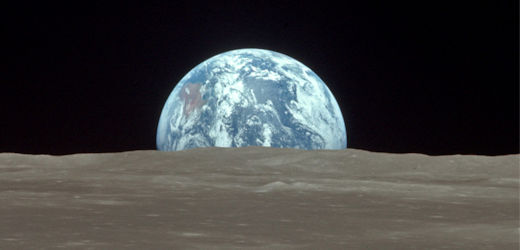
NASA’s THEMIS spacecraft ran across the particles in 2008 not far from the place where the solar wind slams into Earth’s magnetic field. Researchers have long known that shock waves at that location could accelerate particles to high energies–but not this high. The particles coming out of the Earth-solar wind interface have energies up to 100,000 electron volts, ten times greater than previously expected.
How is this possible? Liu found the answer by combining THEMIS data with computer simulations of the sun-Earth interface. When the solar wind meets Earth, it forms a shock wave around Earth’s magnetic field, shaped like the bow waves that form ahead of a boat moving through water. Within this “bow shock” immense stores of energy can be abruptly released akin to the sonic boom of an airplane.
Liu found that some electrons are shocked not just once, but twice or more, undergoing mirror-like reflections within the bow shock that build energy to unexpected levels. Most of the boosted particles shoot back into space away from Earth.

Above: Dr. Terry Liu created this diagram showing the location of the natural particle accelerator and how it sprays radiation into space.
“Similar particles have been detected near Saturn, suggesting that the process is at work there as well,” says Liu. “Indeed,” adds Angelopoulos, “this type of particle acceleration could be happening throughout the cosmos–from supernovas to solar storms–wherever a supersonic wind hits a barrier.”
Meanwhile, back home, Earth-orbiting satellites and departing astronauts have a new source of radiation to contend with. It’s right over their shoulder.
Read the original research at Science Advances.
Realtime Space Weather Photo Gallery
Free: Spaceweather.com Newsletter
THIS GIFT IS GENIUS: What would Einstein think!? On June 8, 2019, the students of Earth to Sky Calculus launched a cosmic ray balloon to the stratosphere. This Albert Einstein bobblehead went along for the ride:
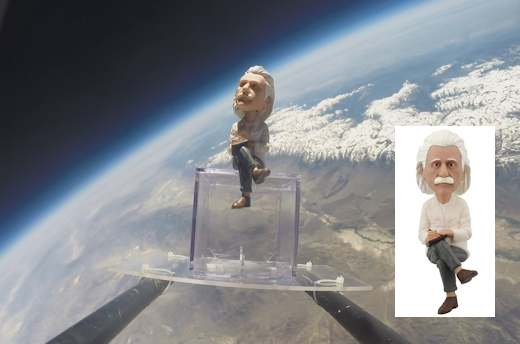
Albert contemplated the curve of the Earth for almost 3 hours as the balloon ascended 111,222 feet above the Sierra Nevada Mountains of central California.
You can have him for $66.74--that is, 10 times the gravitational constant, G. The students are selling these bobbleheads to support their cosmic ray ballooning program. They make great novelty gifts! Each one comes with a greeting card showing the item in flight and telling the story of its journey to the edge of space.
Far Out Gifts: Earth to Sky Store
All sales support hands-on STEM education