SUBSIDING STORM: A G2-class geomagnetic storm that began during the early hours of Aug. 31st is subsiding now. During the peak of the storm, auroras were observed in the USA as far south as Wisconsin and Michigan. Although the storm is subsiding, it could flare up again on Sept. 1st. A stream of solar wind continues to buffet Earth's magnetic field at speeds near 700 km/s. Auroras around the Arctic Circle are all but certain, while a second episode of auroras in northern-tier US states cannot be ruled out. Aurora alerts: SMS Text.

Mia Stålnacke of Kiruna, Sweden, took this picture last night when the storm was just getting started:

"Darkness has returned to the subarctic and we are finally seeing the aurora again. The season really started out with a bang!" she says. "This is the view from the Bengt Hultqvist Observatory, the northernmost observatory in Sweden."
Realtime Aurora Photo Gallery
Free: Spaceweather.com Newsletter
THE ANTARES PENDANT: Are you looking for a far-out gift? Consider the Antares Pendant. On Aug. 19, 2019, the students of Earth to Sky Calculus launched a cosmic ray balloon to the edge of space, 104,002 ft high. This ruby-red crystal necklace went along for the ride:
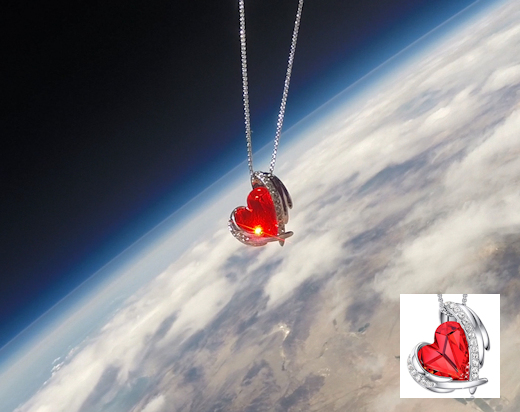
You can have it for $149.95. The students are selling these white gold-plated pendants to support their cosmic ray ballooning program. The glittering Swarovski crystal has a deep ruby hue inspired by the red-supergiant star Antares in Scorpio. Each one comes with greeting card showing the pendant in flight and telling the story of its journey to the edge of space and back again.
Far Out Gifts: Earth to Sky Store
All sales support hands-on STEM education
A GIGANTIC JET OVER CHINA: You never know what you might see in the wake of a big storm. On Aug. 25th, Chinese astrophotographer Chao Shen of Shaoxing City went outside to photograph the Milky Way. A typhoon named "White Deer" had passed through the day before, and the storm clouds were parting. "I saw the stars--but that's not all," says Shen. "A Gigantic Jet leaped up right before my eyes!"

Gigantic Jets are lightning-like discharges that spring from the tops of thunderstorms, reaching all the way to the edge of space. They're related to sprites, but larger and more powerful.
"Shen definitely caught a Gigantic Jet," confirms Oscar van der Velde of the Lightning Research Group at the Universitat Politècnica de Catalunya. "It looks like it may have reached as high as 90 km above the ground."
"Gigantic Jets are much more rare than sprites," says van der Velde. "While sprites were discovered in 1989 and have since been photographed by the thousands, it was not until 2001-2002 that Gigantic Jets were first recorded from Puerto Rico and Taiwan." Only dozens of Gigantic Jets have ever been photographed.
Shen says that "the Jet came from a storm about 100 km southwest of me. It was so huge, I was able to see it clearly despite the distance."


Above: The arrow in this weather map points from Chao Shen's camera toward the jet-producing storm.
Observers of sprites may be wondering if Shen really saw this jet. The answer is "yes." Unlike sprites, which flicker so rapidly that they are difficult to see with the unaided eye. Gigantic Jets can lasts for hundreds of milliseconds, long enough for human eyes to register their purple glow.
Gigantic jets are part of a growing menagerie of strange forms that appear above intense thunderstorms, including sprites, elves, trolls, and blue jets. Some researchers believe that cosmic rays help trigger these "transient luminous events" by ionizing the air in and around thunderheads. If so, now is a good time to look for Gigantic Jets, because cosmic rays are nearing a Space Age high. Thank you, Solar Minimum!
Realtime Sprite Photo Gallery
Free: Spaceweather.com Newsletter