A "SUPER SPRITE" OVER CHINA: Last week in China, a photographer captured a rare photo of a "super sprite"--a gigantic tentacled jet leaping up from the stormy wake of Typhoon White Deer. See the picture and learn more about these strange forms of upward-directed lightning here.
GEOMAGNETIC STORM--UNDERWAY NOW: A stream of high-speed solar wind is lashing Earth's magnetic field, blowing at speeds greater 700 km/s. This is sparking geomagnetic storms around the poles. On Sept. 1st, storm conditions are flickering between category G1 and G2. If this storm persists until nightfall, sky watchers in the USA as far south as Wisconsin, Michigan and Montana could see Northern Lights. Aurora alerts: SMS Text.


Göran Strand sends this picture from Östersund, Sweden. "On Sept. 1st, I got to see my first Northern Lights of the season," he says. "The geomagnetic activity is still very good so if you have clear skies tonight, head out and look to the North!"
Realtime Aurora Photo Gallery
Free: Spaceweather.com Newsletter
160 YEARS AGO, A GEOMAGNETIC MEGA-STORM: Picture this: A billion-ton coronal mass ejection (CME) slams into Earth's magnetic field. Campers in the Rocky Mountains wake up in the middle of the night, thinking that the glow they see is sunrise. No, it's the Northern Lights. People in Cuba read their morning paper by the red illumination of aurora borealis. Earth is peppered by particles so energetic, they alter the chemistry of polar ice.
Hard to believe? It really happened--exactly 160 years ago. This map shows where auroras were sighted in the early hours of Sept. 2, 1859:

As the day unfolded, the gathering storm electrified telegraph lines, shocking technicians and setting their telegraph papers on fire. The "Victorian Internet" was knocked offline. Magnetometers around the world recorded strong disturbances in the planetary magnetic field for more than a week.
The cause of all this was an extraordinary solar flare witnessed the day before by British astronomer Richard Carrington. His sighting on Sept. 1, 1859, marked the discovery of solar flares and foreshadowed a new field of study: space weather. According to a NASA-funded study by the National Academy of Sciences, if a similar storm occurred today, it could cause a trillion dollars in damage to society's high-tech infrastructure and require years for complete recovery.
Realtime Space Weather Photo Gallery
Free: Spaceweather.com Newsletter
THE ANTARES PENDANT: Are you looking for a far-out gift? Consider the Antares Pendant. On Aug. 19, 2019, the students of Earth to Sky Calculus launched a cosmic ray balloon to the edge of space, 104,002 ft high. This ruby-red crystal necklace went along for the ride:
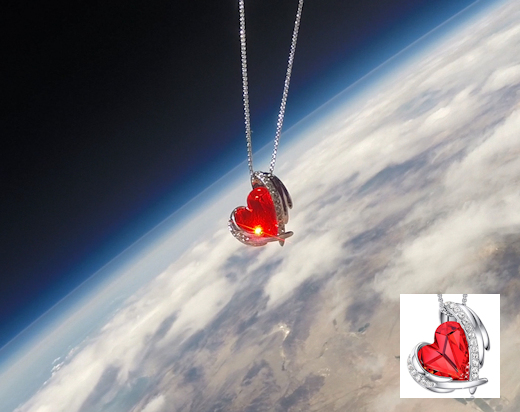
You can have it for $149.95. The students are selling these white gold-plated pendants to support their cosmic ray ballooning program. The glittering Swarovski crystal has a deep ruby hue inspired by the red-supergiant star Antares in Scorpio. Each one comes with greeting card showing the pendant in flight and telling the story of its journey to the edge of space and back again.
Far Out Gifts: Earth to Sky Store
All sales support hands-on STEM education