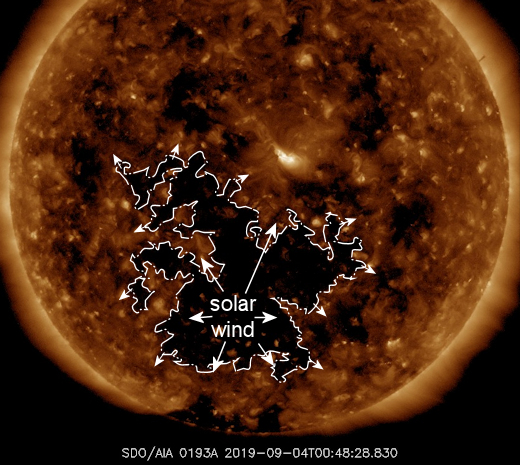
ARCTIC AURORA WATCH: A southern hole in the sun's atmosphere is turning to face Earth. The emerging stream of solar wind could graze our planet's magnetic field on Sept. 7th, causing geomagnetic unrest and auroras around the Arctic Circle. At this time of year, auroras can mix with polar twilight to form uniquely beautiful photo-ops. Stay tuned. Aurora alerts: SMS Text
TRIPLE-PLANET CONJUNCTION: Venus, Mars, and Mercury are having a spectacular conjunction today. Don't bother looking, though. They have gathered together in the noontime sky only degrees away from the glaring sun. Coronagraphs onboard the Solar and Heliospheric Observatory (SOHO) are recording the show:

Using an opaque disk to block the sun's glare, SOHO coronagraphs reveal nearby stars and planets otherwise invisible to the human eye. Today's image shows Venus 5.9 degrees from the sun, Mercury 1.7 degrees from the sun and Mars .... where's Mars? The Red Planet is only 1.2 degrees from the sun, so it is located behind the opaque disk. Soon it will pop into view again. Join SOHO for a ringside seat.
Realtime Space Weather Photo Gallery
Free: Spaceweather.com Newsletter
BE ALERT FOR PURPLE SUNSETS: Tonight when the sun goes down, step outside into the twilight. You might find yourself surrounded by purple. That's what happened to Piotr Wieczorek of Jeziory Małe, Poland, on August 31st:

"The purple was everywhere," says Wieczorek, "even reflected in the water of the lake."
If this happens to you, blame a volcano. This summer, two volcanoes have spewed sulfurous gas into the stratosphere: the Raikoke volcano in the Kirul Islands (June 22nd) and the Ulawun volcano in New Guinea (Aug. 3rd). Fine volcanic aerosols in the stratosphere scatter blue light which, when mixed with ordinary sunset red, produces a purple hue.
Sky watchers have been seeing purple sunsets ever since Raikoke erupted. The volcanic gas appears to be patchily distributed, bringing strange sunsets on some nights, but not all. Clear air, lack of clouds, and country settings improves their visibility.
Realtime Volcanic Sunset Photo Gallery
Free: Spaceweather.com Newsletter
THE SPACE PEARL: It's the first pearl in the stratosphere. On Aug. 19, 2019, the students of Earth to Sky Calculus launched a cosmic ray balloon to the edge of space, 104,002 ft high. This sterling silver pearl necklace went along for the ride:

You can have it for $169.95. The students are selling these pearls to support their cosmic ray ballooning program. Each cultured "space pearl" comes with greeting card showing the necklace in flight and telling the story of its journey to the edge of space and back again. These make great birthday and Christmas gifts.
Far Out Gifts: Earth to Sky Store
All sales support hands-on STEM education