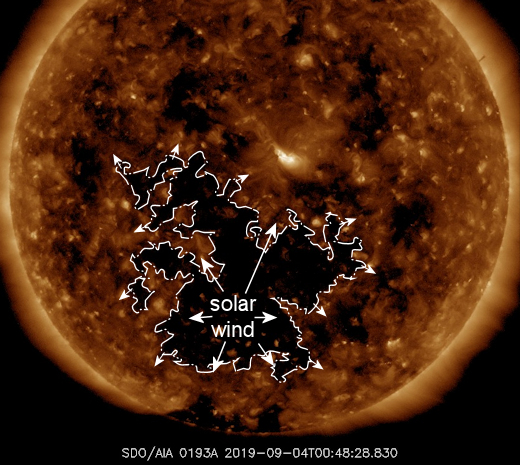
ARCTIC AURORA WATCH: A southern hole in the sun's atmosphere is spewing a stream of solar wind into space. The gaseous material could graze our planet's magnetic field on Sept. 7th or 8th, causing minor geomagnetic unrest and auroras around the Arctic Circle. At this time of year, auroras can mix with polar twilight to form uniquely beautiful photo-ops, so even minor unrest is worth watching. Aurora alerts: SMS Text
THE RETURN OF STEVE: Sky watchers are still sorting out all the things they saw during last weekend's Labor Day geomagnetic storm. Upon further review, not every light in the sky was the aurora borealis. There was also STEVE:
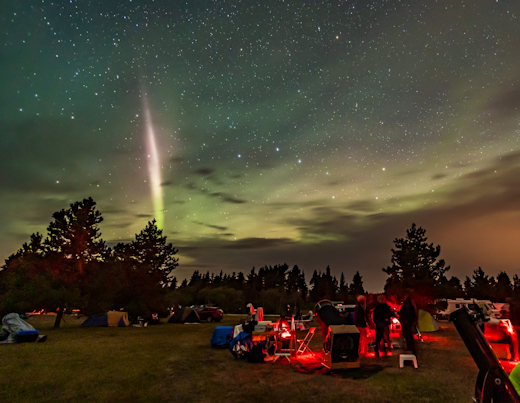
"Look at the mauve-colored plume. That's STEVE," says Alan Dyer, who took the picture at the Saskatchewan Summer Star Party on Aug. 31st. "We saw STEVE two nights in a row from our area in western Canada."
STEVE (Strong Thermal Emission Velocity Enhancement) looks like an aurora, but it is not. The phenomenon is caused by hot (3000°C) ribbons of gas flowing through Earth's magnetosphere at speeds exceeding 6 km/s (13,000 mph). These ribbons appear during some geomagnetic storms, revealing themselves by their soft purple glow.
Earlier this year, researchers led by Toshi Nishimura of Boston University published an important paper about STEVE. Using data from NASA's THEMIS spacecraft, they located STEVE's power source: Magnetic explosions called 'substorms' more than 22,000 km above Earth's surface hurl streams of hot plasma toward Earth. When the material reaches an altitude ~250 km above Earth's surface, it begins to emit a mauve light.
There's more. THEMIS data showed that the same explosions can spray energetic electrons toward Earth. These electrons move even deeper into the atmosphere, all the way down to 100 km, where they ignite a form of green auroras called "the picket fence." Indeed, many sky watchers saw the picket fence beneath STEVE over Labor Day weekend:
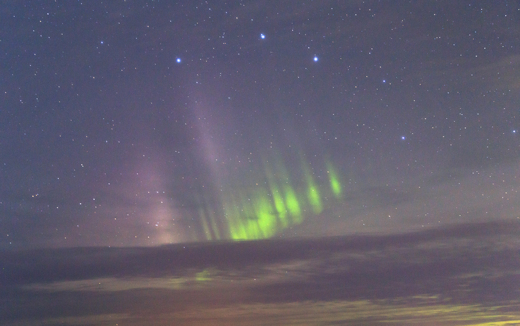
"STEVE and the green pickets were quite strong underneath the handle of the Big Dipper," says Philip Granrud, who took the picture from Kalispell, Montana, on Sept. 1st. "It was beautiful!"
Nishimura's study showed that STEVE and the green pickets are inextricably connected. "They are two different manifestations of a single magnetic explosion high above Earth," explains Nishimura. "The picket fence is an aurora. STEVE is not. Nevertheless, they are linked."
The colors of the display are only partially understood. Picket fences are green because of oxygen, which emits green photons when it is pummeled by energetic electrons. The purple color of STEVE ... is still a mystery. "We are looking at this more closely in a follow-up study," says Nishimura. "We suspect that nitrogen is involved, but we are not yet certain."
Ready for more? Good news. The season for STEVE is now. Studies show that STEVE tends to occur more frequently during spring and fall than summer and winter. The onset of northern autumn, only weeks away, seems to lure the arc out of summer hiding. Aurora alerts: SMS Text
A sharable version of this story is available here.
Realtime STEVE Photo Gallery
Free: Spaceweather.com Newsletter
THE ANTARES PENDANT: Are you looking for a far-out gift? Consider the Antares Pendant. On Aug. 19, 2019, the students of Earth to Sky Calculus launched a cosmic ray balloon to the edge of space, 104,002 ft high. This ruby-red crystal necklace went along for the ride:
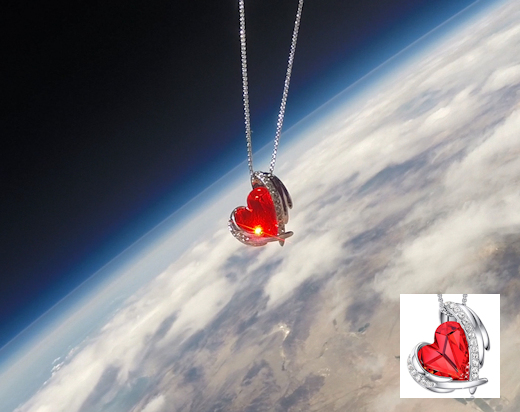
You can have it for $179.95. The students are selling these white gold-plated pendants to support their cosmic ray ballooning program. The glittering Swarovski crystal has a deep ruby hue inspired by the red-supergiant star Antares in Scorpio. Each one comes with greeting card showing the pendant in flight and telling the story of its journey to the edge of space and back again.
Far Out Gifts: Earth to Sky Store
All sales support hands-on STEM education
A HORSESHOE VORTEX CLOUD: Talk about a lucky shot. Yesterday in Finland, Matti Helin looked up and saw one of the rarest of all clouds spinning right next to a rainbow. "I couldn't believe my eyes," says Helin. "It was a gorgeous horseshoe vortex!"
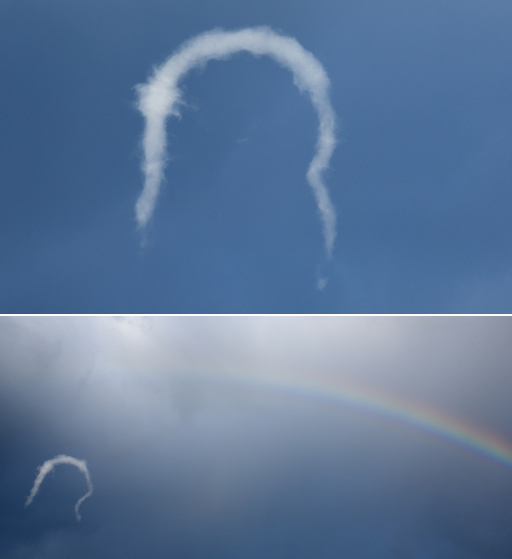
"I was already a bit late for work when I saw the vortex," says Helin. "Taking these pictures made me even later."
These unusual clouds form when a small cumulus cloud drifts over a column of rising warm air. The rising air rolls the cumulus cloud into a spinning vortex. When the ends of the vortex droop, as happened over Finland, the vortex turns into a "horseshoe."
"It was alive for about five minutes," says Helin. "I was very lucky indeed."
Realtime Space Weather Photo Gallery
Free: Spaceweather.com Newsletter