AURORAS SIGNAL THE APPROACH OF FALL: Northern autumn is coming. We know this because auroras are appearing for no special reason. "I didn't expect to see anything last night," reports Yuichi Takasaka of Yellowknife in the Northwest Territories of Canada . "The forecast called for no geomagnetic storms." Yet the auroras were there anyway:

"The auroras were very active," says Takasaka. "We were so very lucky!!!"
What's going on? As autumn approaches, cracks are opening in Earth's magnetic field. Solar wind pours in to spark auroras even without big geomagnetic storms. This is called the the "Russell-McPherron effect," named after the researchers who first explained it. As a result of the cracks, September and October are two of the best months of the year to see auroras.

"The display was remarkably pink," notes Takasaka. Pink is a sign of nitrogen. Most auroras are green--a verdant glow caused by particles from space hitting oxygen atoms 100 km to 300 km above Earth's surface. Pink appears when those particles descend lower than usual, striking nitrogen molecules at the 100 km level and below. Aurora alerts: SMS Text
Realtime Aurora Photo Gallery
Free: Spaceweather.com Newsletter
COMET CROSSING: This weekend, two comets crossed paths in the constellation Aries. "On September 7th, Comet C/2018 N2 (ASASSN) and Comet 260P/McNaught met in this field full of small galaxies," says José J. Chambó, who photographed the close encounter using a robotic iTelescope in Mayhill, New Mexico.

"At closest approach, the two comets were only 10 arcminutes apart," says Chambó. "But their proximity was just a matter of perspective. Comet McNaught (bottom) was 0.6 AU from Earth while Comet ASASSN (top) was 2.6 AU away. In other words, they were separated by almost 300 million km--twice the distance from Earth to the sun."
Realtime Space Weather Photo Gallery
Free: Spaceweather.com Newsletter
THE ANTARES PENDANT: Are you looking for a far-out gift? Consider the Antares Pendant. On Aug. 19, 2019, the students of Earth to Sky Calculus launched a cosmic ray balloon to the edge of space, 104,002 ft high. This ruby-red crystal necklace went along for the ride:
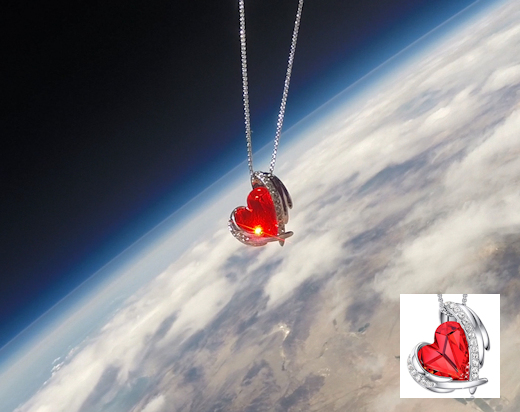
You can have it for $179.95. The students are selling these white gold-plated pendants to support their cosmic ray ballooning program. The glittering Swarovski crystal has a deep ruby hue inspired by the red-supergiant star Antares in Scorpio. Each one comes with greeting card showing the pendant in flight and telling the story of its journey to the edge of space and back again.
Far Out Gifts: Earth to Sky Store
All sales support hands-on STEM education