WATCH OUT FOR THE HARVEST MOON: Tonight's full Moon has a special name--the Harvest Moon. It's the full Moon closest to the northern autumnal equinox (Sept. 23rd). In years past, farmers depended on the light of the Harvest Moon to gather ripening crops late into the night. Post-Edison, we appreciate it mainly for its beauty. Enjoy the Harvest moonlight.
PURPLE VOLCANIC SUNSETS: Almost 3 months after the Kirul Islands' Raikoke volcano blasted a plume of sulfurous gas into the stratosphere, sunsets around the northern hemisphere are still strangely colored. Dorothea Grolig photographed this example from the Vienna Woods of Lower Austria on Sept. 12th:

"We are still getting purple sunsets," marvels Grolig. "The colors are quite striking."
The effect is going strong because Raikoke had help: On Aug. 3rd, New Guinea's Ulawun volcano also punched through to the stratosphere, adding its own emissions to that of Raikoke. Fine volcanic aerosols in the stratosphere scatter blue light which, when mixed with ordinary sunset red, produce a purple hue.
Purple isn't the only thing to look for, says atmospheric optics expert Les Cowley. In addition, he advises, sky watchers should "be alert for a very bright yellow twilight arch, fine cloud structure in the arch seen through binoculars, and long diffuse rays and shadows."
Realtime Volcanic Sunset Photo Gallery
Free: Spaceweather.com Newsletter
INTERSTELLAR COMET: 'Oumuamua is not alone. Another interstellar visitor appears to be passing through the solar system--and this time it's definitely a comet. Ukrainian amateur astronomer Gennady Borisov discovered the object, now named C/2019 Q4 (Borisov), approaching from beyond the orbit of Mars on Aug. 30th. Click to view a 3D visualization of Comet Borisov's orbit from NASA's Jet Propulsion Lab:

Based on observations gathered since Borisov discovered the distant fuzzball, the comet seems to be following a hyperbolic orbit with an eccentricity greater than 3.5. This means the comet is unbound to the sun. Indeed, it is moving some 30.7 km/s (68,700 mph) too fast for the sun's gravity to hang onto it. Comet Borisov is a first time visitor to the inner solar system, and after this flyby it will return to deep space.
Comet Borisov will make its closest approach to the sun (2 AU) around Dec. 7th. Three weeks later, near the end of December, it will make its closest approach to Earth (also 2 AU). At the moment the comet is very dim, around magnitude +18. How bright it may become by December is anyone's guess.

Above: Dim and distant, Comet Borisov was photographed in the constellation Cancer on Sept. 12th by Graziano Ventre using an 11-inch telescope.
The first known interstellar object to visit our solar system, 'Oumuamua, caused a sensation when it was discovered racing away from the sun in late 2017. Speculation about its nature ranged from an alien spacecraft to a fossil exocomet. Astronomers still aren't sure what it was. Comet Borisov, on the other hand, appears to have a fuzzy atmosphere (a "coma") and perhaps a stubby tail--signs that it really is a comet.
Because Comet Borisov is still just entering the solar system, astronomers will have plenty of time to study it in the months ahead. Is it truly interstellar? What are comets from other solar systems made of? Answers to these and many other questions are forthcoming.
Meanwhile, if you are a skilled amateur astronomer and wish to observe Comet Borisov, you may find orbital elements for pointing your telescope here and here. Got a picture? Please submit it to our photo gallery!
Realtime Space Weather Photo Gallery
Free: Spaceweather.com Newsletter
STERLING SILVER MOONSTONE PENDANT: Are you looking for a far-out gift? Nothing says "I love you" like a moonstone from the edge of space. On Jan 27th, the students of Earth to Sky Calculus flew this moonstone wrapped in a hand-crafted sterling silver Celtic love knot 35.1 km (115,158 feet) above Earth's surface:
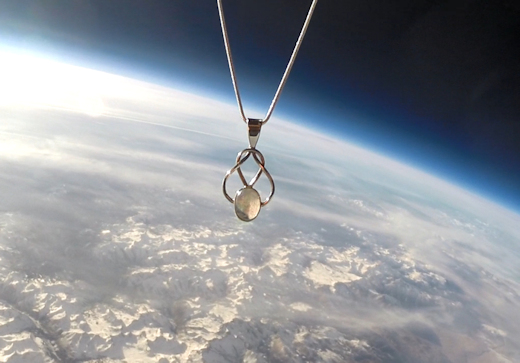
You can have it for $179.95. The students are selling these pendants to support their cosmic ray ballooning program. Each one comes with a greeting card showing the item in flight and telling the story of its journey to the edge of space. All sales support the Earth to Sky Calculus cosmic ray ballooning program and hands-on STEM research.
Far Out Gifts: Earth to Sky Store
All sales support hands-on STEM education