ARCTIC AURORA WATCH: A stream of solar wind flowing from a southern hole in the sun's atmosphere could graze Earth's magnetic field on Sept. 17th. Arctic sky watchers should be alert for auroras mixed with gibbous moonlight when the gaseous material arrives. Aurora alerts: SMS Text.

NEW IMAGES OF COMET BORISOV: It's definitely a comet. New color images from the Gemini telescope atop Hawaii's Mauna Kea volcano show that C/2019 Q4 (Borisov) has a tail. "We really had to scramble for this one since we got the final details at 3:00 am on Sept. 9th and were observing it by 4:45!" says Andrew Stephens of the Gemini Observatory who coordinated the observations.

There are thousands of comets in the Solar System, but this one is special. Comet Borisov is interstellar. The newly-discovered comet is following a hyperbolic orbit with an eccentricity greater than 3.7. This means it is unbound to the sun. Indeed, Comet Borisov is moving 30.7 km/s (68,700 mph) too fast for the sun's gravity to hang onto it. It must have come from the stars.
This is the first time an interstellar visitor to our Solar System has clearly shown a tail due to outgassing. The only other known interstellar visitor was 'Oumuamua in 2017-2018, a cigar-shaped object with no visible comet-like emissions. 'Oumuamua's shape and apparent lack of outgassing led some credible scientists to wonder if it might be an alien probe. The Gemini photo of Comet Borisov shows that it, at least, is a natural object.
On Sept. 12th in Weißenkirchen, Austria, astrophotographer Michael Jäger used a 12-inch telescope to capture his first short video of Comet Borisov:
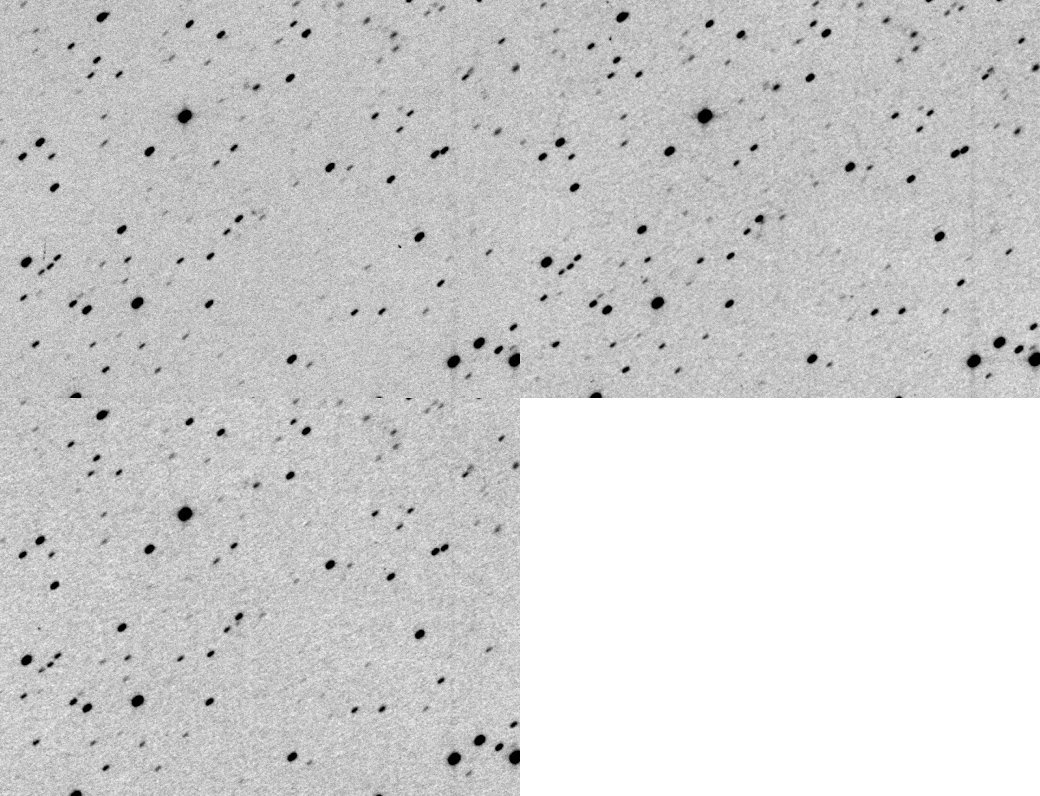
Note the grey speck moving near the center of the animation. That's the comet.
"It is dim because it is still so far from the sun--about 2.75 AU away," notes Jäger. "Although it has an extraordinary orbit, so far Comet Borisov looks rather ordinary, much like other comets I have seen at such distances."
Because Comet Borisov is still just entering the solar system, astronomers will have plenty of time to study it in the months ahead. Is it truly interstellar? What are comets from other solar systems made of? Answers to these and many other questions are forthcoming.
Meanwhile, if you are a skilled amateur astronomer and wish to observe Comet Borisov, you may find orbital elements for pointing your telescope here and here. Got a picture? Please submit it to our photo gallery!
Realtime Space Weather Photo Gallery
Free: Spaceweather.com Newsletter
PURPLE VOLCANIC SUNSETS: Almost 3 months after the Kirul Islands' Raikoke volcano blasted a plume of sulfurous gas into the stratosphere, sunsets around the northern hemisphere are still turning purple. Dorothea Grolig photographed this example from the Vienna Woods of Lower Austria on Sept. 12th:
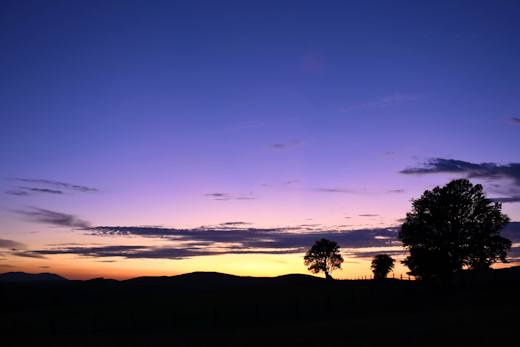
Why purple? Fine volcanic aerosols in the stratosphere scatter blue light which, when mixed with ordinary sunset red, produce a purple hue.
The effect is going strong so long after the eruption because Raikoke had help: On Aug. 3rd, New Guinea's Ulawun volcano also punched through to the stratosphere, adding its own emissions to that of Raikoke.
Purple isn't the only thing to look for, says atmospheric optics expert Les Cowley. In addition, he advises, sky watchers should "be alert for a very bright yellow twilight arch, fine cloud structure in the arch seen through binoculars, and long diffuse rays and shadows."
Realtime Volcanic Sunset Photo Gallery
Free: Spaceweather.com Newsletter
THE SPACE PEARL: It's the first pearl in the stratosphere. On Aug. 19, 2019, the students of Earth to Sky Calculus launched a cosmic ray balloon to the edge of space, 104,002 ft high. This sterling silver pearl necklace went along for the ride:
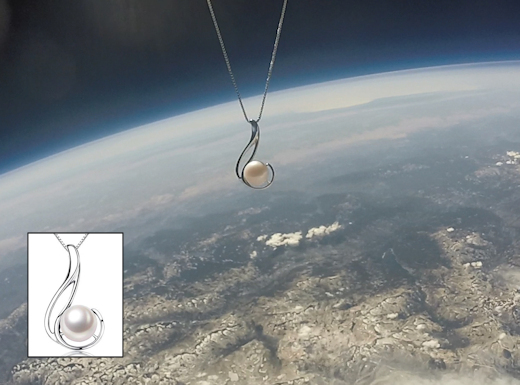
You can have it for $169.95. The students are selling these pearls to support their cosmic ray ballooning program. Each cultured "space pearl" comes with greeting card showing the necklace in flight and telling the story of its journey to the edge of space and back again. These make great birthday and Christmas gifts.
Far Out Gifts: Earth to Sky Store
All sales support hands-on STEM education