ARCTIC AURORA WATCH: A stream of solar wind flowing from a southern hole in the sun's atmosphere could graze Earth's magnetic field on Sept. 17-18. Arctic sky watchers should be alert for auroras mixed with gibbous moonlight when the gaseous material arrives. Aurora alerts: SMS Text.

IT MUST BE SEPTEMBER: Studies show that September is one of the very best months for auroras. At this time of year around the Arctic Circle, the lights often appear for no apparent reason. That's exactly what happened last night. With no geomagnetic storm to provoke a display, one appeared anyway:


Jani Ylinampa took the picture from Rovaniemi, Finland. "These were quite bright auroras, lighting up the sky even with the nearly full Moon as competition," says Ylinampa. "This was the best show of the season so far, without exaggeration!"
What supercharges the auroras of September? It's called the "Russell-McPherron effect," named after the researchers who first explained it. During weeks around equinoxes, cracks open in Earth's magnetic field. Solar wind pours in and fuels unexpected displays of aurora borealis. Stay tuned for even more as the actual equinox approaches on Sept. 23rd. Aurora alerts: SMS Text.
Realtime Aurora Photo Gallery
Free: Spaceweather.com Newsletter
THIS IS NOT A NUCLEAR EXPLOSION: Fortunately, not everything is as it seems. In San Francisco, CA, Friday the 13th ended with a mushroom cloud on the horizon. It was not a nuclear explosion. "It was a sunset mirage," explains Mila Zinkova, who photographed the phenomenon:

"Friday the 13th was a hot, calm day in San Francisco," says Zinkova. "The horizon was relatively clear and we could see mirages of ships and distant lands from the beach. This made me decide to film the sunset."
Good decision. Warm air, strong temperature gradients, and at least one temperature inversion sliced the image of the setting sun into multiple distorted layers. Briefly, the sun assumed the form of a mushroom cloud, followed by an astonishing rectangular sun. But the best was yet to come.

"The sunset ended with a high green flash," says Zinkova.

This was rare indeed. Most green flashes occur right at the sea surface. This one, however, was suspended high above waters. A strong kink in the temperature gradient thousands of feet above sea level magnified usually small differences in refraction between red and green light, creating a "floating green flash."
"The last miraged image of the sun melted into the sunset sky more than 2 minutes after the predicted time of sunset, which shows how strong and anomalous the refraction was," says Zinkova. "If there were no atmospheric extinction, I probably would have been able to see the miraged sun for another few minutes." Zinkova's full video of the event may be found here. 
Realtime Space Weather Photo Gallery
Free: Spaceweather.com Newsletter
CRYSTAL STARSHIP ENTERPRISE: Last month, the students of Earth to Sky Calculus launched the starship Enterprise to the stratosphere. Riding onboard a high-altitude cosmic ray balloon, the laser-etched crystal spaceship traveled 34.7 km (113,845 feet) above Earth's surface:
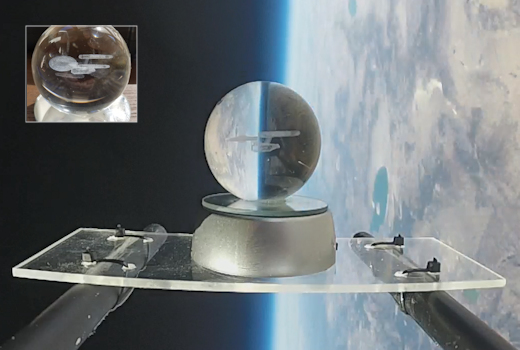
You can have it for $149.95. The students are selling the Enterprise to support their cosmic ray ballooning program. Each starship comes with a greeting card showing the item in flight and telling the story of its journey to the edge of space. Also included is a multi-colored LED illuminated stand (shown in the picture above). This creates a colorful visual effect and allows the Enterprise to be used as a far-out night light.
Far Out Gifts: Earth to Sky Store
All sales support hands-on STEM education