ARCTIC AURORA WATCH: A stream of solar wind flowing from a southern hole in the sun's atmosphere could graze Earth's magnetic field on Sept. 17-18. Arctic sky watchers should be alert for auroras mixed with gibbous moonlight when the gaseous material arrives. Aurora alerts: SMS Text.

THE ANALEMMA OF BUDAPEST: If you took a picture of the sun at the same time each day, would it remain in the same position? The answer is no, and the figure-8 shape traced out by the sun over the course of a year is called an analemma.
Hunarian photographer György Soponyai stitched together more than 30 pictures spanning 12 months to reveal the analemma of 2018-2019 over the city of Budapest:

"My analemma project started on Sept. 24, 2018, and continued until Sept. 15, 2019," says Soponyai. "All of the pictures were taken at local noon (11:44 CET) in Budapest from the Margaret Bridge, looking south. This position offers not only an excellent view of the midday sun but also a breathtaking panorama of our capital city: The Hungarian Parliament, the Chain Bridge, the Castle of Buda and the riverbank of Danube -- no wonder this area has been a UNESCO World Heritage Site since 1987."
The upper and lower tips of the "8" represent the solstices--the longest and shortest days of the year. Today the Hungarian sun is near the middle--a sign that autumn is approaching on Sept. 23rd.
"I took the foreground photo on Dec. 13, 2018, about a week before the winter solstice," says Soponyai. "It's the lowest sun just behind the clouds."
Other planets have analemmas, too. Not all are figure-8s, however. The shape depends on the tilt of the planet's spin axis and the eccentricity of its orbit around the sun. Martian analemmas resemble a teardrop, while Jupiter's analemma looks like a jelly-bean:

courtesy: analemma.com
Click here and scroll down to learn more about alien analemmas.
SPACE STATION RADAR SOUNDS: Every day, 24/7, France's GRAVES space surveillance radar scans the skies for satellite and meteor passing over Europe. While GRAVES is monitoring the heavens, Heiko Ulbricht of Freital, Germany, is monitoring GRAVES. He uses a 143 MHz antenna and receiver to listen in to "pings" as objects pass over the radar site in neighboring France. On Sept. 16th he caught a big one:
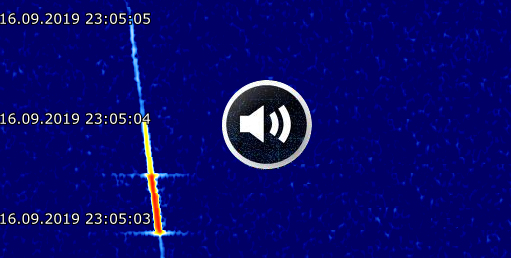
"It was the International Space Station," says Ulbricht. The massive, metallic ISS makes a wonderful target for Earth-based radars, and it created a loud reflection of GRAVE's radar beam. "The signal at 21:05:03 UT was very strong," he says--not surprising given that the ISS is wider than a full-sized football field.
"The Doppler effect was strong as well," he adds. "You could hear the shifting frequency of the reflection as the space station raced overhead at 17,000 mph."
Realtime Space Weather Photo Gallery
Free: Spaceweather.com Newsletter
THE ANTARES PENDANT: Are you looking for a far-out gift? Consider the Antares Pendant. On Aug. 19, 2019, the students of Earth to Sky Calculus launched a cosmic ray balloon to the edge of space, 104,002 ft high. This ruby-red crystal necklace went along for the ride:
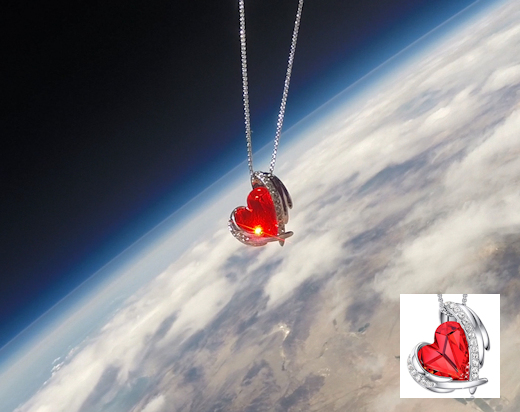
You can have it for $179.95. The students are selling these white gold-plated pendants to support their cosmic ray ballooning program. The glittering Swarovski crystal has a deep ruby hue inspired by the red-supergiant star Antares in Scorpio. Each one comes with greeting card showing the pendant in flight and telling the story of its journey to the edge of space and back again.
Far Out Gifts: Earth to Sky Store
All sales support hands-on STEM education