THE NEXT SOLAR WIND STREAM: Earth is currently moving through a void between significant streams of solar wind. The next impulse of gas from the sun is expected on Sept. 23rd when an equatorial hole in the sun's atmosphere firehoses Earth. Waning moonlight will favor visibility of Arctic auroras. Aurora alerts: SMS Text.
HOW RAINBOWS SUCK LIGHT OUT OF THE SKY: A few days ago in Östersund, Sweden, Göran Strand saw a beautiful double rainbow. The arcing colors, however, were not what attracted his attention. "The amazing thing was the dark band between them!" he says.

"This band is called Alexander's dark band after Alexander of Aphrodisias who first described the effect in 200 AD." says Strand.
All double rainbows are separated by such a band. The bright primary bow (on the left) is formed by light reflected once inside raindrops. The less-bright secondary bow (on the right) is formed by light reflected twice inside raindrops. These reflections, single vs. double, scatter light in opposite directions. In between the two rainbows, light is simply not bent toward the observer, so it looks dark.
And that's how rainbows can suck light out of the sky. Find more examples in the Realtime Rainbow Photo Gallery!
SPACE STATION RADAR SOUNDS: Every day, 24/7, France's GRAVES space surveillance radar scans the skies for satellite and meteor passing over Europe. While GRAVES is monitoring the heavens, Heiko Ulbricht of Freital, Germany, is monitoring GRAVES. He uses a 143 MHz antenna and receiver to listen in to "pings" as objects pass over the radar site in neighboring France. On Sept. 16th he caught a big one:
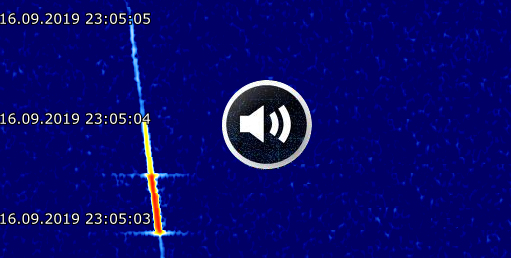
"It was the International Space Station," says Ulbricht. The massive, metallic ISS makes a wonderful target for Earth-based radars, and it created a loud reflection of GRAVE's radar beam. "The signal at 21:05:03 UT was very strong," he says--not surprising given that the ISS is wider than a full-sized football field.
"The Doppler effect was strong as well," he adds. "You could hear the shifting frequency of the reflection as the space station raced overhead at 17,000 mph."
Realtime Space Weather Photo Gallery
Free: Spaceweather.com Newsletter
THE ANTARES PENDANT: Are you looking for a far-out gift? Consider the Antares Pendant. On Aug. 19, 2019, the students of Earth to Sky Calculus launched a cosmic ray balloon to the edge of space, 104,002 ft high. This ruby-red crystal necklace went along for the ride:
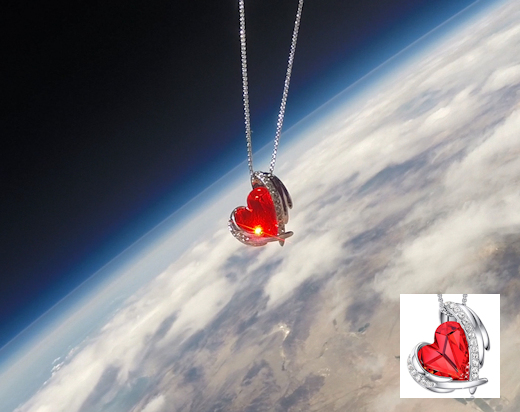
You can have it for $179.95. The students are selling these white gold-plated pendants to support their cosmic ray ballooning program. The glittering Swarovski crystal has a deep ruby hue inspired by the red-supergiant star Antares in Scorpio. Each one comes with greeting card showing the pendant in flight and telling the story of its journey to the edge of space and back again.
Far Out Gifts: Earth to Sky Store
All sales support hands-on STEM education