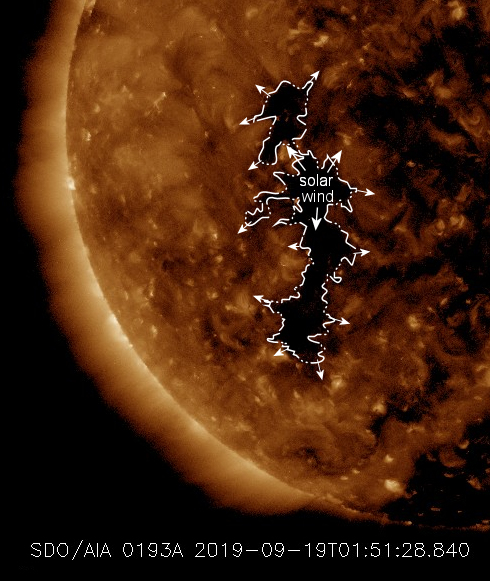
THE NEXT SOLAR WIND STREAM: Earth is currently moving through a void between significant streams of solar wind. The next impulse of gas from the sun is expected on Sept. 23rd when a narrow hole in the sun's atmosphere firehoses Earth. Waning moonlight will favor visibility of Arctic auroras. Aurora alerts: SMS Text.
HUGE SOLAR PROMINENCE: For the past two days, amateur astronomers around the world have been monitoring a wall of plasma dancing along the sun's southeastern limb. "It is a huge solar prominence," reports Martin Wise, who photographed the structure today from his backyard observatory in Trenton, Florida:
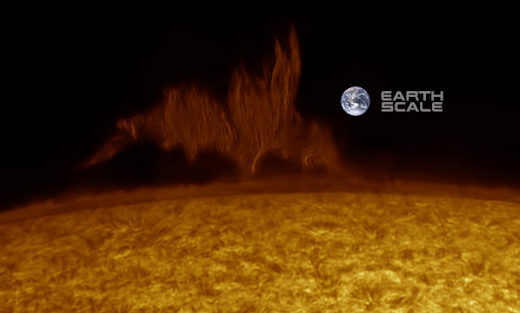
"I used a 200 mm telescope and an H-alpha filter to take the picture," Wise explains. "H-alpha" filters are tuned to the red glow of solar hydrogen, beautifully revealing hot hydrogen-rich structures like this one.
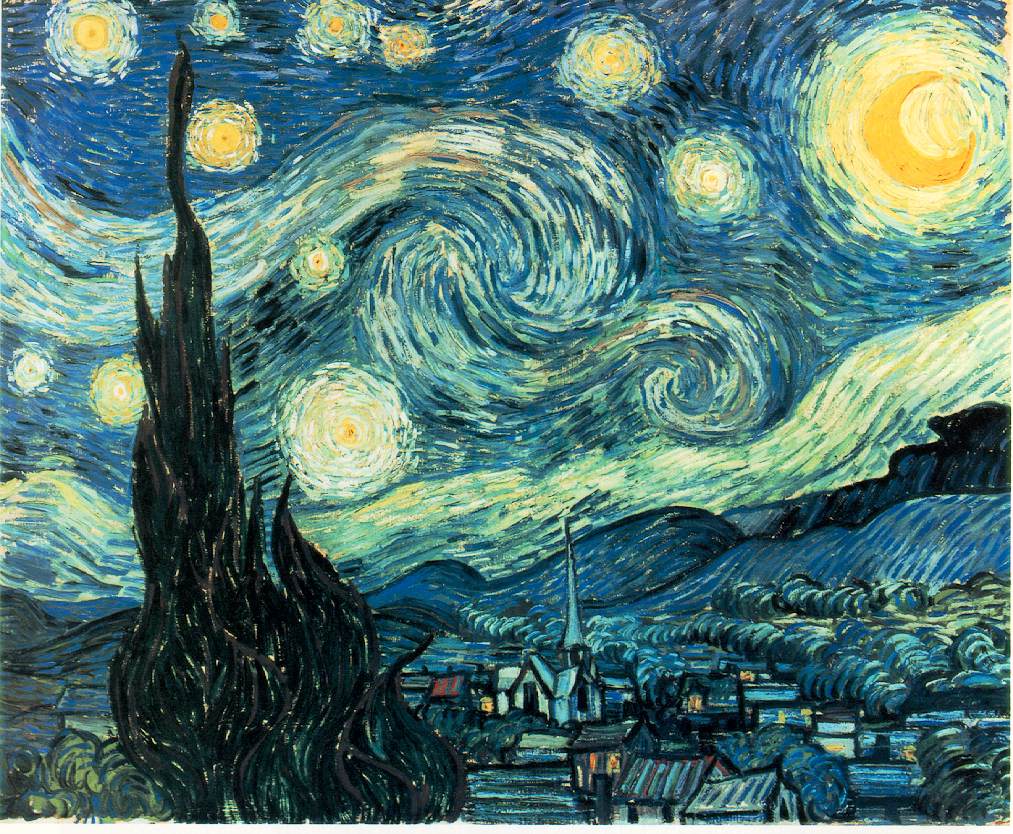
This is a type of prominence called a "hedgerow prominence" because some of them resemble trimmed shrubs. Hot glowing plasma inside the structure is held aloft by unstable solar magnetic fields. NASA and Japanese space telescopes have taken high resolution images of similar prominences and seen some amazing things such as (1) tadpole-shaped plumes that float up from the base of the prominence; (2) narrow streams of plasma that descend from the top like waterfalls; and (3) swirls and vortices that resemble van Gogh's Starry Night.
Got a solar telescope? Take a look!
Realtime Space Weather Photo Gallery
Free: Spaceweather.com Newsletter
PERSISTENT PURPLE SUNSETS: How long does volcanic gas linger in the stratosphere? Sky watchers around the world are seeing for themselves. Three months after the Raikoke volcano spewed a plume of sulfurous gas into the stratosphere, sunsets are still turning purple. Here's the latest plum-colored sunset from Lavallette, New Jersey:
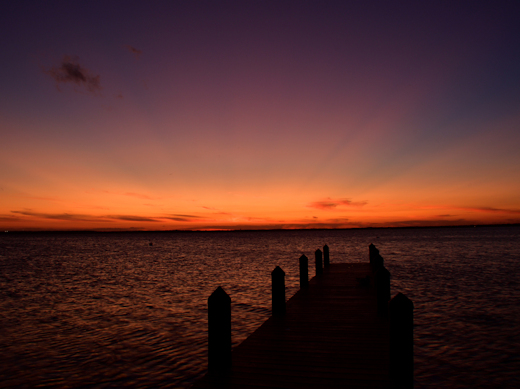
"The purple color became prominent about 20 minutes after sunset," says Joseph Golebieski, who took the picture on Sept. 18th. "I used a Nikon D500 digital camera set at ISO 200 for a 1/5s exposure."
Why purple? Fine volcanic aerosols in the stratosphere scatter blue light which, when mixed with ordinary sunset red, produces a violet hue. The stratosphere is laced with emissions not only from Raikoke in the Kirul islands, but also from the Ulawun volcano in New Guinea. Plumes from both punched through to the stratosphere during summer 2019.
Research shows that sulfurous gas in the stratosphere can linger for as much as 3 years. Sulfur dioxide in the stratosphere combines with water to form sulfuric acid aerosols. Eventually, the droplets grow large enough to fall to Earth--but the process is slow. This means purple sunsets could continue for some time to come.
Realtime Volcanic Sunset Photo Gallery
Free: Spaceweather.com Newsletter
3D LASER-ETCHED MOON: On August 16, 2018, the students of Earth to Sky Calculus launched a cosmic ray balloon to the stratosphere. This unique laser-etched Moon cube went along for the ride, ascending to an altitude of 101,140 feet:
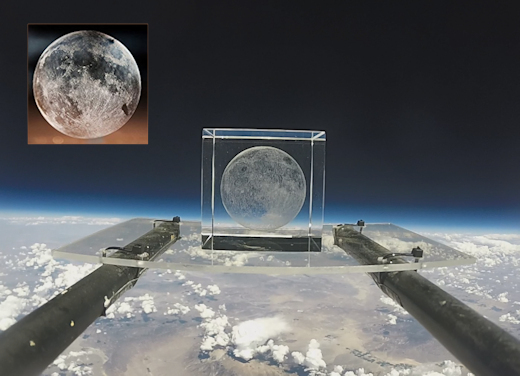
You can have it for $119.95. The students are selling these cubes as a fund-raiser for their cosmic ray ballooning program. It's an authentic representation of the Moon, with all of the craters, mountains and lava plains accurately portrayed.
Each Moon-cube comes with a unique gift card showing the item floating at the top of Earth's atmosphere. The interior of the card tells the story of the flight and confirms that this gift has been to the edge of space and back again.
Far Out Gifts: Earth to Sky Store
All sales support hands-on STEM education