CAN YOU SEE INTERSTELLAR COMET BORISOV? Answer: Probably not. Interstellar Comet Borisov (C/2019 Q4) is currently very dim (magnitude +17) and unless something truly bizarre happens, it's going to stay that way. At closest approach in December, Comet Borisov will still be 2 AU (300 million km) away from the sun. Feeble solar heating will increase the comet's brightness only a little to magnitude +15--that is, 4000 times too faint to see with the naked eye. Now for the good news: Comet Borisov is truly bizarre, so the unexpected could happen. [photo gallery]
NORTHERN LIGHTS AND A LUNAR FOGBOW: The end of summer is a good time to be in Aslaska. Specifically, on the foggy banks of the Coleville River Delta. Last night, photographer James Helmericks was there, and this is what he saw:

"Bright moonlight created a fogbow as Northern Lights rippled across the sky," says Helmericks. "At one point, the fogbow brightened so much it created a reflection in the river."

Fogbows are close cousins of rainbows, and they are formed in essentially the same way: light bounces in and out of water droplets. The difference is droplet size. Large raindrops make rainbows. Smaller droplets of water make fogbows. Small droplets don't separate the colors of sunlight as widely as large raindrops do. In a fogbow, therefore, the colors are smeared together, producing a ghostly-white arc.
The auroras were an autumnal bonus. There was no geomagnetic storm in progress, however, no storm was required. At this time of year, during nights around the equinox, cracks open in Earth's magnetic field. Solar wind pours in to fuel Arctic lights. Aurora alerts: SMS Text.
Realtime Aurora Photo Gallery
Free: Spaceweather.com Newsletter
SPACE STATION FLIES THROUGH A RAIKOKE SUNSET: On June 22nd, astronauts on board the International Space Station photographed a volcanic eruption so large, it could be seen from Earth orbit. The Raikoke volcano in the Kirul Islands sent a plume of gas all the way up into the stratosphere. Three months later, a photographer from a small village in Iran saw the ISS fly through a purple "Raikoke sunset."

"At the end of the day on Sept. 19th, I was waiting for the space station to appear when the sky turned purple," says Ali Norouzi Varankeshi of Baraghan, Iran. "It was a volcanic sunset, and the ISS flew right through it. I photographed the flyby from a hillside overlooking the city lights of nearby Karaj."
Months after the astronauts first noticed Raikoke, its emissions are still lingering in the upper atmosphere. Fine volcanic aerosols in the stratosphere scatter blue light which, when mixed with ordinary sunset red, produces a purple hue. Last month, the Ulawun volcano in New Guinea also sent sulfurous gases into the stratosphere, enhancing the effect.
People around the world are seeing these purple sunsets--not every night, because the volcanic gas is patchy, but often. The purple color is usually preceded by a yellow arch hugging the horizon. As the sun sets, violet beams emerge from the yellow, overlapping to fill the western sky with a soft purple glow.
Realtime Volcanic Sunset Photo Gallery
Free: Spaceweather.com Newsletter
3D LASER-ETCHED MOON: On August 16, 2018, the students of Earth to Sky Calculus launched a cosmic ray balloon to the stratosphere. This unique laser-etched Moon cube went along for the ride, ascending to an altitude of 101,140 feet:
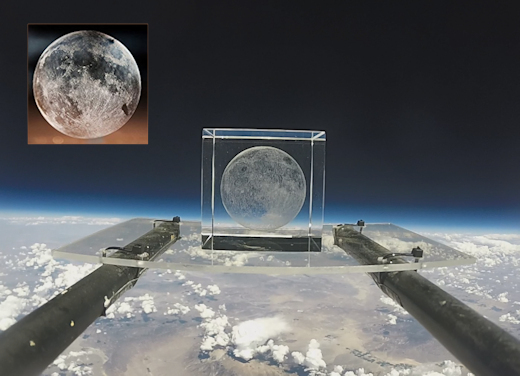
You can have it for $119.95. The students are selling these cubes as a fund-raiser for their cosmic ray ballooning program. It's an authentic representation of the Moon, with all of the craters, mountains and lava plains accurately portrayed.
Each Moon-cube comes with a unique gift card showing the item floating at the top of Earth's atmosphere. The interior of the card tells the story of the flight and confirms that this gift has been to the edge of space and back again.
Far Out Gifts: Earth to Sky Store
All sales support hands-on STEM education