THE SOLAR WIND IS COMING: A hole in the sun's atmosphere is facing Earth and spewing a stream of solar wind in our direction. Estimated time of arrival: Sept. 23-24. Arriving on the first day of northern autumn, the gaseous material could spark a nice display of equinox auroras around the Arctic Circle. Aurora alerts: SMS Text.

EQUINOX AURORAS: Auroras love equinoxes. At this time of year even a gentle gust of solar wind can spark bright auroras around the Arctic Circle. Ben Coopersends this example of the phenomenon from Reine, Norway:

"It unbelievable show last night in the Lofoten islands," says Cooper.
No geomagnetic storm was in progress on Sept. 21st when Cooper took the picture. Instead, a minor solar wind stream was brushing against Earth's magnetic field--barely elevating the background density and speed of gaseous material flowing around our planet.
What happened? It's called the "Russell-McPherron effect." During weeks around equinoxes, cracks open in Earth's magnetic field, allowing solar wind to enter and ignite Arctic auroras. This effect will continue in the nights ahead as the autumnal equinox approaches and the solar wind continues to blow. Happy Equinox!
Realtime Aurora Photo Gallery
Free: Spaceweather.com Newsletter
SPACE STATION FLIES THROUGH A RAIKOKE SUNSET: On June 22nd, astronauts on board the International Space Station photographed a volcanic eruption so large, it could be seen from Earth orbit. The Raikoke volcano in the Kirul Islands sent a plume of gas all the way up into the stratosphere. Three months later, a photographer from a small village in Iran saw the ISS fly through a purple "Raikoke sunset."

"At the end of the day on Sept. 19th, I was waiting for the space station to appear when the sky turned purple," says Ali Norouzi Varankeshi of Baraghan, Iran. "It was a volcanic sunset, and the ISS flew right through it. I photographed the flyby from a hillside overlooking the city lights of nearby Karaj."
Months after the astronauts first noticed Raikoke, its emissions are still lingering in the upper atmosphere. Fine volcanic aerosols in the stratosphere scatter blue light which, when mixed with ordinary sunset red, produces a purple hue. Last month, the Ulawun volcano in New Guinea also sent sulfurous gases into the stratosphere, enhancing the effect.
People around the world are seeing these purple sunsets--not every night, because the volcanic gas is patchy, but often. The purple color is usually preceded by a yellow arch hugging the horizon. As the sun sets, violet beams emerge from the yellow, overlapping to fill the western sky with a soft purple glow.
Realtime Volcanic Sunset Photo Gallery
Free: Spaceweather.com Newsletter
THE SPACE PEARL: It's the first pearl in the stratosphere. On Aug. 19, 2019, the students of Earth to Sky Calculus launched a cosmic ray balloon to the edge of space, 104,002 ft high. This sterling silver pearl necklace went along for the ride:
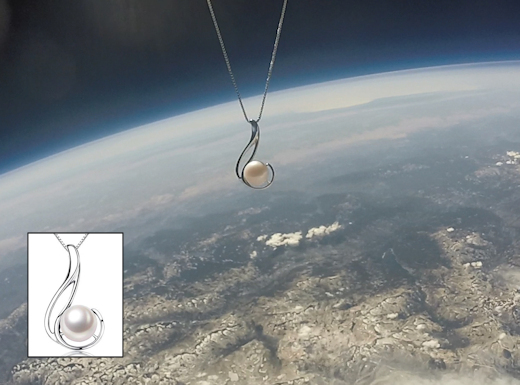
You can have it for $169.95. The students are selling these pearls to support their cosmic ray ballooning program. Each cultured "space pearl" comes with greeting card showing the necklace in flight and telling the story of its journey to the edge of space and back again. These make great birthday and Christmas gifts.
Far Out Gifts: Earth to Sky Store
All sales support hands-on STEM education