A SUMMER WITHOUT SUNSPOTS: The sun is undergoing a remarkable period of spotlessness. During northern summer 2019, the face of the sun was blank (no sunspots) more than 89% of the time. This marks it as one of the deepest Solar Minima in a century. Interestingly, the summer of 2019 also brought a sign that Solar Minimum is coming to an end. Get the full story from Dr. Tony Phillips.
GEOMAGNETIC STORM WARNING: A large hole in the sun's atmosphere is facing Earth and spraying solar wind in our direction. Estimated time of arrival: Sept. 28. NOAA forecasters say G1- and G2-class geomagnetic storms are possible when the gaseous material reaches Earth.



We've seen this "coronal hole" before. It previously faced Earth a month ago. Solar wind emerging at 750 km/s firehosed our planet's magnetosphere on Aug. 31st-Sept. 1st, sparking G2-class geomagnetic storms. In the USA, auroras were sighted in multiple states including Wisconsin, Michigan, Montana, Wyoming, Idaho, and Maine.
A repeat performance is possible in the nights ahead. Sign up for Space Weather Alerts and receive a text message when auroras appear in your area.
Realtime Aurora Photo Gallery
Free: Spaceweather.com Newsletter
A GIGANTIC JET ABOVE TROPICAL STORM KAREN: Tropical storm Karen is currently falling apart in the Caribbean. Just before it began to decay, the storm unleashed a tremendous bolt of upper atmospheric lightning. On Sept. 24th, Frankie Lucena photographed the gigantic jet from Puerto Rico:
"This massive Gigantic Jet appeared while tropical storm Karen was just south of my location in Cabo Rojo," says Lucena. "To capture it, I used a Watec 902H Ultimate camera with a 12mm lens."
Gigantic Jets are lightning-like discharges that spring from the tops of intense thunderstorms, reaching all the way to the ionosphere 90+ km above Earth's surface. They're related to sprites, but larger and more rare. While thousands of sprites have been photographed since upper atmospheric lightning was widely recognized in the 1980s, only dozens of Gigantic Jets have been seen.
Although Gigantic Jets are rare, Lucena ha s been recording them for years. He trains his video camera on storms passing by Puerto Rico. It helps when the storms are 100 km or more away because then he can see over the tops of the clouds. This satellite map shows the viewing geometry on Sept. 24th:


Interestingly, he finds that Gigantic Jets tend to come from weaker storms. Hurricanes produce few, while tropical storms and tropical waves produce more. Decaying tropical storm Karen was typical.
"We are still in the early stages of understanding why certain storms produce Gigantic Jets," says Oscar. "Observations like Lucena's are helpful in improving our understanding of this rare phenomenon."
Realtime Sprite Photo Gallery
Free: Spaceweather.com Newsletter
PURPLE HEART SPACE PENDANT: Nothing says "I Love You" like a heart-shaped pendant from the edge of space. Last week, the students of Earth to Sky Calculus flew an array of cosmic ray sensors to the stratosphere onboard a giant helium balloon. This purple heart went along for the ride:
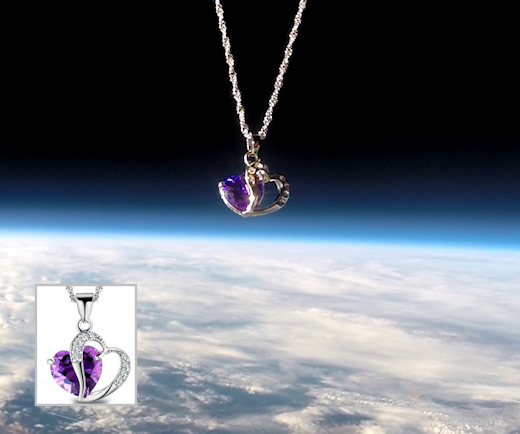
You can have it for $129.95. The students are selling these pendants as a fund-raiser for their cosmic ray monitoring program. They make great anniversary, birthday and Christmas gifts. Each pendant comes with a greeting card showing the jewelry in flight and telling the story of its journey to the stratosphere and back again.
Far Out Gifts: Earth to Sky Store
All sales support hands-on STEM education