MINOR GEOMAGNETIC STORMS: Minor G1-class geomagnetic storms are in progress on Sept. 28th as a fast-moving stream of solar wind buffets Earth's magnetic field. The gaseous material is flowing from a large hole in the sun's atmosphere. So far, predictions that the storm might intensify to category G2 (moderately strong) have not been realized. However, Earth is expected to remain inside the stream for another ~24 hours, so stronger storms may yet occur. Aurora alerts: SMS Text



This may be a 'minor' storm, but last night it was strong enough to create a beautiful display of auroras over Denmark. "My first capture of aurora this season!" reports Ruslan Merzlyakov, who sends this picture from Nykøbing Mors:

"I was really excited to be able to stay for almost 4 hours and enjoy the night lights dancing over the water," says Merzlyakov. "Watch the timelapse video here."
Realtime Aurora Photo Gallery
Free: Spaceweather.com Newsletter
MAGNETIC VIBRATIONS: What happens when a stream of solar wind traveling 1.5 million mph hits Earth's magnetic field? The magnetic field vibrates. In Preston, UK, Stuart Green has been monitoring this weekend's solar wind event using a magnetometer in his backyard:

"Earth's magnetic field has definitely been vibrating in response to a stream of fast flowing solar wind racing from a large coronal hole," says Green.
Indeed, the wild swings on his plot are the textbook definition of a geomagnetic storm--in this case, category G1. They are the magnetic manifestation of auroras dancing at the same time around Arctic Circle.
"The sensor is buried in my garden about 0.5 meters below the surface in an East/West orientation," he explains. "This allows very sensitive (sub nanotesla) measurements of magnetic declination during geomagnetic storms. The plot shows the change in magnetic flux density in nanotesla occurring between readings every few minutes."
Realtime Aurora Photo Gallery
Free: Spaceweather.com Newsletter
THE FULL MOON PENDANT: Poets, lovers, and artists have long known this simple truth: Nothing is more romantic than a full Moon. Now you can give the full Moon as a gift--the full Moon space pendant, that is. This one flew to the stratosphere onboard an Earth to Sky Calculus cosmic ray balloon:
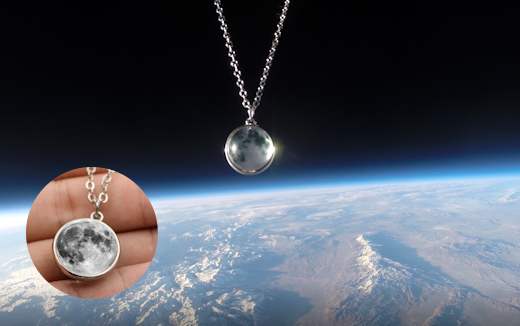
You can have it for $119.95. The students are selling these spherical glass pendants to support their cosmic ray ballooning program. Each one comes with a Valentine's card showing the pendant in flight and telling the story of its journey to the edge of space and back again.
Far Out Gifts: Earth to Sky Store
All sales support hands-on STEM education