A SUNSPOT EMERGES: Breaking a string of 27 spotless days, a new sunspot is emerging near the sun's southeastern limb. It is crackling with minor B-class solar flares. The latitude of the active region suggests it is a member of old Solar Cycle 24. This sunspot is notable only because sunspots are so rare during a deep Solar Minimum such the the one currently in progress. Stormy space weather is not expected. Aurora alerts: SMS Text.
A GREEN FLASH ON VENUS: You've heard of green flashes on the sun. But what about green flashes on Venus? They're real, and now is a good time to observe them. All you need is a body of water, a sunset, and a telescope.
"I saw one last week," reports eye-witness Paolo Palma of Rome, Italy. "At the end of the day on Sept. 26th I was watching the sunset from my deck overlooking the Tyrrhenian Sea. A fragment of the setting sun seemed to break away and turn a strong shade of green, like a leaf falling on the nearby sea."

It was a green flash--something that happens fairly often to the setting sun when temperature inversions and strong thermal gradients develop above the sea surface.
"The sky was clear," continues Palma, "and I had my Dobsonian telescope with me. I decided to swing my telescope up to Venus, which itself was only a few degrees above the horizon. As it sank toward the sea, it had a green flash, too!"

Green flashes on the sun happen because the low atmosphere acts like a prism, splitting the solar disk into primary R-G-B colors. Temperature gradients above the sea surface can magnify the green into an eye-catching flash. It's a type of mirage.
The same physics that makes green flashes on the sun can make green flashes on Venus. In fact, green flashes on Venus may be even easier to create.
Atmospheric optics expert Les Cowley explains: "Planets and especially point-source stars need less stringent conditions as evidenced by Paolo's observation of Venus spreading into a color strip while it was still well above the horizon. Mirages just do not get that high. Normal atmospheric refraction is sufficient to do this." When Venus approaches the horizon, mirage conditions kick in, magnifying the green for a truly verdant flash.

Now is a good time to observe Venusian green flashes. The second planet is just emerging from solar conjunction. So, when the sun sets into the waves, Venus is not far behind, sampling the same thermal conditions as the green-flashing sun. Seaside sky watchers should be alert for the phenomenon in the evenings ahead.
Observing tips: Venus may not be easy to find in the bright twilight of sunset. Having trouble? Try using binoculars when the sun is safely below the horizon. Please be very careful not to accidentally look at the sun through unfiltered optics of any kind. Even when the sun is hanging low, magnified sunlight can cause serious eye damage.
Realtime Green Flash Photo Gallery
Free: Spaceweather.com Newsletter
CROWD-FUNDING SPACE WEATHER RESEARCH: Did you know that cosmic rays in Earth's atmosphere are intensifying? It's true. We're monitoring the phenomenon with regular space weather balloon flights to the stratosphere. This student science program is not supported by any government grant or corporate sponsorship. Instead, we raise our research funds by selling these:
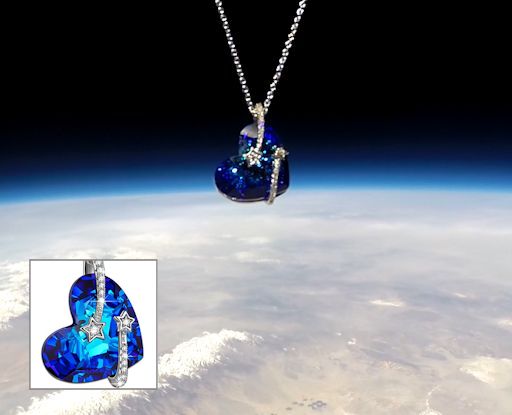
This pendant, and others like it, have touched the edge of space. We fly them to the stratosphere alongside our cosmic ray sensors for fundraising.
You can have one for $199.95. With a sterling silver backface that says "I Love You to the Moon and Back," these blue jewels make great anniversary, Christmas and birthday gifts. All sales support the Earth to Sky Calculus cosmic ray ballooning program and hands-on STEM research.
Far Out Gifts: Earth to Sky Store
All sales support hands-on STEM education