SUNSET CONJUNCTION: When the sun goes down tonight, step outside and look southwest. The crescent Moon is passing by Jupiter only a few degrees away. Try to catch them before the sky fades completely black. A bright conjunction of Jupiter and the Moon framed by twilight blue is extra beautiful. Sky map: Oct 3rd.

COSMIC RAYS ARE NEARING A SPACE AGE RECORD: Solar Minimum is underway, and it's a deep one. Sunspot counts suggest it is one of the deepest minima of the past century. The sun's magnetic field has become weak, allowing extra cosmic rays into the solar system. Neutron monitors at the Sodankyla Geophysical Observatory in Oulu, Finland, show that cosmic rays are percentage points away from a Space Age record:

Researchers at the Sodankyla Geophysical Observatory have been monitoring cosmic rays since 1964. When cosmic rays hit Earth's atmosphere, they produce a spray of secondary particles that rain down on Earth's surface. Among these particles are neutrons. Detectors in Oulu count neutrons as a proxy for cosmic rays.
As the top panel shows, cosmic rays naturally wax and wane with the 11-year solar cycle. During Solar Maximum cosmic rays are weak; during Solar Minimum they are strong. The Space Age record for cosmic rays was set in late 2009-early 2010 near the end of a very deep Solar Minimum.
Records, they say, are meant to be broken. As 2019 comes to a close, neutron counts at Oulu are approaching the very high levels seen in 2009-2010. A new record could be just weeks or months away. This is important because excess cosmic rays pose a health hazard to astronauts and polar air travelers, affect the electro-chemistry of Earth's upper atmosphere, and may help trigger lightning.

Because cosmic rays are such an important form of space weather, we've added a new data feed to our web site. It's right here. Every day you can see how Oulu neutron counts are changing. The values are expressed as percentages of the "Space Age average"--that is, the average of all neutron counts since 1964.

This data feed is made possible by the extraordinary dedication and decades-long monitoring program of the Sodankyla Geophysical Observatory in Oulu, Finland. Thank you!
Realtime Space Weather Photo Gallery
Free: Spaceweather.com Newsletter
THE ANTARES PENDANT: Are you looking for a far-out gift? Consider the Antares Pendant. On Aug. 19, 2019, the students of Earth to Sky Calculus launched a cosmic ray balloon to the edge of space, 104,002 ft high. This ruby-red crystal necklace went along for the ride:
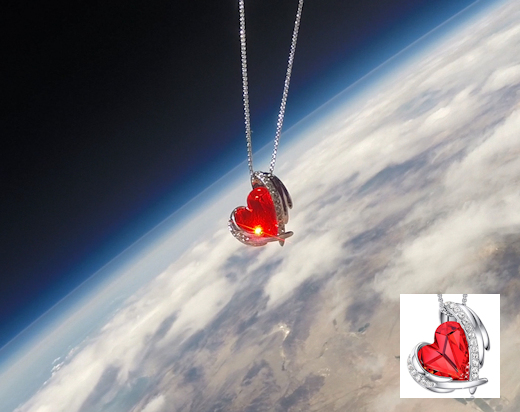
You can have it for $179.95. The students are selling these white gold-plated pendants to support their cosmic ray ballooning program. The glittering Swarovski crystal has a deep ruby hue inspired by the red-supergiant star Antares in Scorpio. Each one comes with greeting card showing the pendant in flight and telling the story of its journey to the edge of space and back again.
Far Out Gifts: Earth to Sky Store
All sales support hands-on STEM education