NEW COSMIC RAY DATA FEED ON SPACEWEATHER.COM: As Solar Minimum deepens, cosmic rays are intensifying. You can now watch the daily change in radiation right here on Spaceweather.com. A new data feed displays neutron monitor measurements from the University of Oulu's Cosmic Ray Station in Finland. Radiation levels are now just percentage points away from setting a Space Age record: full story.

IRISH SKIES TURN PURPLE: Decaying hurricane Lambert swept past Ireland yesterday. Curiously, when the skies cleared they weren't blue. "They were purple," reports John Murphy, who sends this picture from Cork City:

"As Oct. 3rd came to an end, strong gusts and heavy rain eventually gave way to this volcanic sunset," he says.
That's right. Hurricane Lambert didn't cause the strangely colored sunset. The Raikoke volcano did. Located in Russia's Kuril islands, Raikoke erupted on June 22nd, pushing volcanic aerosols high into the stratosphere. They're still up there. Apparently, one of the sulfurous plumes followed Hurricane Lambert across Ireland Oct 3rd, painting the sunset sky with unusual color.
Why purple? Fine volcanic aerosols in the stratosphere scatter blue light which, when mixed with ordinary sunset red, produces a purple hue. Months after Raikoke erupted, sky watchers around the world are still seeing purple skies when its emissions float by. Browse the gallery for more examples.
Realtime Volcanic Sunset Photo Gallery
Free: Spaceweather.com Newsletter
A MULTIPLE ANALEMMA: If you took a picture of the sun at the same time each day, would it remain in the same position? The answer is no, and the figure-8 shape traced out by the sun over the course of a year is called an analemma. Over the years, Spaceweather.com has featured many beautiful analemmas ... but none like this. John Dartnell of North Wiltshire, UK, photographed the sun 24 times a day for a whole year, creating a rare multiple "biscuit tin" analemma:

"I made a pinhole camera from a biscuit tin," explains Dartnell. "Exposures were controlled by a battery driven clock. A rotating disc with a cut out slot acted as a shutter to give an exposure every hour. The resulting image shows six analemmas with traces of three others."


In all, this one picture captures 12 months of exposure time on a single photographic paper--from Sept. 2018 to Sept. 2019. The upper and lower tips of each "8" represent the solstices--the longest and shortest days of the year. Equinoxes occur near the necks.
"Making an analemma in the UK is a challenge because of our cloudy weather," says Dartnell. "You can't consistently see the sun at noon. That why I decided on this approach of setting up a pinhole camera that could record the sun at intervals throughout the day. As you can imagine, at the end of the year I opened up the tin with a mixture of great anticipation and potential disappointment. I was glad to see it was a success."
Realtime Analemma Photo Gallery
Free: Spaceweather.com Newsletter
THE ANTARES PENDANT: Are you looking for a far-out gift? Consider the Antares Pendant. On Aug. 19, 2019, the students of Earth to Sky Calculus launched a cosmic ray balloon to the edge of space, 104,002 ft high. This ruby-red crystal necklace went along for the ride:
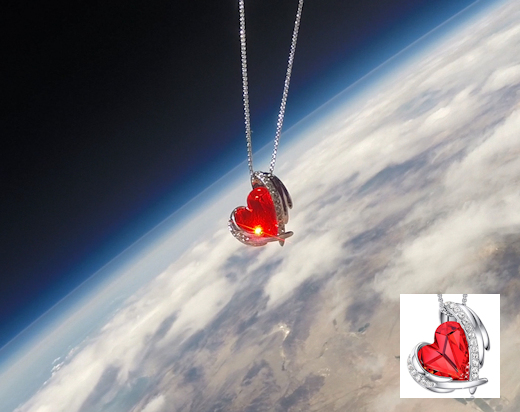
You can have it for $179.95. The students are selling these white gold-plated pendants to support their cosmic ray ballooning program. The glittering Swarovski crystal has a deep ruby hue inspired by the red-supergiant star Antares in Scorpio. Each one comes with greeting card showing the pendant in flight and telling the story of its journey to the edge of space and back again.
Far Out Gifts: Earth to Sky Store
All sales support hands-on STEM education