NEW COSMIC RAY DATA FEED ON SPACEWEATHER.COM: As Solar Minimum deepens, cosmic rays are intensifying. You can now watch the daily change in radiation right here on Spaceweather.com. A new data feed displays neutron monitor measurements from the University of Oulu's Cosmic Ray Station in Finland. Radiation levels are now just percentage points away from setting a Space Age record: full story.

THE 2019 TRANSIT OF MERCURY: Mark your calendar: On Monday, Nov 11th, Mercury will pass directly in front the sun. The rare transit begins at 12:35 UT (7:35 am EST) and lasts for almost six hours. Mercury's tiny form—jet black and perfectly round—will glide slowly across the solar disk, as shown in this movie created by science-artist Larry Koehn of ShadowandSubstance.com:
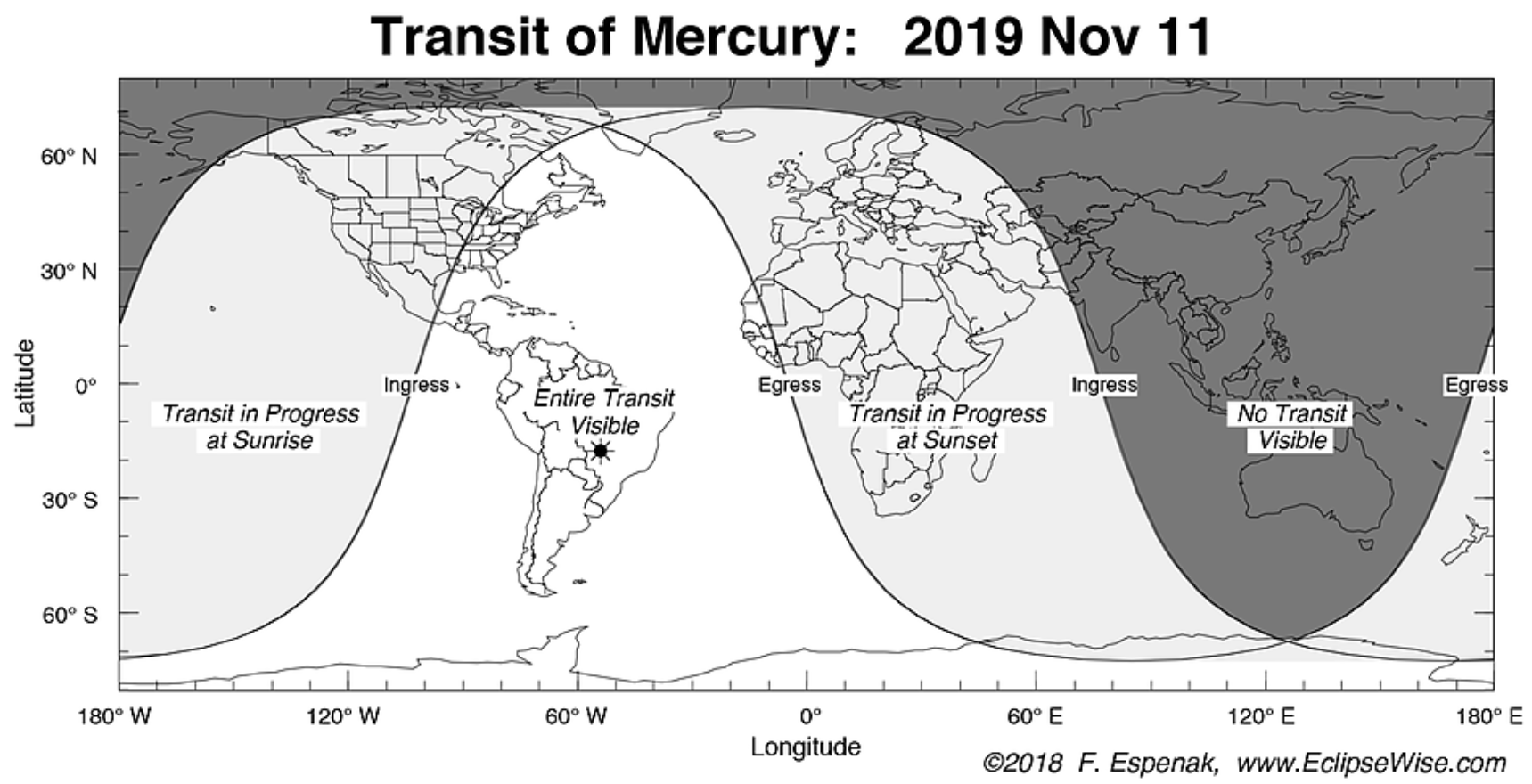
People in every continent except Australia can see at least a portion of the crossing. In the USA, the best place to be is on the Atlantic coast, where the entire transit is visible. On the Pacific coast the transit will already be in progress at sunrise.
Warning! Do not stare at the sun during the transit. Mercury covers a tiny, tiny fraction of the solar disk, so the sun remains as bright as ever. Eye damage can occur.
Eclipse glasses will keep your eyes safe, but they won't help you see Mercury. The planet is only 1/194th of the sun's apparent diameter. A safely-filtered telescope with a magnification of 50x or more is recommended to watch this event.
Nothing beats a telescope equipped with an H-alpha filter. H-alpha filters are narrowly tuned to the red glow of solar hydrogen. They reveal the sun as a boiling inferno cross-crossed by dark seething magnetic filaments. On Nov. 11th, the tiny form of Mercury will join the fray.
Transits of Mercury occur only 13 times each century. The next one won't occur until Nov. 13, 2032. Don't miss this unusual event!
Realtime Space Weather Photo Gallery
Free: Spaceweather.com Newsletter
THE NEW MOONSTONE PENDANT: Are you looking for a far-out gift? Nothing says "I love you" like a moonstone from the edge of space. On June 12th, the students of Earth to Sky Calculus flew this moonstone wrapped in a sterling silver Celtic love knot 34.1 km (111,877 feet) above Earth's surface:

You can have it for $139.95. The students are selling these pendants to support their cosmic ray ballooning program. Each one comes with a greeting card showing the item in flight and telling the story of its journey to the edge of space. Sales support the Earth to Sky Calculus cosmic ray ballooning program and hands-on STEM research.
Far Out Gifts: Earth to Sky Store
All sales support hands-on STEM education