NEW COSMIC RAY DATA FEED ON SPACEWEATHER.COM: As Solar Minimum deepens, cosmic rays are intensifying. You can now watch the daily change in radiation right here on Spaceweather.com. A new data feed displays neutron monitor measurements from the University of Oulu's Cosmic Ray Station in Finland. Radiation levels are now just percentage points away from setting a Space Age record: full story.

TWO SOLAR CYCLES ARE ACTIVE AT THE SAME TIME: Solar Minimum is here, and it is very deep. During this quiet nadir of solar activity, something happens that might surprise you: Two solar cycles become active at the same time. Yesterday's sun displayed this counter-intuitive phenomenon:
 Above: An extreme UV image of the sun with magnetic field maps inset. Credit: NASA/SDO
This image from NASA's Solar Dynamics Observatory shows two active regions on the sun--one north of the equator and once south. These are not sunspots. Instead, they are "hot spots" where magnetic fields have gathered with just enough intensity to bottle-up some glowing-hot plasma, but not quite enough strength to create a full-fledged sunspot.
The magnetic polarity of these two hot spots identifies them as members of different solar cycles (see: Hale's Law). The southern hot spot comes from old Solar Cycle 24. The northern hot spot comes from new Solar Cycle 25. Adjacent solar cycles always overlap during Solar Minimum and, indeed, this is happening right now.
If forecasters are correct, Solar Cycle 25 will gain strength in the years ahead, ultimately dispatching old Solar Cycle 24. A new Solar Maximum comprised entirely of Solar Cycle 25 sunspots should arrive as early as 2023.
Realtime Space Weather Photo Gallery
Free: Spaceweather.com Newsletter
RAIKOKE SUNRISE: You've heard of the Raikoke sunset. Now let us introduce you to the Raikoke sunrise! Jan Curtis photographed one on Oct. 5th from Vail, Arizona:

The purple color of the dawn sky is a result of the Raikoke volcano. Located in Russia's Kirul Islands, Raikoke erupted with unusual power on June 22nd, hurling a plume of sulfurous gas into the stratosphere. Months later, those fumes are still up there. Most people notice them in the form of purple sunsets. Early risers like Curtis can see the same phenomenon at sunrise.
Why purple? Fine volcanic aerosols in the stratosphere scatter blue light which, when mixed with ordinary sunrise red, produces a purple hue. Purple, however, isn't the only thing to look for. Volcanic skies are also marked by a yellow twilight arch with long diffuse rays and shadows--features which are prominent in Curtis's photo. If you're up before dawn, take a look.
Realtime Volcanic Sunset Photo Gallery
Free: Spaceweather.com Newsletter
THE NEW MOONSTONE PENDANT: Are you looking for a far-out gift? Nothing says "I love you" like a moonstone from the edge of space. On June 12th, the students of Earth to Sky Calculus flew this moonstone wrapped in a sterling silver Celtic love knot 34.1 km (111,877 feet) above Earth's surface:
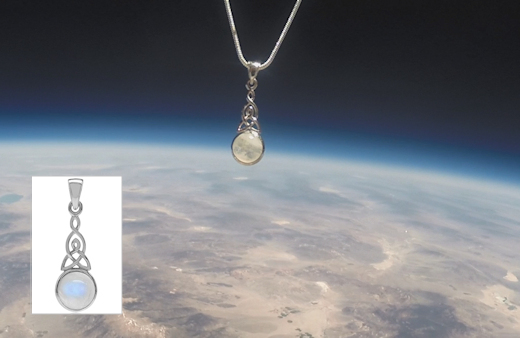
You can have it for $139.95. The students are selling these pendants to support their cosmic ray ballooning program. Each one comes with a greeting card showing the item in flight and telling the story of its journey to the edge of space. Sales support the Earth to Sky Calculus cosmic ray ballooning program and hands-on STEM research.
Far Out Gifts: Earth to Sky Store
All sales support hands-on STEM education