NEW COSMIC RAY DATA FEED ON SPACEWEATHER.COM: As Solar Minimum deepens, cosmic rays are intensifying. You can now watch the daily change in radiation right here on Spaceweather.com. A new data feed displays neutron monitor measurements from the University of Oulu's Cosmic Ray Station in Finland. Radiation levels are now just percentage points away from setting a Space Age record: full story.

ARCTIC AURORAS ARE HAPPENING NOW: There is no geomagnetic storm in progress--but sometimes you don't need one. "We're seeing beautiful auroras over Abisko, Sweden," reports Chad Blakley of Lights over Lapland. His automated webcam took this picture not long after sunset on Oct. 7th:

"What a fantastic way to start the 2019/20 aurora season," says Blakley. "Soon we will install a second webcam pointed nearly straight up. This will give us an opportunity to look directly into powerful coronas (auroras that seem to rain down from directly overhead) for the rest of the season."
Where are these auroras coming from? Small cracks are opening in Earth's magnetic field, allowing solar wind to enter the magnetosphere and fuel Northern Lights. This phenomenon, called "the Russell-McPherron effect," can produce Arctic light shows even during periods of low solar activity--that is, now.
Realtime Aurora Photo Gallery
Free: Spaceweather.com Newsletter
AN UNUSUAL FIREBALL: This weekend, NASA's Network of All Sky Meteor Cameras captured a rare fireball--a "Daytime Sextantid." Here it is disintegrating over Arizona just before sunrise on Saturday, Oct. 5th:

Daytime Sextantids are so rarely seen that the American Meteor Society says "spotting any [Daytime Sextantid] activity would be a notable accomplishment." Consider it noted. NASA cameras on Kitt Peak, Mount Lemmon, and Mount Hopkins caught the fireball in mid-flight, allowing a solid triangulation of its orbit and identification as a Daytime Sextantid.


Daytime Sextantids are related to the Geminid meteors of December. Both belong to the "Phaethon-Geminid Complex"--a complicated swarm of debris that includes "rock comet" 3200 Phaethon along with asteroids 1999 YC and 2005 UD. The ensemble appears to be the remains of a giant breakup of ... something ... thousands of years ago.
While the Geminid branch of the complex produces one of the best meteor showers of the year (mark your calendar: Dec. 14th), the Daytime Sextantid branch is much more difficult to observe. Its meteors fly out of the constellation Sextans, which is, at this time of year, located very close to the sun. Most of the action occurs in broad daylight with only a few fireballs leaking out during the twilight hours immediately before sunrise.
Realtime Space Weather Photo Gallery
Free: Spaceweather.com Newsletter
THE NEW MOONSTONE PENDANT: Are you looking for a far-out gift? Nothing says "I love you" like a moonstone from the edge of space. On June 12th, the students of Earth to Sky Calculus flew this moonstone wrapped in a sterling silver Celtic love knot 34.1 km (111,877 feet) above Earth's surface:
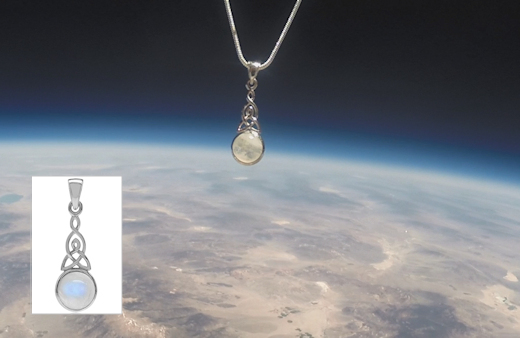
You can have it for $139.95. The students are selling these pendants to support their cosmic ray ballooning program. Each one comes with a greeting card showing the item in flight and telling the story of its journey to the edge of space. Sales support the Earth to Sky Calculus cosmic ray ballooning program and hands-on STEM research.
Far Out Gifts: Earth to Sky Store
All sales support hands-on STEM education