SOLAR MINIMUM CONDITIONS ARE IN EFFECT: The sun has been blank (no sunspots) for 28 of the past 30 days. This is a sign that Solar Minimum is underway. During this phase of the solar cycle, sunspots and solar flares are rare, but we get plenty of holes in the sun's atmosphere and lots of extra cosmic rays. Solar Minimum conditions are expected to continue uninterrupted for the remainder of 2019. Aurora alerts: SMS Text.
A DOUBLE GIGANTIC JET: Since sprites were discovered in the late 1980s, researchers have photographed thousands of the strange upward-reaching lightning bolts. Their big cousins, Gigantic Jets, are far more rare. Recorded examples number in the dozens. It is no wonder, then, that observers are still seeing new behaviors in this type of powerful "super sprite." On Oct. 2nd, photographer Frankie Lucena may have recorded the first example of a "double Gigantic Jet."

"In the past, I've captured Gigantic Jet events that split into two, but this is the first time I've seen a Gigantic Jet that fired a second time just as the first jet was beginning to fade out," explains Lucena. "They shared the same channel of ionization, so it is considered to be a single event."
Lucena photographed the repeating jet from his private observatory in Cabo Rojo, Puerto Rico. The instigating thunderstorm was about 100 km offshore. The arrow in this satellite image points from his camera to the source of the lightning:

Lucena is a leading photographer of Gigantic Jets. In a field where sightings number in the dozens, Lucena alone has photographed 39 Gigantic Jets from his Caribbean observatory since he began his work in 2010. So when he says a repeating Gigantic Jets is rare, it really is. View more examples of sprites and their cousins in the Realtime Sprite Photo Gallery.
Realtime Sprite Photo Gallery
Free: Spaceweather.com Newsletter
ARCTIC AURORA OUTBURST: Who needs sunspots? On Oct. 7th the spotless sun sparked an outburst of auroras over Tromsø, Norway. "It was quite a surprise!" says Markus Varik, who photographed the display:

"These were some of the most amazing Northern Lights one could imagine," he says.
What happened? It's called "the Russell-McPherron effect," named after the researchers who first described it. During weeks around equinoxes, cracks occasionally open in Earth's magnetic field, allowing solar wind to enter the magnetosphere. The in-rushing gas produces an Arctic light show--no sunspots required.
That's what happened with no warning on Oct. 7th. "We all like surprises!" says Varik, "It's a true blessing to have these nights, as Solar Minimum is definitely underway."
Realtime Aurora Photo Gallery
Free: Spaceweather.com Newsletter
THE NEW MOONSTONE PENDANT: Are you looking for a far-out gift? Nothing says "I love you" like a moonstone from the edge of space. On June 12th, the students of Earth to Sky Calculus flew this moonstone wrapped in a sterling silver Celtic love knot 34.1 km (111,877 feet) above Earth's surface:
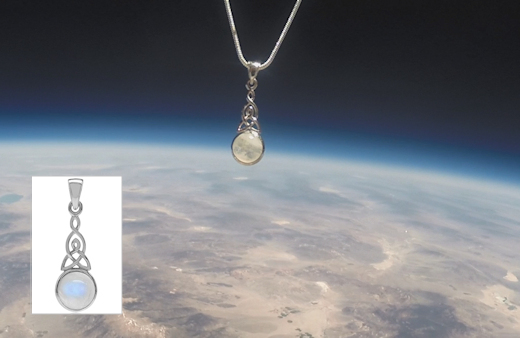
You can have it for $139.95. The students are selling these pendants to support their cosmic ray ballooning program. Each one comes with a greeting card showing the item in flight and telling the story of its journey to the edge of space. Sales support the Earth to Sky Calculus cosmic ray ballooning program and hands-on STEM research.
Far Out Gifts: Earth to Sky Store
All sales support hands-on STEM education