ARCTIC AURORA WATCH: Around the Arctic Circle, auroras are likely on Oct. 20th when a minor stream of solar wind grazes Earth's magnetic field. The gaseous material is flowing from a southern hole in the sun's atmosphere. Aurora alerts: SMS Text.

A 60,000 MILE SPLIT END: The solar cycle is currently reaching a nadir that could set 2019 apart as the deepest Solar Minimum of the Space Age. Sunspots are very scarce. Because the face of the sun is blank, observers are turning their attention to the edge and, indeed, finding things to see. Amateur astronomer Alan Friedman sends this picture from his backyard observatory in Buffalo, New York:

"On Oct. 15th I saw this prominence in the process of being released from its magnetic bond to the solar disk," says Friedman. "It looked like very tall wispy tuft of hair with a split end, which I measure to be about 60,000 miles high!"
Prominences are glowing clouds of hot gas held together by filaments of magnetism. When they rise over the edge of the sun, they can become easy to see through properly-filtered telescopes. Prominences come in all shapes and sizes. Indeed, Friedman saw another one yesterday that looked like a fish. Browse the photo gallery for more examples:
Realtime Spaceweather Photo Gallery
Free: Spaceweather.com Newsletter
CROWD-FUNDING SPACE WEATHER RESEARCH: Did you know that cosmic rays in Earth's atmosphere are intensifying? It's true. We're monitoring the phenomenon with regular space weather balloon flights to the stratosphere. This student science program is not supported by any government grant or corporate sponsorship. Instead, we raise our research funds by selling these:
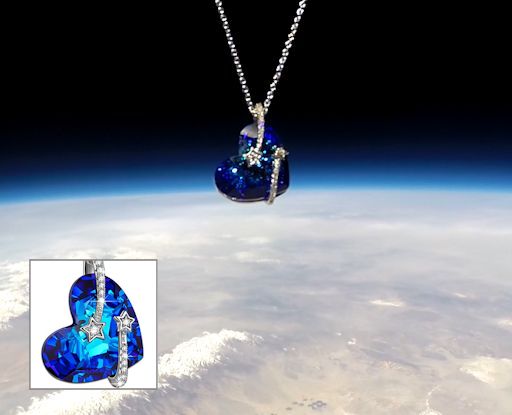
This pendant and others like it have touched the edge of space. We fly them to the stratosphere alongside our cosmic ray sensors for fundraising.
You can have one for $179.95. With a sterling silver backface that says "I Love You to the Moon and Back," these blue jewels make great anniversary, Christmas and birthday gifts. All sales support the Earth to Sky Calculus cosmic ray ballooning program and hands-on STEM research.
Far Out Gifts: Earth to Sky Store
All sales support hands-on STEM education
ZODIACAL LIGHTS IN THE ATACAMA DESERT: Zodiacal lights are incredibly subtle and faint--so much so that even most astronomers have never seen them. There's one place in the world, however, where Zodiacal lights are sometimes so bright, they can be seen not only in the sky but also reflected from the ground. Daniele Gasparri sends this picture from the Atacama desert in Chile:

"I've been living in the Atacama desert for almost 2 years," says Gasparri. "On Sept. 25, 2019, the Zodiacal Lights were so intense that they could be seen in the wind blown waters of a lagoon."
When you see Zodiacal Lights, you've seen the backbone of our solar system. Zodiacal Lights are sunlight reflected from interplanetary dust. The pale glow traces the dusty plane through which all planets orbit, known to astronomers as the ecliptic plane. In the southern hemisphere, September and October are the best months to see Zodiacal Lights because in the evening the ecliptic plane juts over the horizon almost vertically.
Zodiacal Lights seem especially bright in the Atacama desert because the area has exceptionally dark skies and very clear, dry air. "At 4300 meters of altitude, 235 km from the nearest city, the night sky of Atacama is the best of the world--a true 'astronomer's paradise,'" says Gasparri. More of Gasparri's desert sky photos may be found at AstroAtacama.com.